Define:
- Diverticulosis
- Diverticulitis
- Diverticular disease
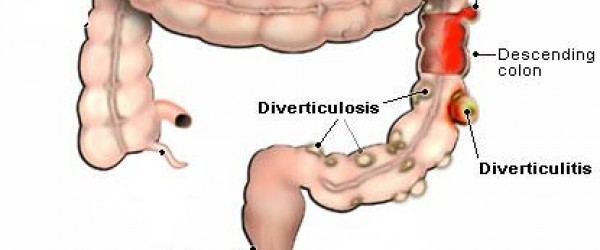
- Diverticulosis (usually no symptoms although may be bleeding): the presence of diverticula (pouches that form in a hallow structure in the body, colonic diverticula = pouch formation in large intestine)
- Diveticulitis: the inflammation of diverticula
- Diverticular disease: symptomatic diverticula
Outline the theories on the aetiology of diverticulosis of the colon
- There is thickening of the muscle layer and because of high intraluminal pressures, pouches of mucosa extrude through the muscular wall through weakened areas near blood vessels to form diverticula
- Cholinergic denervation with increasing age will lead to hypersensitivity and increased uncoordinated muscular contraction, which may lead to pouch formation
- It may be related to low-fibre diet, which induces a muscular hypertrophy, and an increase in intraluminal pressure
- Diverticulitis occurs when faeces obstruct the neck of the diverticulum causing stagnation and allowing bacteria to multiply
- This can then lead to perforation, abscess formation, fistulae or generalized peritonitis.
Describe the morphology and pathological consequences of diverticulosis of the colon
- 95% of diverticulae are asymptomatic
- Diverticulosis takes the form of outpouchings of mucosa, which are weak. They have a peritoneal surrounding.
- Impaction of faecolith (faecal matter) within the diverticulum, similar to in appendicitis, will cause irritation, and may eventually lead to rupture
- Inflammation and ulceration may result in abscess formation, fistulae and haemorrhage
- Repeated attacks of diverticulitis trigger fibro-muscular thickening, and stenosis
- All inflammatory pathologies may stimulate carcinoma.
Where does diverticula most commonly occur? Why?
The sigmoid colon with 95% of complications arising at this site. This is because it is the narrowest point and therefore has highest pressure
What are the clinical features of diverticular disease?
- Left sided colic, relieved by defecation
- Altered bowel habit (including blood and mucus passage)
- Nausea
- Flatulence
- Severe pain and constipation if severe (causing luminal narrowing)
Describe the clinical features of diverticulosis of the colon
Diverticulosis
- asymptomatic in 95% of cases and found incidentally on barium enema.
- If symptomatic they exactly mimic carcinoma colon (diverticular disease).
Describe the signs and symptoms of diverticulitis
Infection occurs due to stagnation of the contents of the diverticula
Symptoms:
- Severe left sided colic
- Constipation (or overflow diarrhoea)
- Symptoms mimicking appendicitis but on the left
Signs:
- Fever & tachycardia
- Tenderness, guarding & rigidity on the left hand side
- Can be palpable mass in the LIF
- Raised WCC and inflammatory markers
Outline the complications of diverticulosis
Diverticula may complicate to perforation (in association with acute diverticulosis), fistula formation (into bladder or vagina), intestinal obstruction, and bleeding with mucosal inflammation.
Primary differential diagnosis for left iliac fossa pain?
diverticulitis as not many other causes of LIF pain
What are the risk factors and protective factors for carcinoma of the large bowel.
Risk factors:
- Family history
- age
- western diet (low in fibre, high in fats)
- ulcerative colitis
- smoking
Protective factors:
- Fruit & vegetables
- exercise
- hormone replacement therapy
- aspirin/NSAIDs
Carcinoma of the large bowel. Go into more depth about the genetic factors? What genes ect.?
Genetic aetiology:
- Familial adenomatous polyposis (FAP) is responsible for <1% of cancers, and occurs due to tumour suppressor gene APC mutations
- Hereditary non-polyposis colorectal cancer (HNPCC) is responsible for <5% of all cancers, and arises from germline mutations in mismatch repair genes
- Most cancer are sporadic however, occurring without family history
Describe the morphology/natural history of carcinomas of the large bowel
- Adenocarcinoma, with characteristic ‘singlet ring cells’ on histology.
- The vast majority of colorectal cancers occur in the recto-sigmoid region
- Caecum & Ascending colon: 15%
- Transverse colon: 10%
- Descending colon: 5%
- Sigmoid colon: 25%
- Rectum: 45%
- They usually appear as a polypoid mass with ulceration, spreading initially by direct inflitration through the bowel wall.
- It then involves the lymphatics and blood vessels, metastasising primarily to the liver. Transcoelomic spread can also occur
What are the main two types of carcinomas of the large bowel?
Many carcinomas develop sporadically, and originate from benign adenomas (polyps). Tubular adenomas (90%) start off as smaller swellings but develop into pedunculated structures, with hyperchromatic dysplastic glands. Villous adenomas (1%) most commonly occur in the rectum. They form a smaller mass which may be quite large and have a delicate frond-like structure, with a broad base and no pedicle. The fronds are formed of dysplastic epithelium.
What are the common symptoms/signs suggestive of carcinoma of the colon, rectum and anus?
Any colorectal tumour may present with an abdominal mass, abdominal pain, haemorrhage, perforation or fistula
- Right sided (proximal) tumours are more often asymptomatic, and may present with iron deficency anaemia/weight loss
- Left-sided tumours more commonly present with PR (rectal) blood/mucus, altered bowel habit, tenesmus (crampling rectal pain), obstruction and a mass on PR examination
- Anal tumours may be present with bleeding, pain, changes in bowel habit, pruritis ani, masses or a stricture
What is the staging system used for colorectal cancers?
Duke’s Staging:
- Duke’s A: Tumours invade submucosa +/- muscularis propria
- Duke’s B: Tumours invade past the muscularis propria (into subserosa/directly into other organs, but no nodal involvement)
- Duke’s C: Regional lymph node involvement
- Duke’s D: Distant metastases
What are haemorrhoids?
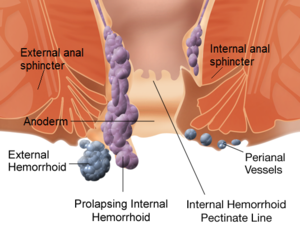
They are vascular structures in the anal canal. In their normal state, they are cushions that help with stool control.
They become a disease when swollen or inflamed; the unqualified term “hemorrhoid” is often used to refer to the disease
Describe the pathology of haemorrhoids?
Where are they? (anatomy)
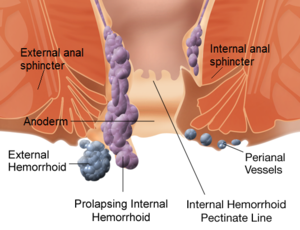
- The anal cusions are highly vascular areas, formed of smooth muscle with subepithelial anastomoses of the rectal arteries/veins
- The anal cushions contribute to continence along with the anal sphincter, and are at 3, 7 and 11 o’clock when viewed from the lithotomy position
- Haemorrhoids (piles) are prolapses of these cushions, containing the normally dilated rectal venous plexus covered by rectal muscosa
- They are though to arise due to a breakdown of the smooth muscle layer, the muscularis mucosae
Where is the anal canal?
Where are the anal sphincters?
How do they work?
What are their roles?
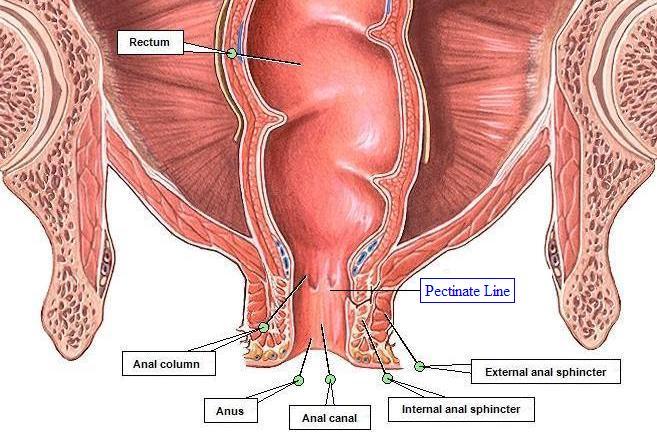
- The anal canal runs from the superior aspect of the pelvic diaphragm to the anus, and is normally collapsed
- The internal sphincter is an involuntary sphichter surrounding the upper 2/3rd of the anal canal
- Tonic contraction is stimulated by sympathetic fibres from the superior rectal/hypogastric plexus
- Parasympathetic fibres inhibit this tonic contraction, thus requiring contraction of puborectalis/the external anal sphincter to maintain continence
- The external anal sphincter surrounds the lower 2/3rd of the anal canal, and is under voluntary control, mediated by the inferior rectal nerve (S4)
- Aside from sphincter function, they provide important sensory information, allowing differentiation between solid, liquid and gas
How can you differentiate between internal and external haemorrhoids?
Internal haemorrhoids
- originate from above the dentate (pectinate) line, therefore are covered with columnar epithelium (endoderm), and are not painful.
- They drain via the superior rectal vein into the portal venous system.
- The cushions make up internal haemorrhoids.
External haemorrhoids
- originate from below the dentate line, therefore are lined with epithelium (ectoderm) and innervated by cutaneous branches of the pudendal nerve – and become painful
- They drain via the middle and inferior rectal veins into the systemic circulation
- External haemorrhoids may cause problems around the entire circumference of the anus.
What are the symptoms of haemorrhoids?
- Rectal bleeding (bright red on the paper)
- Prolapse
- Mucous discharge
- Pruritis ani
- Pain if the piles become thrombosed
What are complications of haemorrhoids?
- Anaemia
- If severe/continued bleeding
- Thrombosis
- If prola[sing piles are gripped by the anal sphicter (‘stangulated piles’) then venous return is occluded, leading to thrombosis
- The haemorrhoids swell, become purple and tense, causing significant pain/distress
- the thrombosed piles often fibrose within 2-3 weeks, giving spontaneous cure
What examinations would you do for a patient with haemorrhoids?
Why? What might you find?
- Abdominal examination
- Palpable masses, enlarged liver
- Rectal examination
- Prolapsing haemorrhoids are obvious
- Inspection of the perineum may show large external haemorrhoids at 3, 7 and 11 (left lateral, right posterior, right anterior) and will disclude other DDxs, but anal cancer may look similar
- Proctoscopy/rigid sigmoidoscopy
- Can visualize teh haemorrhoids/piles and assess for a lesion higher in the rectum
- Colonoscopy/Flexi-sigmoidoscopy
- If symptoms suggest a more sinister pathology
What are the differential diagnosis for rectal bleeding?
(not an objective but useful to know)
- Haemorrhoids (most common cause)
- Anal fissure (exquiste tenderness, skin tag)
- Diverticulitis (bloody ‘splash’ in the pan, LIF symptoms)
- Rectal cancer (tenesmus [cramping rectal pain/need to have a bowel movement], PR bleeding with defecation)
- Colon cancer (red blood mixed with the stool, change in bowel habit)
- Ulcerative colitis (abdominal pain, urgency to defecate)
- Crohn’s disease (weight loss, chronic diarrhoea)
- Massive upper GI bleed (usually melena, but frank blood if very large, usually haematemesis also)
- Trauma
- ischaemic/infective colitis
- Angiodysplasia
What are the symptoms of patients with perianal infections?
Patients may experience:
- pain, swelling (95%)
- fever (18%)
- discharge (12%)
- a mass (abscess)