When is a PR interval prolonged?
When it is more than 1 large box
When is the QRS complex prolonged?
When it is more than 3 small boxes
When is the Corrected QT interval (QTc) prolonged?
When more than 44 small boxes
What criteria must be met for the ECG to be in sinus rhythm?
- Rhythm must be regular
- Heart rate between 60 - 100 bpm
- P waves are present
- P waves must be upright in leads I,II
- PR interval should be 3-5 boxes (normal)
- QRS complex should be under or equal to 3 small boxes
- Every P wave must be followed by a QRS complex
- Every QRS is preceded by a P wave.
What is an atrioventricular conduction block?
This is a delay / failure of conduction of impulses from atrium to ventricles via AV node and bungle of His.
What causes AV conduction block?
Acute MI
Degenerative change (fibrosis as people age - changes electrical conduction)
What are the types of AV conduction block?
First degree heart block
Second degree heart block (Mobitz type 1 and Mobitz type 2)
Thrid degree heart block
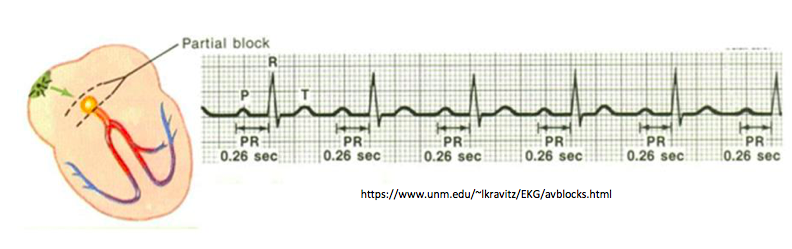
What is 1st degree heart block?
Impulses get through but takes longer.
PR interval is prolonged to over 0.2 seconds (5 small boxes)
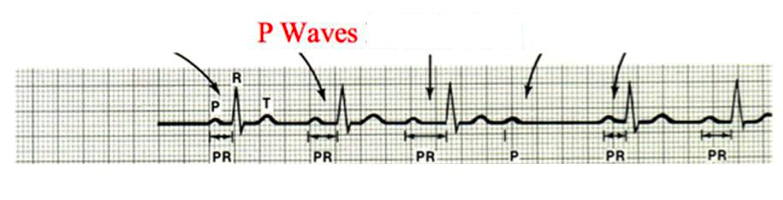
What is 2nd degree heart block - Mobitz type 1?
Also called Wenkebach type.
Successively longer PR intervals until one QRS is dropped then the cycle starts again.
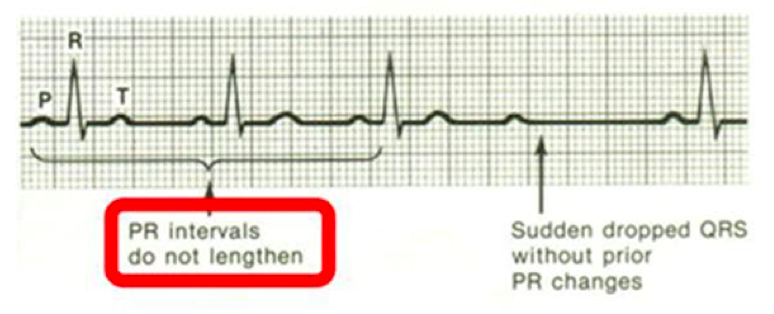
What is 2nd degree heart block - Mobitz type II?
PR intervals do not lengthen but, suddenly dropped QRS complex.
This is dangerous as there is a high risk of progression to complete heart block.
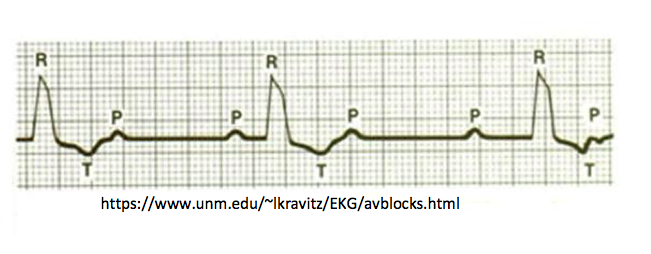
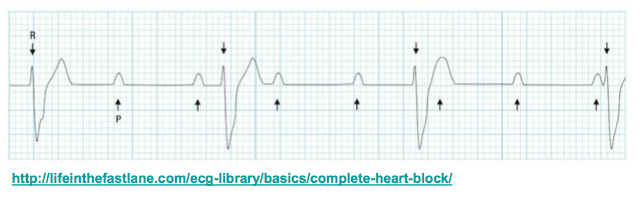
What is 3rd degree heart block?
This is complete failure of AV conduction.
This means Atria and Ventricles are depolarising independently.
Ventricular pacemaker takes over (Ventricular escape rhythm).
Usually wide QRS complexes.
Ventricular rate is very slow (30-40bpm), often too slow to maintain BP.
Urgent pacemaker insertion usually required.
Ventricle doesn’t conduct through His Purkinje system so slower conduction.
In 3rd degree heart block, P-P intervals are regular and R-R intervals are regular but, there is no relationship between P waves and QRS complexes (The PR interval is completely variable from beat to beat)
What is a bundle branch block?
- Delayed conduction in the branches of the bundle of His (right or left bundle)
- P waves and PR interval normal
- Wide QRS complex (>3 small squares) - since ventricular depolarisation takes longer.
Where can abnormal impulses form from?
- These are also called supraventricular rhythms as they arise above the ventricles.
- Sinus node
- Atrium
- AV node
- Ventricular rhythms.
- Ventricle
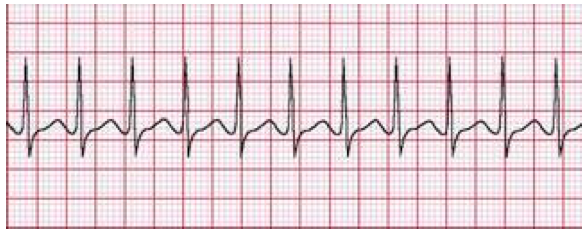
What happens in a supraventricular rhythm?
SVT Normal (narrow) QRS complex.
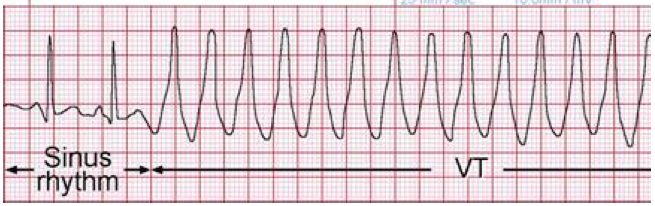
What happens in ventricular rhythm?
Wide and bizarre QRS complexes.
What is atrial fibrillation?
- This is a supraventricular rhythm.
- Rhythm arises from multiple atrial foci
- Rapid, chaotic impulses
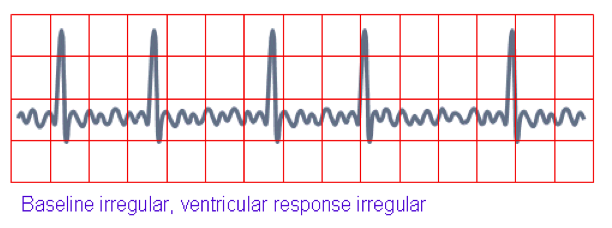
- No P waves, just a wavy baseline (as chaotic depolarisation)
- Impulses reach AV node at a rapid, irregular rate.
- Not all are conducted (because of AV node refractory period)
- When conducted, ventricles will depolarise normal.
- Therefore narrow QRS complexes with irregular R-R intervals
What are the haemodynamic effects of AF?
- Atrial contraction lost (they just quiver)
- Ventricles contract normally (but irregular rate)
- Heart rate and pulse is irregular
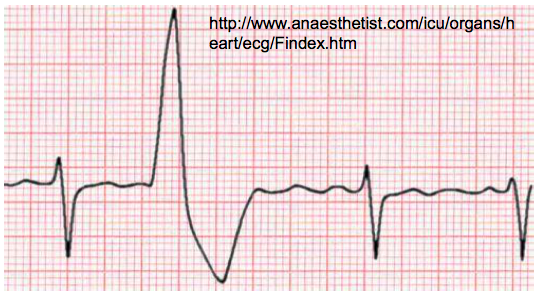
What are ventricular ectopic beats?
- Ectopic focus in ventricle muscle
- Impulses does not spread via the fast His-purkinje system.
- Therefore much slower depolarisation of ventricular muscle
- S0, wide QRS complex, different in shape to usual QRS
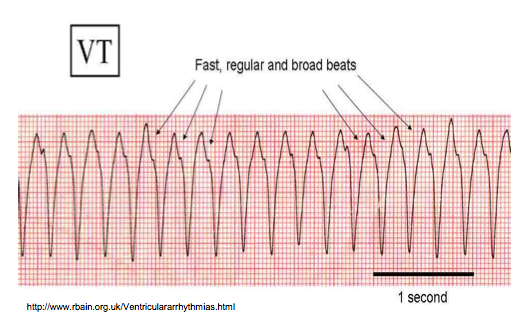
What is ventricular tachycardia?
A run of 3 or more consecutive ventricular ectopics
VT is a broad complex tachycardia
Persistent VT is a dangerous rhythm - it needs urgent treatment.
High risk of VF
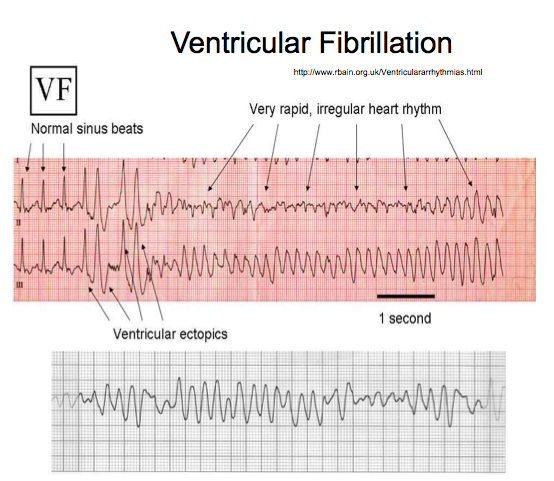
What is ventricular fibrillation?
- Abnormal chaotic fast ventricular depolarisation
- Impulses from numerous ectopic sites in ventricular muscle
- No co-ordinated contraction
- Ventricles quiver
- No cardiac output
- Cardiac arrest
What are the ECG changes in Ischaemia and MI?
- Coronary artery occlusion -ischaemia or infarction (necrosis) in area supplied by artery
- Changes are seen in the leads facing affected area of ventricles
- Need to look at P-QRST in all 12 leads.
- Need to know which groups of leads look at different parts of the heart
MI and Ischaemia?
Reduced perfusion due to narrowed coronary artery/ies
Partial narrowing of the lumen causes:
- Sub endocardial ischaemia / injury - This area is furthest away from coronary arteries which lie on the surface of heart - hence most vulnerable region, involved first
Complete occlusion of lumen causes:
- Full thickness (trans mural) injury
- Including sub-epicardial region
What is a STEMI?
This is due to complete occlusion of coronary artery by a thrombus
‘Full thickness’ of myocardium involved
Subepicardal injury causes ST segment elevation in leads facing the affected area.
ST elevation - Behave as if abnormal current coming towards injured epicardium during repolarisation.
ST elevation is the earliest sign of a STEMI
Diagnosis of STEMI - indication for urgent re-perfusion to prevent / minimise muscle necrosis.
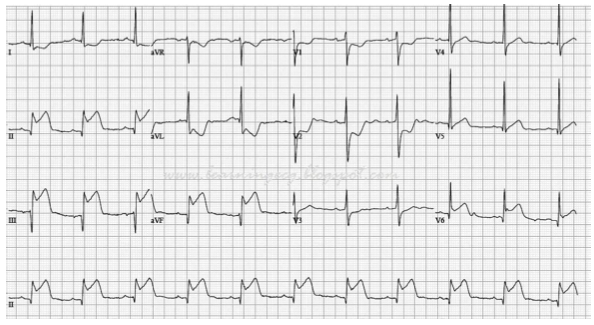
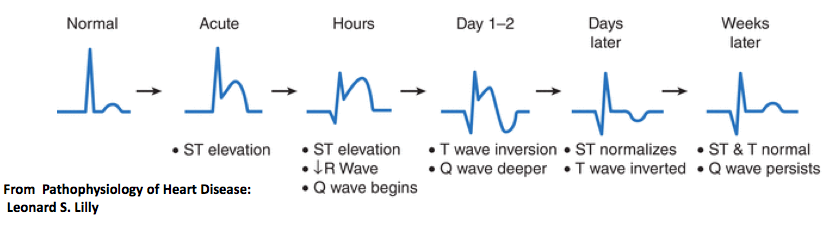
What are the evolving changes in an ST segment elevation Mi (STEMI)?
Acute: ST elevation
Hours: ST elevation , Decrease R wave, Q wave begins
Day 1-2: T wave inversion, Q wave deeper
Days later: ST normalizes, T wave inverted
Weeks later: ST and T normal, Q wave persists



-
Introduction to CV15
-
Haemodynamics37
-
The Heart As A Pump39
-
The Control Of Cardiac Output26
-
Embryology39
-
Congenital Heart Disease19
-
Electrical And Mechanical Mechanisms26
-
Autonomic Control Of CVS24
-
Control Of Blood Pressure31
-
ECG35
-
Common ECG Abnormalities32
-
Arrhythmias And Drugs36
-
Special Circulations36
-
Chest Pain And Coronary Syndromes25
-
Investigations Of Acute Coronary Syndromes19
-
Pathophysiology Of Heart Failure24
-
Investigations and Management of Heart Failure17
-
Peripheral Arterial and Venous Disease40
-
Understanding symptoms and signs20
-
Shock26



