Where are transition elements found?
In the d-block. They are from titanium to copper.
What is the definition of a transition element?
An element that can form at least 1 stable ion with an incomplete d-subshell.
What is the electronic configuration of Cr (chromium) and Cu (copper)? Why do they have the configuration that they do?
Cr: [Ar] 3d5 4s1
Cu: [A] 3d10 4s1
This provides more stability.
Why are Sc (scandium) and Zn (zinc) not transition elements?
What are the chemical properties of transition elements?
- They form complex ions
- They can exist in variable oxidation states
- They form coloured ions (e.g. Fe2+ ions are pale green and Fe3+ are yellow)
- Transition metals and their compounds make good catalysts because they can change oxidation states by gaining or losing electrons withing their d orbitals. This means they can transfer electrons to speed up reactions.
What are some examples of transition metal catalysts?
- Iron is the catalyst for the Haber process to produce ammonia.
- Vanadium(V) oxide, V2O5, is the catalyst used in the contact process to make sulfuric acid.
- Nickel is the catalyst used to harden margarine.
When you mix a transition metal ion with NaOH, you get a coloured precipitate. What are the equations for the reactions of the following with NaOH:
- Copper(II)?
- Cobalt(II)?
- Iron(II)?
- Iron(III)?
Also, what are the colour changes?
1. Cu2+(aq)+2OH-(aq)⇒Cu(OH)2(s) Pale blue solution ⇒ blue precipitate
2. Co2+(aq)+2OH-(aq)⇒Co(OH)2(s) Pink solution ⇒ Blue precip. (goes pink when left to stand)
3. Fe2+(aq)+2OH-(aq)⇒Fe(OH)2(s) Pale green solution ⇒ Green precipitate (darkens on standing)
4. Fe3+(aq)+3OH-(aq)⇒Fe(OH)3(s) Yellow solution ⇒ Orange precipitate (darkens on standing)
- What is a complex ion?
- What is a coordinate bond?
- What is a ligand?
- What is the coordination number?
- A metal ion surrounded by coordinately bonded ligands.
- A coordinate bond is a covalent bond where both electrons in the shared pair come from the same atom.
- A ligand is species that donates a pair of electrons to a central metal ion or atom.
- The number of coordinate bonds that are formed with the central metal atom or ion.
What is the shape of a complex ion which has:
- 6 coordinate bonds?
- 4 coordinate bonds?
- Octahedral shape
- Tetrahedral shape
What are the names for the following types of ligands?
- A ligand with 1 lone pair
- A ligand with 2 lone pairs
- A ligand with more that 2 lone pairs
- monodentate
- bidentate
- multidentate
What is cis-platin?
Cis-platin is a complex of platinum(II) with two chloride ions and two ammonia molecules in a square planar shape.

How does cisplatin work?
- The two chlorine ligands are very easy to displace and so the cis-platin loses them, and bonds to two nitrogen atoms on the DNA molecule inside the cancerous cell.
- This block on the DNA prevents the cancerous cell from reproducing by division. The cell will dies since it’s unable to repair the damage.
What is ligand substitution and what does it cause?
It is when one ligand is swapped (or substituted) for another ligand. It causes a colour change.
In ligand substitution, what happens to the coordinate of the complex ion when ligands of similar size are substituted?
- The coordination number doesn’t change.
[Co(H2O)6]2+(aq) + 6NH3(aq)
[Co(H2O)6]2+(aq) + 6NH3(aq) <==> ?
1) What are the products?
2) What colour change occurs?
3) What are the shapes?
[Co(H2O)6]2+(aq) + 6NH3 <=> [Co(NH3)6]2+(aq) + 6H2O(l)
OCTAHEDRAL for both
Colour change from pink to pale brown.
What happens to the coordination number and shape when different sized ligands (e.g. H2O and Cl-) are substituted?
They will change
[Cu(H2O)6]2+(aq) + 4Cl-(aq) ?????
- What are the products?
- What are the shapes?
- What are the colour changes?
- [CuCl4]2-(aq) + 6H2O(l)
- octahedral to tetrahedral
- from pale blue to yellow
[Co(H2O)6]2+(aq) + 4Cl-(aq) <==> ?????
- What are the products?
- What are the shapes?
- What are the colour changes?
- Is this reaction exo or endothermic?
- What happens if you increase the heat?
- What happens if you add more conc. HCl?
- What happens if you add more water?
- <==> [CoCl4]2-(aq) + 6H2O(l)
- octahedral to tetrahedral
- from pink to blue
- Endothermic.
- Equil. shifts to right.
- Shifts to right.
- Equil. shifts to right.
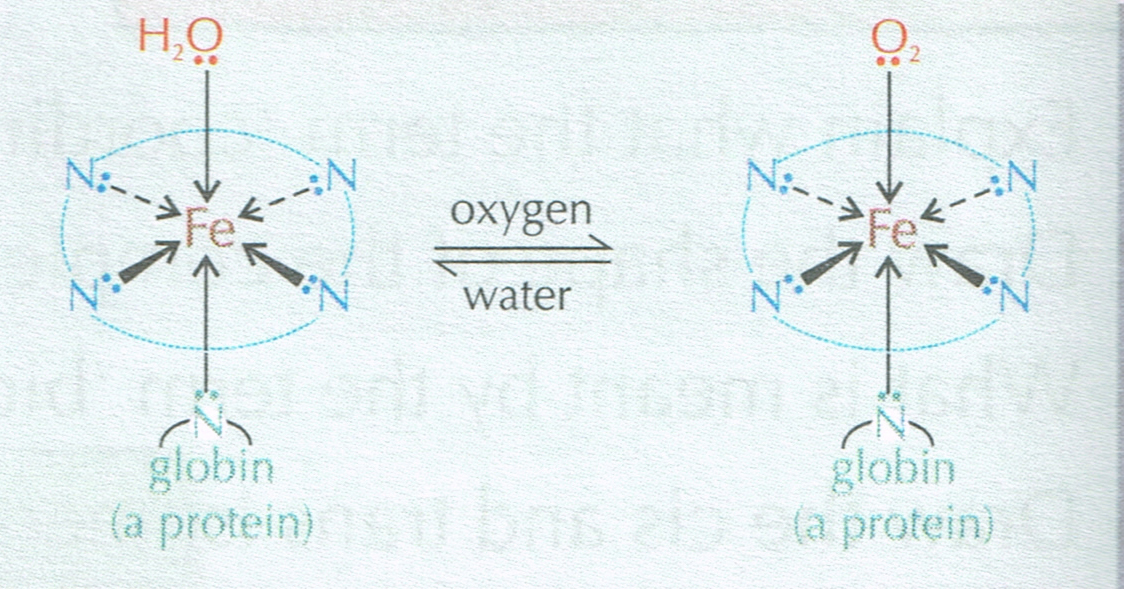
How does Fe2+ in haemoglobin allow oxygen to be carried in the blood?
- Fe2+ in ions for 6 coordinate bonds.
- Four of the lone pairs come from notrogen atoms within a haem (multidentate ligand).
- Fifth lone pair comes from a nitrogen atom on protein globin.
- Water ligand attaches to 6th position.
In lungs, O2 conc. high so H2O ligand substit. with O2 ligand forming oxyhaemoglobin. This is carried around the body and when it gets to area of body where O2 is needed, O2 is substituted with a H2O molecule again.
What happens when you inhale carbon monoxide?
- If CO is inhaled, the haemaglobin swaps its water ligand for a CO ligand, forming carboxyhaemoglobin.
- This is bad news because carbon monoxide is a strong ligand and doesn’t readily exchange with oxygen or water ligands, meaning the haemoglobin can’t transport oxygen anymore.
What is the definitition of the stability of a complex ion?
The stability constant, Kstab, of a complex ion is the equilibrium constant for the formation of the complex ion from its constituent ions in solution.
How do you calculate Kstab?
Use Fe2+(aq)+ 6CN-(aq)<==> [Fe(CN)6]4-
Kstab = [(Fe(CN)6)4-]
           —————

          [Fe<sup>2+</sup>][CN<sup>-</sup>]<sub>6</sub>
Note: If the complex you start with ONLY has WATER ligands, you don’t include H2O in the stability constant.
What does the stability constant tell you?
The greater the kstab, the more stable the complex ion and the more likely the chance of ligand substitution occuring.




