COPD
* Is a chronic condition that can be medically managed but exhibits periods of exacerbation
* Is a disease state characterized by airflow limitation that is not fully reversible
- This is different than asthma which is reversible
- However, many people with asthma also have COPD
* Asthma is recognized as a risk factor for COPD (asthma-COPD overlap syndrome)
* 15 million Americans have been diagnosed with COPD
Review of Normal A&P
* Trachea, primary bronchi, cilia, goblet cells, bronchioles, (dead space)
* Gas exchange occurs at the alveolar level and in the normal anatomy, they resemble grape-like structures that have maximum surface contact with the pulmonary capillary bed for maximum gas exchange
* The ___ separates the thoracic cavity from the abdominal cavity and is important in the normal breathing process
diaphragm
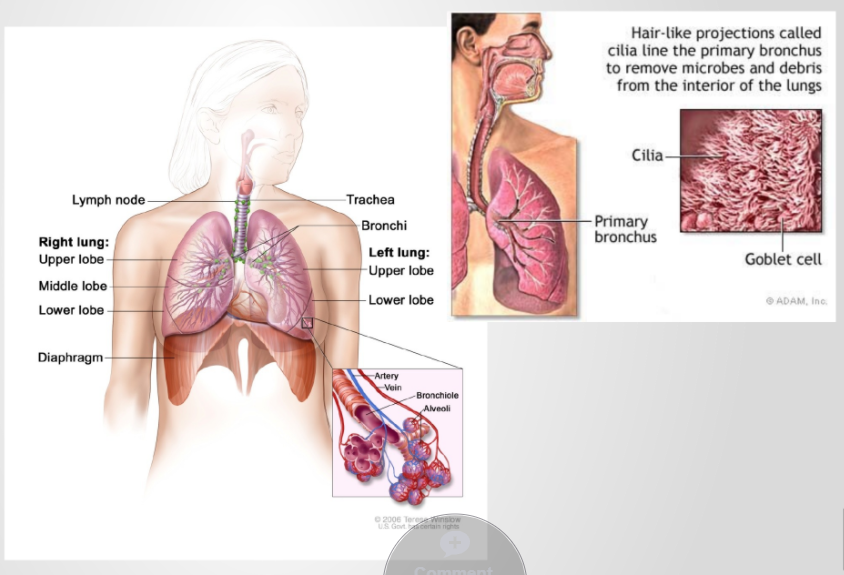
COPD involves 2 disease processes that affect airway patency: inflammation of the large and small airways in __ __, and the destruction of lung parenchyma in ___
Regardless of how the disease process manifests, the end result of COPD is a chronic ventilation-perfusion mismatch:
Blood flows past non-oxygenated alveoli (anatomical dead space), resulting in hypoxemia and progressive ___ (increased blood CO2)
Airflow limitation is progressive and is associated with abnormal inflammatory response of the lungs to noxious agents; inflammatory response occurs throughout the airways, lung parenchyma, and pulmonary vasculature
- Scar tissue and airway narrowing
chronic bronchitis; emphysema
hypercapnia
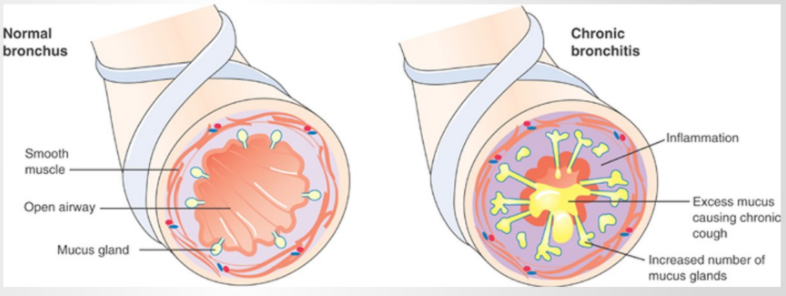
With ___, the mucous glands in the lungs become enlarged 2º to an irritant causing increased mucous production which stimulates coughing
- Coughing produces inflammation in bronchi and bronchioles causing thickening of walls
- Ciliary function is reduced and stagnant; mucous may plug airways
- Chronic [] is defined clinically by the presence of chronic bronchial secretions, enough to cause expectoration, occurring on most days for a minimum of 3 months of the year for 2 consecutive years
bronchitis
___ is a condition where there is permanent destructive enlargement of the air spaces distal to the terminal bronchioles
- Is an abnormal distension of the air spaces beyond the terminal bronchioles with destruction of the walls of the alveoli
- Often leaves enlarged, thin-walled air spaces, known as “blebs” when they occur near visceral pleura and “bullae” when they develop in lung parenchyma
- There’s decreased elasticity of lung tissue
Emphysema
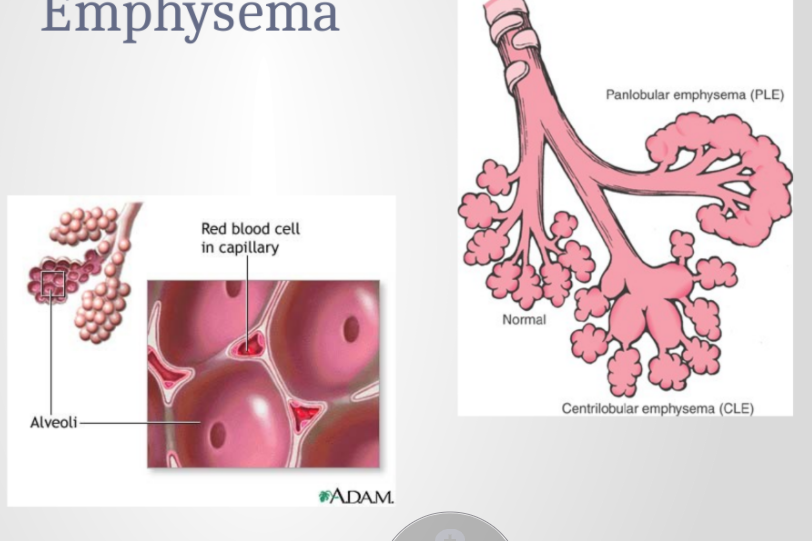
* Decreased alveolar surface area causes an increase in “dead space” and decreased areas for gas exchange
* Reduction of or collapse of the pulmonary capillary bed increases pulmonary vascular resistance and pulmonary artery pressures
- Right side of the heart has to pump blood to the lungs that have increased pressures and over time, the patient may develop cor pulmonale (right sided heart failure)
* There’s decreased surfactant production so the risk of alveolar collapse increases
* There’s increased trapping of air related to alveolar destruction and decreased elasticity (due to increased proteases released r/t increased pollutants) to recoil air out of the lungs
* With emphysema, patients have abnormal, permanent enlargement of the alveoli and terminal bronchioles
* Main types of emphysema include centrilobular and panlobular
?
Effects the entire lung equally
Destroys the lung tissue at the more distal structures and alveolar sacs
Panlobular emphysema
?
Lung destruction begins in the central respiratory bronchioles and extends toward the periphery
As tissue walls disintegrate, bronchioles enlarge and become confluent
Found in long-term smokers; is the more common form; and effects are more severe in the upper lobes
Centrilobular emphysema
* In both types, altered tissue results in reduced elasticity of the lungs, increased dead space, and a heightened risk of airway collapse during expiration, causing airway obstruction
* Destruction of alveoli reduces the surface area at the alveolar-capillary membrane, which decreases gas exchange and reduces surfactant production
___ - gases cross alveoli to capillary bed
___ - airation into lungs
___ - blood gas to cells
Diffusion
Ventilation
Perfusion
?
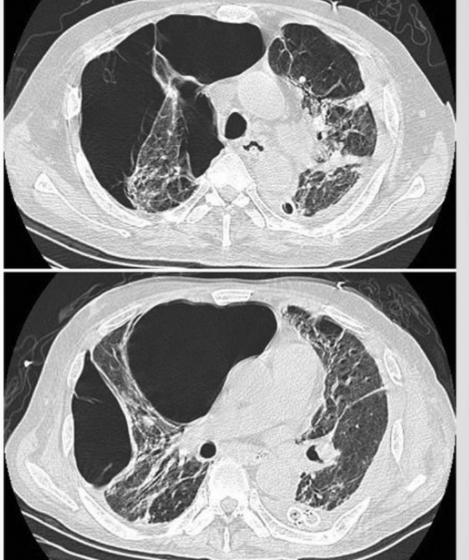
Are the black areas filled with air on diagnostic imaging
- Take up a lot of dead space and prevent full exhalation
- Treatment with thoracoscopic bullectomy; volume reduction surgery with localized area of ___; lung transplant with larger areas
Bullae
Normal Inspiration
* Diaphragm pulls down and air rushes into the negative space produced
* Intercostal muscles contract and pulls ribs up and out
Normal Expiration
* Diaphragm relaxes, intercostals relax, elastic recoil and ribs return to baseline
COPD
With the hyperinflated lungs, patient is unable to exhale and air gets trapped. Diaphragm flattens but ribs remain in an anatomical position of inspiration versus expiration
The lung with COPD
- Hyperinflation of the lung (air is darker than lung tissue)
- Increased space between ribs
- Less of an angle in the bases; the diaphragm forced down and ribs are forced up and out. Similar to inspiratory position at rest
- Patient has difficulty taking a deeper breath and needs to force an exhalation. One way to release trapped air is pursed-lip breathing

Risk Factor Cues for COPD
* Tobacco smoke causes 80-90% of COPD cases
* Passive smoking
* Infections
* Occupational exposure
* Ambient air pollution
* Genetic abnormalities (alpha1-antitrypsin (AAT) deficiency)
* The only known genetic risk factor is the condition known as alpha1-antitrypsin (AAT) deficiency
- AAT is a protease inhibitor produced by the liver, which acts predominantly by inhibiting neutrophil elastase in the lungs
- Accounts for less than 1% of COPD cases in the US
Diagnostics
* H&P
* PFT, peak flow
* CXR
* ABGs
* Pulse oximetry
* Hgb, Hct, & RBC
* WBC
* AAT levels
- Severity of COPD will be determined by diminished PFT’s and severity of manifestations such as chronic cough, chronic sputum production, and dyspnea
- ABG - respiratory acidosis because they are unable to exhale retained CO2
- Pulse oximetry - 88% can be normal for a COPD’er
- Hgb and Hct must be sufficient for O2 carrying capacity to be optimum - elevated RBC may be evident - compensating for low O2 levels
- WBC monitored for S&S of infection which can exacerbate an episode
- AAT - alpha1-antitrypsin (AAT) deficiency - gene mutation (especially the Z/Z formation) can cause COPD) regulates proteases that break down pollutants in the lungs; no AAT ⇢ pollutants build up
GOLD Classification of COPD Severity
- GOLD 1: Mild ⇢ FEV1 > or = 80% predicted for person’s weight, height, gender
- GOLD 2: Moderate ⇢ FEV1 50-79% predicted
- GOLD 3: Severe ⇢ FEV1 30-49% predicted
- GOLD 4: Very Severe ⇢ FEV1 <30% predicted
- FEV1 is a measurement in pulmonary spirometry or pulmonary function tests; it is the volume of air exhaled forcibly over 1 second after a full inspiration
- This is important because people with COPD cannot take a deep breath in. At rest, their lungs/ribs/diaphragm are in a state of constant inspiration
Signs & Symptoms
- CO2 narcosis
- Low pulse oximetry
- Abnormal ABGs
- Dyspnea
- Chest tightness
- Cough
- Wheeze/crackles
- Tachypnea
- Orthopnea
- Tachycardia
- Hypertensive
- MS changes
- Tripod position
- Accessory muscles
- Prolonged expiration
- Anxiety
CO2 Narcosis
- Normally the typical person’s respiratory drive is dependent on an increased blood CO2 (hypercarbia)
- CO2 goes up and the RR increases
- In COPD, they live with an elevated CO2 so a decreased O2 level will increase the RR
- If the patient is hypoxic and oxygen must be given, the risk is giving them too much O2 may shut down their respiratory drive; RR can plummet
- If a higher rate is needed to maintain oxygen saturation at the prescribed level, check the patient at least every 30 minutes for a decreased RR
- If the rate drops below 10 breaths/min in a patient with COPD, attempt to arouse him or her
- If he or she doesn’t arouse easily, reduce the oxygen flow and reassess
- If the RR does not increase or if the SpO2 drops, call the Rapid Response Team
- These patients usually require lower levels of O2 delivery, usually 1-3L/min via nasal cannula
- Dyspnea especially over 50 years of age; may be noted on exertion then progresses to dyspnea at rest; watch for trends
- Cough may be non-productive or productive; worse in the morning
- May need to schedule ADL’s later in the morning (after they clear their lungs of mucous but before they are tired from moving around)
- May have wheeze that probably worsens with activity
- Orthopnea - how many pillows being used at night?
- ABG’s
__ pH
__ PaO2
__ PaCO2
Possibly elevated bicarbonate
⇣
⇣
⇡
- Mental status changes - anxiety, restless, memory impairment, confusion
- Tripod position
- Accessory muscles - nasal flaring, supraclavicular/abdominal/eye brows elevated and intercostal muscles
- Prolonged expiration - decreased elasticity of parenchyma traps gas in alveoli
- Anxiolytics are sometimes prescribed for the anxiety that accompanies the feeling of not being able to breathe

Signs & Symptoms
- Peripheral cyanosis
- Cyanosis - related to hypoxia - seen in a 5 g/dL rise in unoxygenated blood
- Late sign is oral cyanosis
- Frequent infections
- Infections related to increased secretions and steroids
- Finger clubbing
- Clubbing related to long-term hypoxia
- Weight loss
- Related to inability to eat and breathe at same time
- ADLs
- Client too tired to perform on own

Complications
- Pulmonary infection
- Related to increased secretion and inability to clear
- Atelectasis or pneumothorax
- Related to bullae - decreased surfactant production
- Respiratory insufficiency or failure
- Pulmonary hypertension/cor pulmonale
- Pulm htn r/t increased fibrous scar tissue and decreased elasticity of parenchyma (heart is pumping against a brick wall [lung])
Right sided heart failure
- Hypoxia and hypoxemia
- Increasing dyspnea, fatigue
- Enlarged and tender liver
- Warm, cyanotic hands and feet with bounding pulses
- Cyanotic lips
- Distended neck veins
- Right ventricular enlargement (hypertrophy)
- Visible pulsations below the sternum
- GI disturbances, such as nausea or anorexia
- Dependent edema
- Metabolic and respiratory acidosis
- Pulmonary htn
- Respiratory failure may need mechanical ventilation and ICU stay
Medications
- Beta-adrenergic agonists
- SABA, LABA, anticholinergics
- Anticholinergics
- Xanthines
- Corticosteroids
- Anti-inflammatories including corticosteroids which are much slower acting than bronchodilators
- Must be tapered as patient’s pulmonary status improves
- Mast cell stabilizers
- Leukotriene modifiers
- Mucolytics
- Inhaled (Mucomyst) acetylcysteine or PO guaifenesin may be used to liquefy mucous for ease of expectoration
- Focus is on long-acting medications
Asthma leads to dyspnea, chest tightness, cough, and wheezing
- Affects about 32 million Americans with approximately 4,000 deaths/year
- 30% prevalence among women and African Americans
- Is recurrent, chronic, and reversible (which separates it from COPD)
3 contributing processes
- Increased mucous production
- Inflammation of the mucosa
- Bronchospasm/constriction

- Asthma has many triggers that can set the immune system into motion
- When the person is exposed to an allergen, IgE antibodies are released and attach to mast cells
- They in turn release inflammatory mediators such as histamine and leukotrienes
- Mediators cause vasodilation and increase blood flow; they increase capillary permeability and inflammation
- There’s impaired mucociliary function with decreased removal of mucous; all with bronchoconstriction



