Define cluster compounds.
Species which have 3D shapes and direct element-element bonds.
Typically have a ‘core’ which may be surrounded by a shell of other substituents. If there are no other substituents, then the cluster is said to be ‘naked’.
Lines often only show connectivity, not actual bonds (shows atoms that are close in space).
Structures of clusters are based on the platonic solids.
Describe the synthesis of borane clusters.
Traditionally characterised by reactions occurring at high temperature, resulting in low yields with a number of different products.
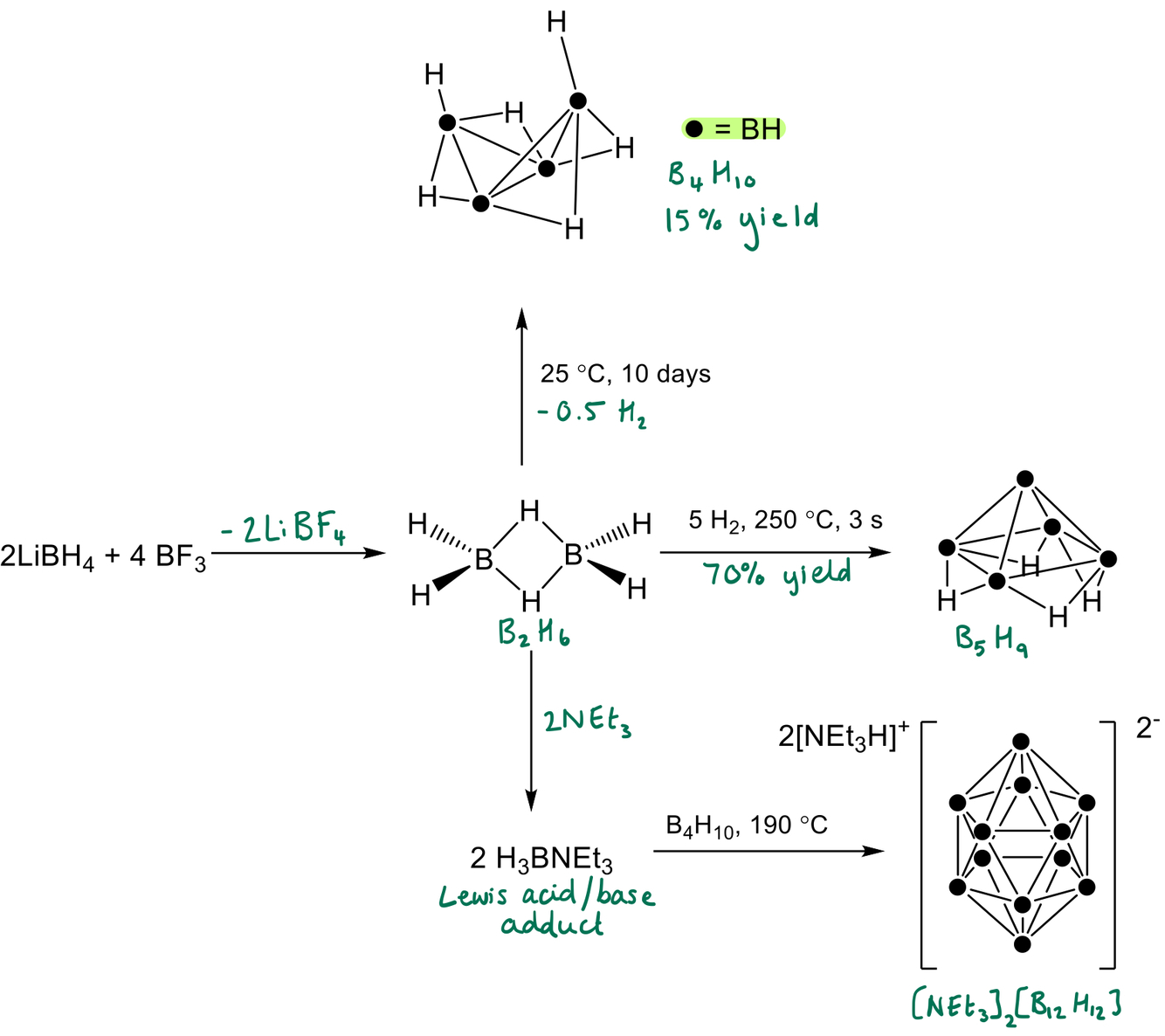
What are the different reactions that borane clusters can undergo?
- Combustion - forms boron oxides
- Hydrolysis - forms boron hydroxide compounds
- Electrophilic substitution - e.g. with Cl2
- Base-induced degradation - e.g. with NH3 or OH-
- Deprotonation reactions - e.g. with NaH
How do you calculate the total valence electron count (TVEC)?
- Add up the number of valence electrons on the core atoms
- Substituents such as H, tBu, etc. all count as one electron
- Add one electron for each negative charge, remove one electron for each positive charge
What is the skeletal electron count (SEC) and how is calculated?
The number of electrons which contribute towards the bonding of the cluster core. For clusters based on a deltahedron with each atom bonded to three others:
SEC = TVEC - 2n
(n = number of cluster vertices)
What are skeletal electron pairs (SEP) and how are they calculated?
The number of electron pairs contributing towards cluster bonding.
SEP = SEC / 2
How can cluster bonding be described?
- Electron precise - all the bonds in the cluster are 2-electron 2-centre bonds
- TVEC = 5n, SEC = 3n
- Electron deficient - too few electrons for 2-electron 2-centre bonds
- TVEC < 5n, SEC < 3n
- Electron rich - too many electrons than needed for 2-electron 2-centre bonds
- TVEC > 5n, SEC > 3n
Describe the structure of electron rich / electron deficient clusters.
- Electron rich clusters have open structures
- Electron deficient clusters are much more closed
What is Wade’s rule?
For an n vertex cage with n+1 SEP then a closo structure will be adopted (closed structure).
Describe the molecular orbital basis of Wade’ rule.
For an n vertex, closo polyhedron, there are n+1 bonding orbitals in the cluster skeleton. This is how we arrive to the SEP = n + 1 rule.
Describe the relationships between clusters with similar SEP.
Removing a vertex from a closo structure gives the structure of a nido cluster with the same SEP. Removing a further vertex gives an arachno cluster, also with the same SEP.
Describe the different cluster structures in terms of vertices and SEP numbers.
- A closo cluster with n vertices has n + 1 SEP
- A nido cluster with n vertices has n + 2 SEP
- An arachno cluster with n vertices has n + 3 SEP
- A hypho cluster with n vertices has n + 4 SEP
Describe how to draw the structure of nido, arachno and hypho clusters.
- They are determined from the shape of the parent closo cluster, which has the same number of SEP and SEP - 1 vertices
- Remove the appropriate number of vertices
- If vertices are different, it is the vertex which is the most connected that is removed
- Additional hydrogen atoms are placed in bridging sites along B-B edges of open faces, or terminal sites (BH -> BH2) if available
Can other groups participate in cluster bonding?
Yes, e.g. C-H can replace B-H in [B6H6]2-. Both the B-H and C-H fragments contribute 3 electrons to give the same octahedral geometry.
In principle, any fragment which has three orbitals available for bonding may form part of the cluster.
What is the relationship between many transition metal and main group species?
When the main group species is replaced by a TM, nothing changes except the TVEC which increases by 10 for each TM.
This can be rationalised in two ways: the isolobal analogy and the Wade-Mingos rules.
Describe the isolobal analogy.
Replacement of a group by a TM makes no changes to the structure of the cluster so it can be suggested that they are both making the same contributions to the bonding. They must be offering the same types of molecular orbitals/number of electrons.
Two fragments are isolobal if they have the same number of frontier orbitals, with the same symmetry, approximately the same energy and the same number of electrons.
How can we predict which fragments are isolobal?
Via homolytic cleavage.
Cleave off groups, e.g. H from C or a ligand from a TM, to obtain the fragments of interest. If they end up with the same number of frontier orbitals (with the same symmetry) and offer the same number of electrons, then they are isolobal.
How do the isolobal analogy and Wade’s rules relate?
The isolobal analogy can be applied to Wade’s rules in order to aid in assessing cluster geometry. We can find an easier fragment that is isolobal to the molecule of interest and find the geometry of the simpler fragment.
Describe the Wade-Mingos rules for transition metal clusters.
TM’s add a further 10 electrons to the cluster system compared to main group compounds (due to the extra 5x d-orbitals). This changes how the SEC is calculated:
- Remove 2 from the TVEC for each main group vertex
- Remove 12 from the TVEC for each TM vertex
Describe capping of TM clusters.
It’s unusual for TM clusters to form large closo-type clusters when n > 6. In these cases, the clusters tend to adopt geometries where additional grops are on the faces of a closo type cluster. This is called face capping.
A capped cluster has the same number of electron pairs for framework bonding as the uncapped cluster.
Define the different capped clusters in terms of vertices and SEP.
- A closo cluster with n vertics has n + 1 SEP
- A monocapped cluster with n vertices has n SEP
- based on a closo cluster with n - 1 vertices and one face is capped
- A bicapped cluster with n vertices has n - 1 SEP
- based on a closo cluster with n - 2 vertices and two faces are capped
- A tricapped cluster with n vertices has n - 2 SEP
- based on a closo cluster with n - 3 vertices and three faces are capped
What is the general methodology for forming M-M bonds?
- Determine the oxidation state and d-electron count of the metal - tells us how many electrons are available to form M-M bonds
- Identify the correct molecular orbital overlap diagram
- Determine the expected bond order
- Consider other factors e.g. periodicity
Why do you find increased bond dissociation energies as you descend the transition metals?
(3d to 4d to 5d)
- 3d orbitals are core-like so they don’t extend significantly beyond core electrons
- show poor orbital overlap therefore the bonds aren’t strong
- 4d + 5d extend further and have better overlap
- tend to see more M-M bonds in cluster compounds towards the bottom of the periodic table
How do metal-metal multiple bonds affect electron counting?
- M-M bonds don’t affect oxidation state - the electrons are shared evenly between the two metals
- When counting the TVEC:
M-M -> 1 extra electron
M=M -> 2 extra electrons
M≡M -> 3 extra electrons



