1
Q
Definition of a cross-sectional study
A
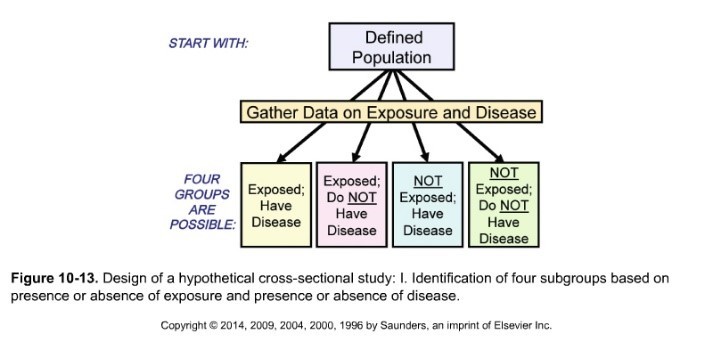
- Observational study –> exposure of characteristic at time of the study
- Simultaneous assessment of exposure and outcome at the time of the study
- Individual is unit of analysis
- The association between prevalent disease and prevalent exposure is examined.
- limited ability to ascertain time sequence of exposure and outcome
- Tends to be used to measure factors associated with diseases with slow onset and long duration
- Not subject to ecologic fallacy – looks at people on an individual level
2
Q
Selection of target population in a cross-sectional study
A
- Identify target population
- Prevalence rates of disease in a particular geographic area, age group, racial/ethnic group or occupational group
- Sometimes based on exposure of interest, if readily identifiable
- If relatively small numbers are involved, entire population may be included or a representative sample
- A community or a random sample of households in a community
- May be a stratified random sample (e.g., based on socioeconomic status, age, etc.)
3
Q
Pros of cross-sectional study
A
- cheap and simple
- ethically safe.
- Quick
- Uses representative sample of the population
- Study sample usually representative of general population (generalizable)
4
Q
Cons of cross-sectional study
A
- establishes association at most, not causality;
- confounders may be unequally distributed;
- group sizes may be unequal.
- Since it identifies prevalence and not incidence, this may not be representative of all the people with the disease
- Potential misclassification if disease is being actively treated or if disease has exacerbations and remissions or is episodic (e.g., asthma, multiple sclerosis, lupus)
5
Q
Biases in cross-sectional study
A
Biases
- Recall bias
- Excludes those who died prior to the study (survivor bias)
- Temporal bias – (most important limitation) cannot determine if the exposure preceded the outcome
- Establishes associations, but not etiologic relationship
- Duration and timing of exposures are important to document, if possible, to try to relate onset of disease
- Potential bias in classifying both disease prevalence and exposure status (chicken vs egg)
- Biased availability for the study - Sick patients may not be easily observed
6
Q
Measure of association in cross-sectional study
A
- Measure of association is the odds ratio = (a/c) / (b/d)
- Prevalence

epi study design
flashcards
Decks in class (7)
# Cards



