What are the approximate fan and cone angles in modern CT units?
- Fan angle = 60 degrees
- Cone angle = 2.4 degrees
List 2 advantages of arc shaped CT detector arrays
- Minimal variation in fluence in detectors due to inverse square law
- Struck in nearly normal manner -> no lateral positioning errors (parallax)
How does cone beam geometry differ from fan-beam / narrow cone beam? What challenges does this present?
- Use of flat panel detector
- Cone angle near to fan angle
- Differences in distance of rays striking detectors, requires additional calculation steps to negate below effects:
Inverse square law
Heel effect
Parallax (positioning errors)
What defines the max FOV?
FAN ANGLE / curved extent of detectors
Briefly detail different scanner generations
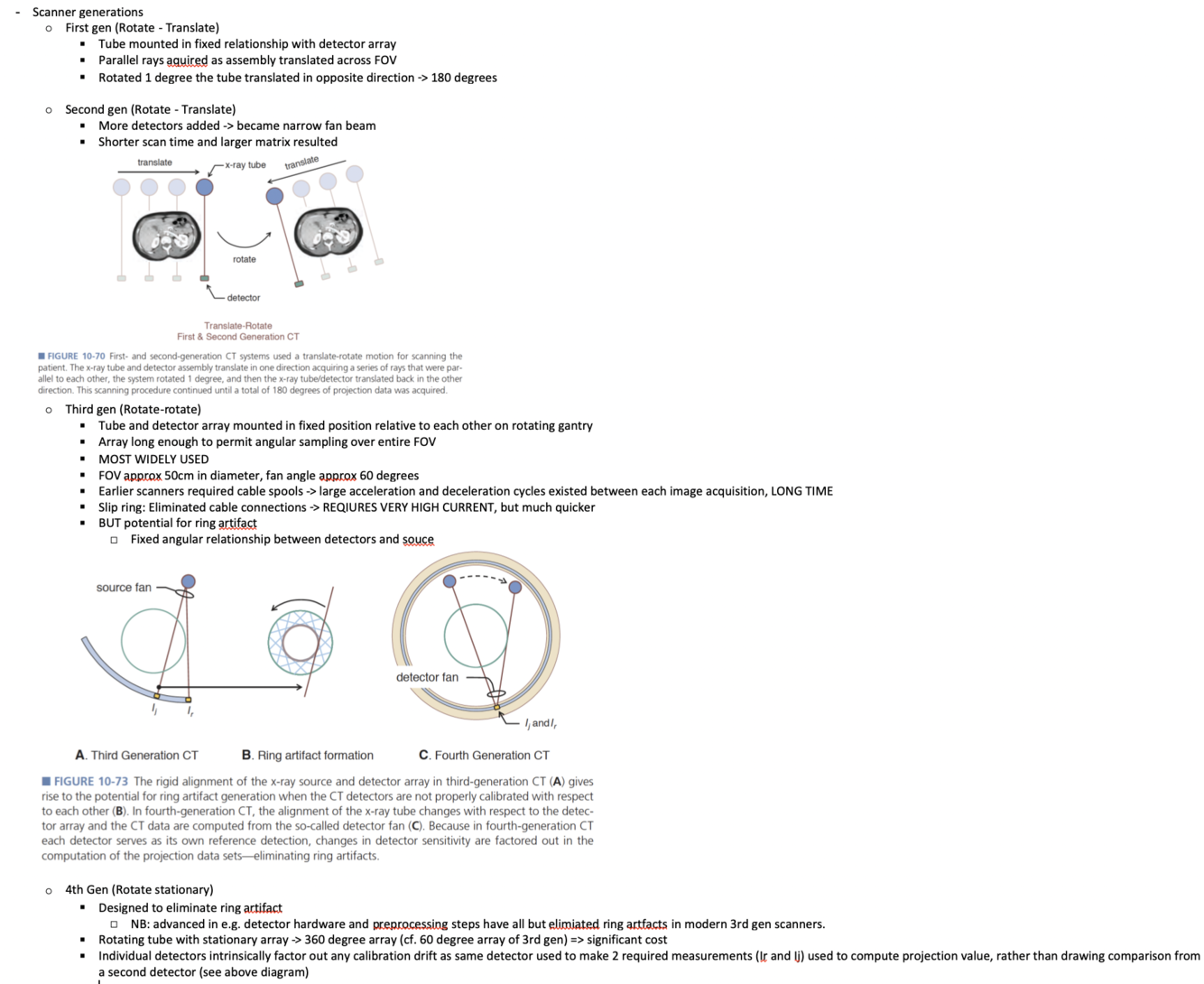
What type of detectors are used in CT? What are they made from?
- Indirect scinitllators (solid state) -> used to use ionisation chambers
- Use crystal e.g. caesium iodide + ceramic material e.g. Gadolinium oxysulfide Gd2O2S (and other materials) which have undgone ‘sintering’ to make more sensitve to xray detection
- FORMED INTO CERAMIC
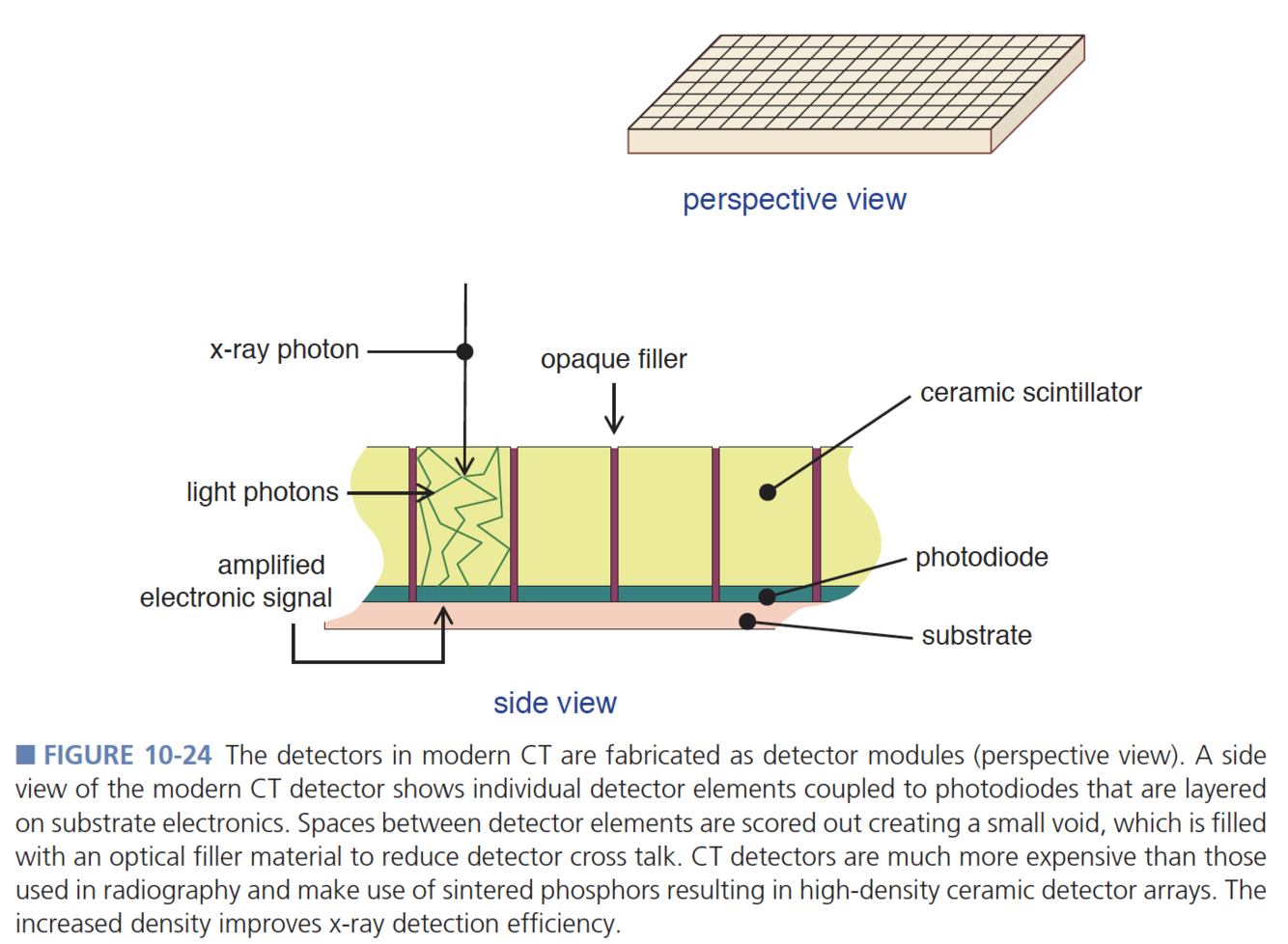
What dictates slice thickness in single array and MDCT scanners?
- Single array - > XRAY BEAM COLLIMATION
- MDCT -> DETECTOR CONFIGURATION / WIDTH
Faster scanning and thinner slices available with MDCT
A 64 slice MDCT scanner (n) with a detector width (T) of 0.625mm is used to scan 20cm of abdomen, pitch = 1, scan time = 1sec. How many scans are required and how long does it take?
64 x 0.625 = 40mm
20cm/4cm = 5 scans
5 x 1 sec -> 5 sec
What downside is there to having multiple thin slices in z direction?
- Decreased photon interaction results in INCREASED NOISE
- > Need to increase dose to negate this.
TRADE OFF between dose, noise and z axis resolution
How do CT and XR tubes compare?
CT:
More powerful - 5-7 Megajoules (XR = 0.3-0.5 Megajoules)
Continuous source
Typically run at 120kV for generic scanning (can alter)
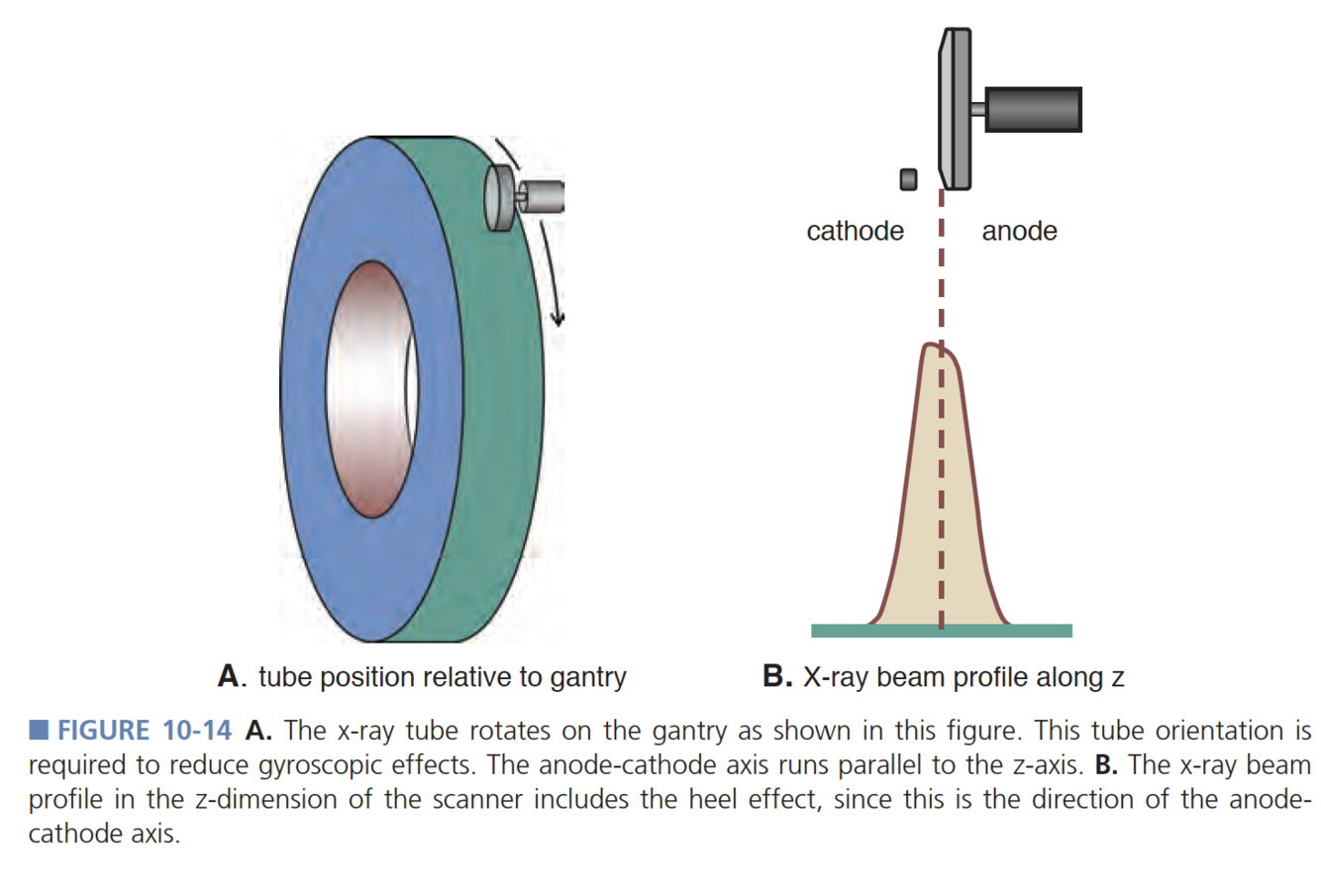
The heel effect is present along which axis in CT scanners?
- z axis
Which radiological interaction predominantes in CT?
COMPTON SCATTER
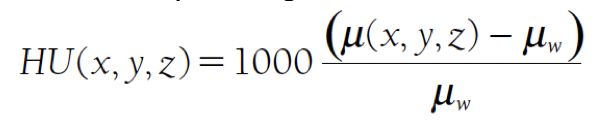
Describe the HU scale: air, fluid, water, fat, ST, contrast, bone
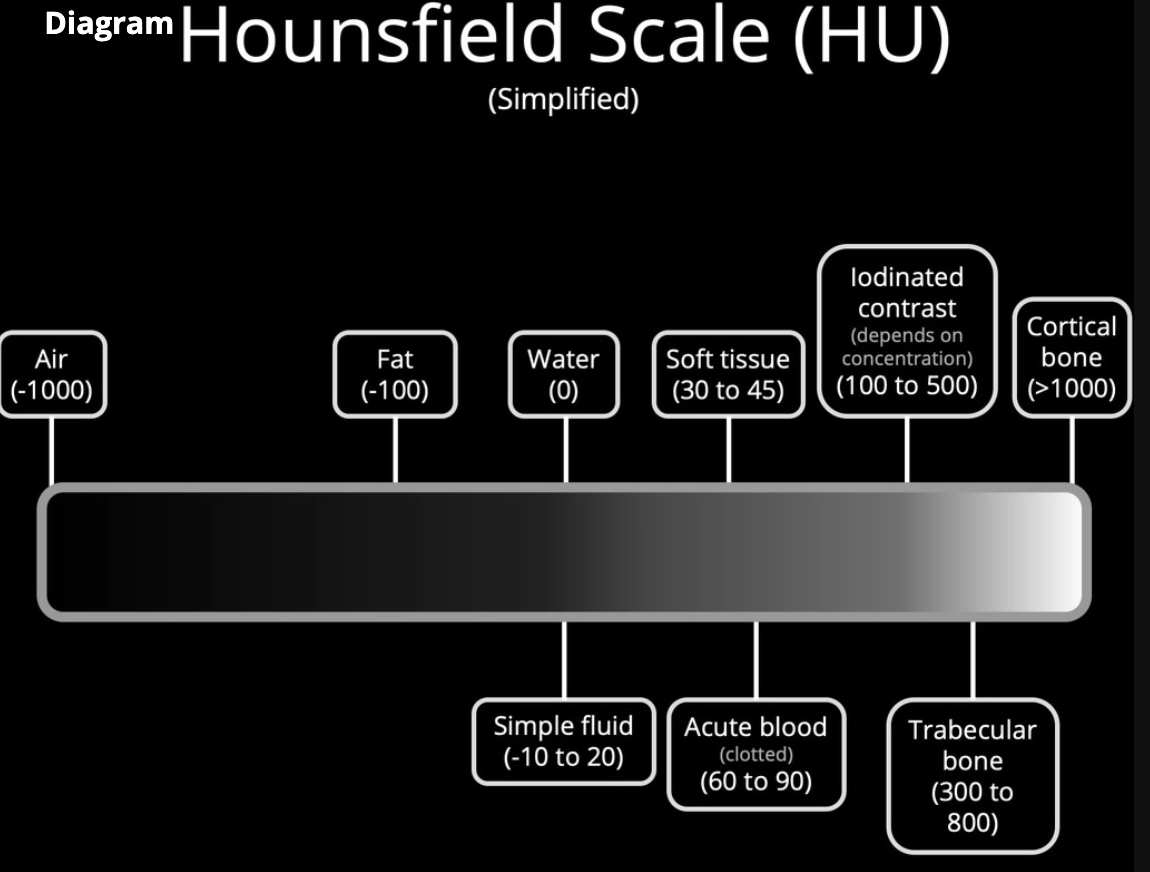
HU equation
Reflects LINEAR ATTENUATION COEFFICIENTS
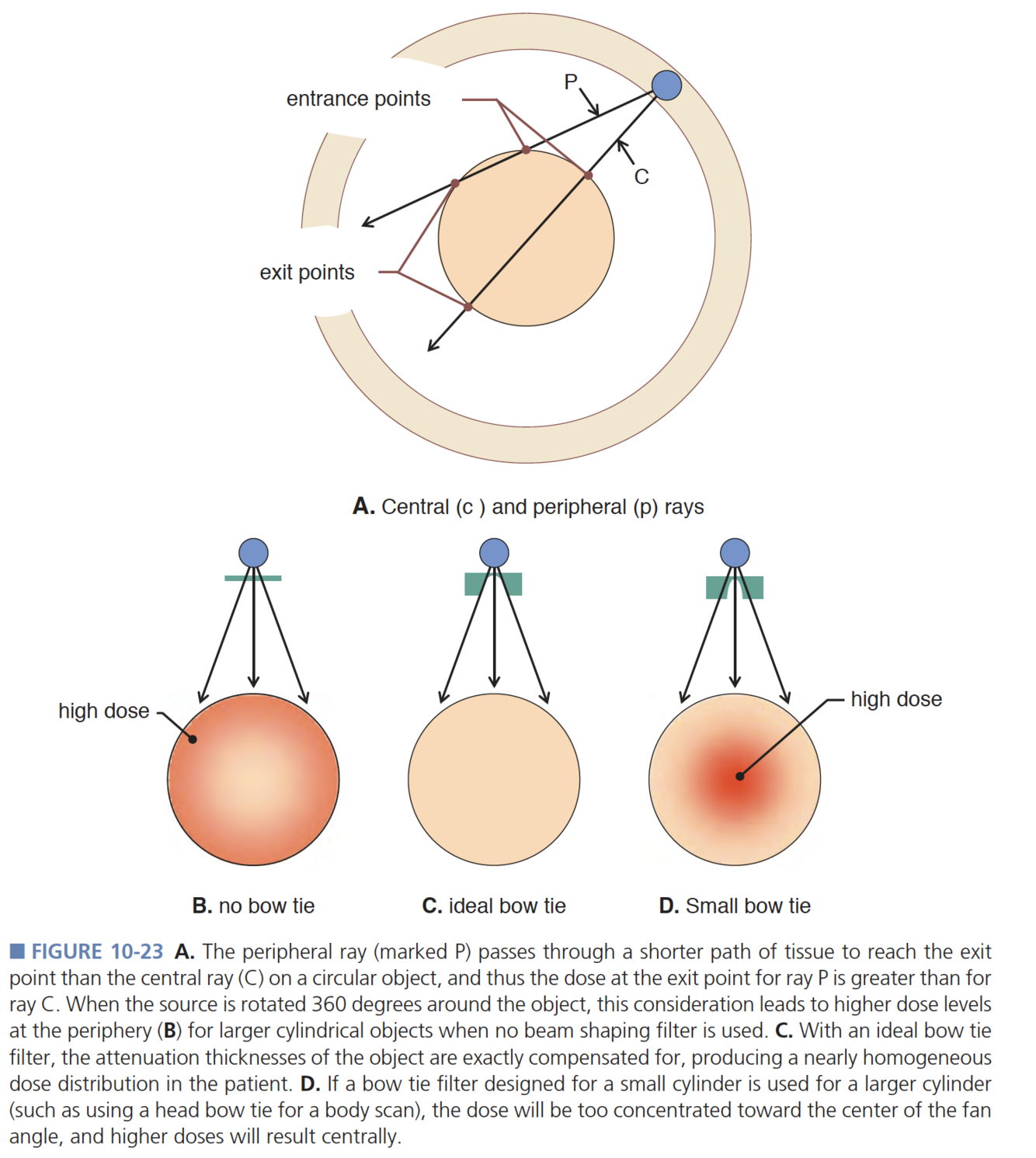
What does the bow tie filter do?
- Reduced patient dose at periphery (if applied correctly)
IF TOO SMALL FILTER USED, will concentrate / increase dose centrally
- Reduced image noise due to decreased statistical variation of beams with markedly different attenuation
What are the pitch equations x 3?
Single slice collimator pitch:
= Ftable / collimation width at isocentre
Multislice collimator pitch
= detector pitch / number of selected detectors or binned combinations
Multislicer detector pitch =
Pitch = Ftable / detector width
Gantry rotation time important too for calculation!
E.g. 0.5s rotation time, 40mm detector width -> what table feed required to achieve pitch of 1? = 80mm/s
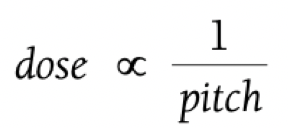
How does pitch relate to dose?
INVERSELY PROPORTIONAL TO PITCH
=> higher pitch, lower dose
Pitch = 1, equiavelent to contiguous
Pitch < 1, OVERSCANNING
- Increased patient dose
- Cardiac imaging, very large patients
Pitch > 1, UNDERSCANNING
- Decreased patient dose
- Paediatric imaging (speed important)
Define PITCH. What is normal pitch range?
Relative advancement of table per tube rotation
THINK SPEED -> HIGHER PITCH, FASTER TABLE MOVEMENT
0.75-1.25 typically
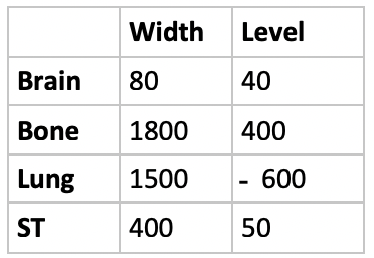
List approximate WW/WL for ST, bone, lung, brain
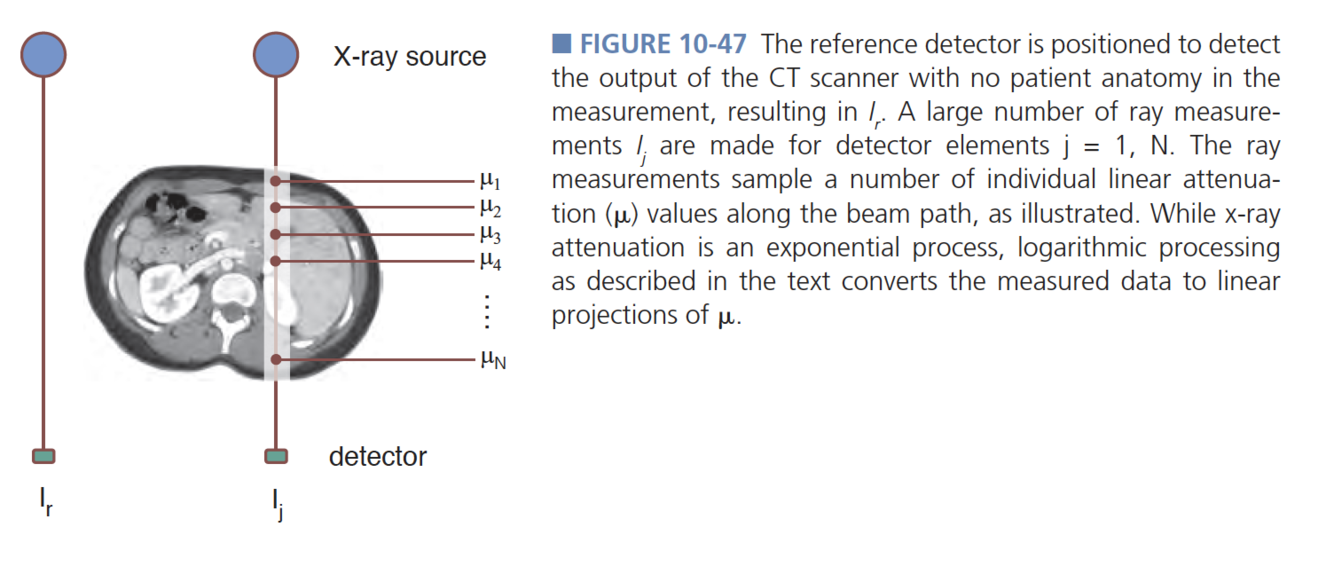
ROUGHLY, what do Ij and Ir refer to?
Ij = Detector value following projection through subject.
Ir = detector value outside of subject
=> IN BROAD TERMS compared to each other during calibration to adjust for e.g. variation secondary to bow tie filtration, distance from source etc
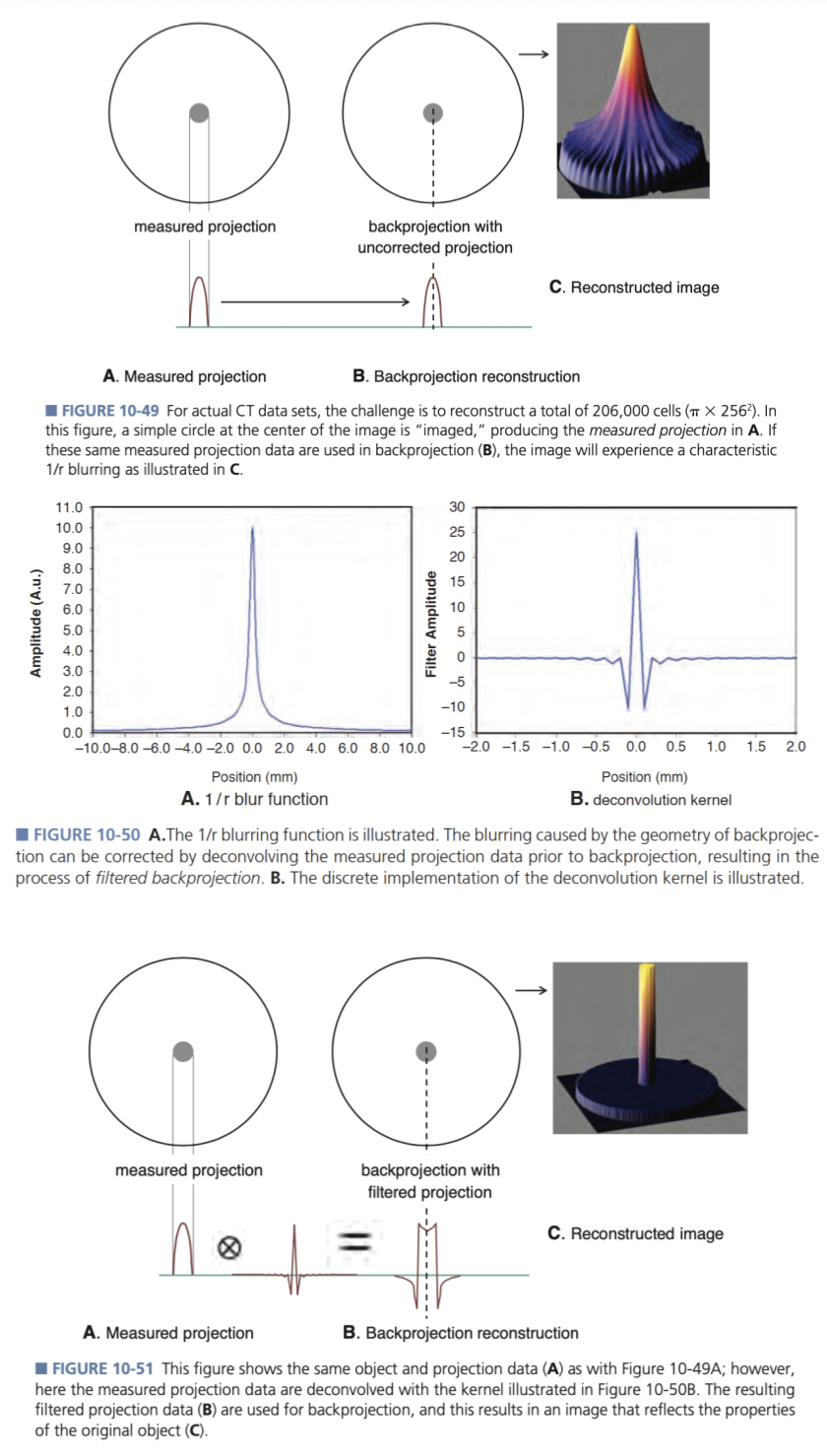
Define forward projection. Describe simple back projection vs filtered back projection
Forward projection = Result of linear attenuation data recieved at detectors. RAW DATA as yet not used to produce CT image
Simple back projection = Smearing of forward projected data across matrix -> results in 1/r blurring due to inherent geometric factors
Filtered back projection = DECONVOLUTION KERNEL applied -> Shapens edges to control for 1/r blurring.
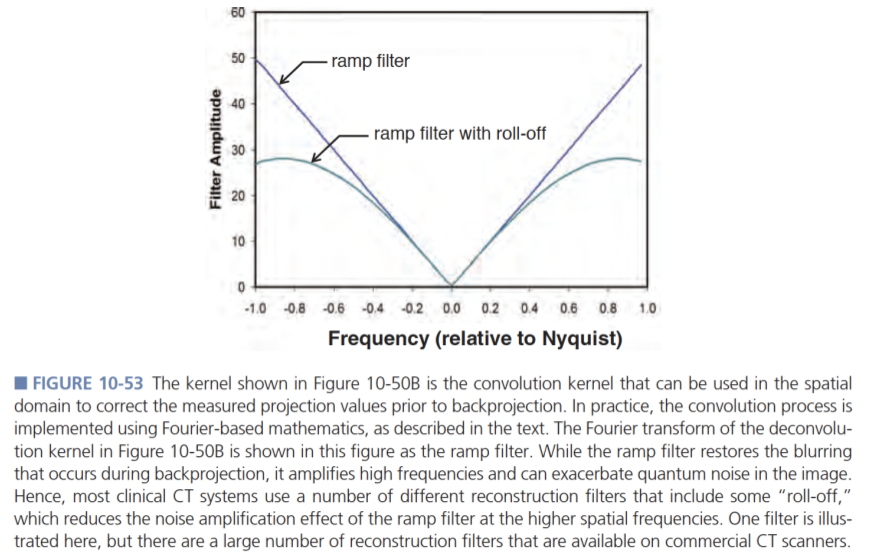
Describe relationship of convolutional methods with fourier transform in CT recon. What is a ramp filter and why is it used?
Convolution = mathematical method to accurately describe physical act of blurring in SPATIAL DOMAIN. 1/r blurring in this method controlled with deconvolution kernel
Fourier transform = Method of transformation of convolutional data into FREQUENCY DOMAIN -> allows for faster data handling.
Ramp filter = same as deconvolution kernel, but as plotted in FREQ DOMAIN (see shape in pic). Requires roll off, because inherently amplified high freq signal -> small objects with predominance of quantum noise! Thus roll-off controls noise.
Briefly describe differences in iterative and analytical reconstruction techniques
Analytical = e.g. simple / filtered backprojection, fourier transform based models. Use of convolutional methods and filtration to control for noise
Iterative = uses base image (may be FBP image) and through numerous iterations improves image accuracy -> Utilised error matrix comparing forward projected data and acquisition data, serially minimising over time
=> BETTER, but numerically intensive. Allows for control of real world factors e.g. focal spot blurring, xray spectrum. In principal -> Better SNR, or equivalent SNR with reduced dose.
Explain the role of sharp / smooth filters in reconstruction -> THINK RAMP
Sharp edge filters:
- Used to increase signal from small (high frequency) objects -> however, inherent increase in NOISE
- Used in regions of HIGH CONTRAST, as demonstrated by lung and bone window characterisitics -> big differences in attenuation e.g. lung vs air, bone vs ST
- LOOKING AT SMALL THINGS
=> Lung, bone
- Smooth edge filters: Used to decrease NOISE, with predominant focus on larger objects features
- Used in regions of LOW CONTRAST, e.g. ST windows, need to reduce noise
- LOOKING AT BIG THINGS
=> e.g. mild differences in attenuation in liver lesion



