1st/2nd generation CT scanners:
- What type/movement is a 1st generation?
- What type/movement is a 2nd generation?
- 1st: pencil beam; translate & rotating beam.
- 2nd: fan beam; translate & rotating beam.
- 3rd generation: fan beam; rotating beam & detector.
- 4th generation: fan beam; rotating beam, fixed detector.
- 5th generation: electron beam CT.
What does it mean when a CT scanner is 3rd generation?
Major point: the x-ray source and detectors rotate around the pt in synchrony & the linear attenuation coefficient of each pixel is calculated useing a reconstruction algorithm.
Minor point: fan beam geometry enabled one complete slice to be covered at one time.
- Originally 288 detectors used, now over 700 arranged in an arc.
- Scan duration: ~5 secs.
- 4th gen: >2000 detectors arranged in an outer ring which is fixed; beam is still fan-shaped; beam rotates, detector fixed; scan duration: a few seconds.
What is helical/spiral CT acquisition?
- Previously, earlier CTs stopped and shot.
- With helical CT, the pt is moved through a rotating XR beam + detector set.
- The helical path results in a 3-D data set which can then be reconstructed into sequential images for a stack.
- Rad dose during a helical acquisition depends on the speed of the pt through the scanner, i.e., the pitch.
Define multislice CT.
- Synonymous w/multi-detector-row CT (MDCT).
- Is a CT system w/multiple rows of CT detectors to create images of multiple sections.
- Conventional CT systems have only one row of CT detectors.
- Canon’s Aquilion ONE contains 320 detectors x 0.5mm.
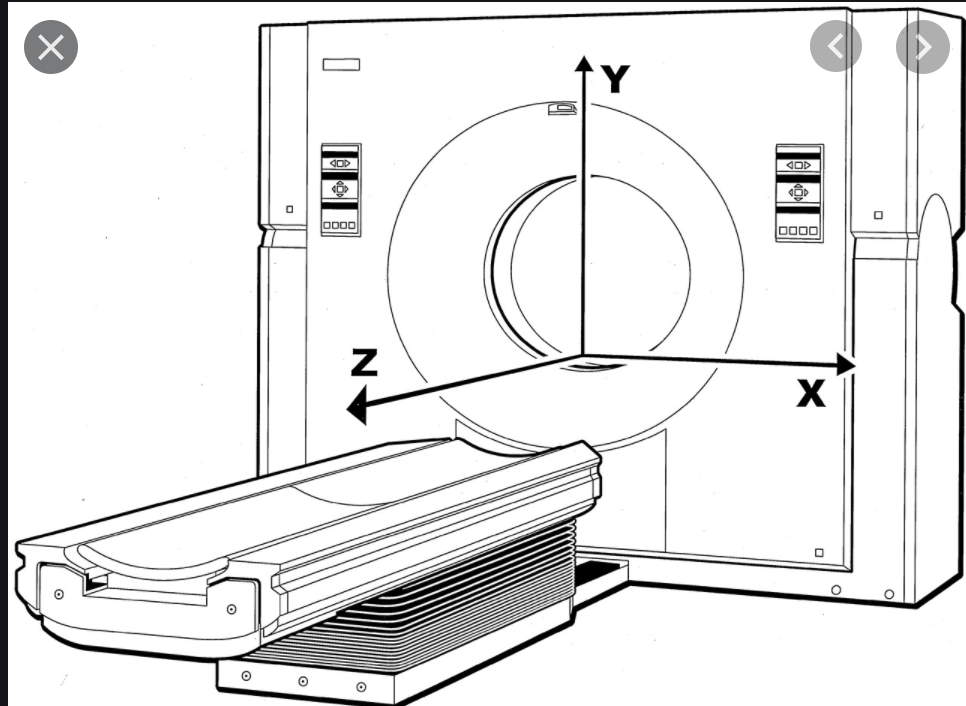
- The number of detectors in the Z direction determines the # of slices that can be simultaneously acquired.
What happens when:
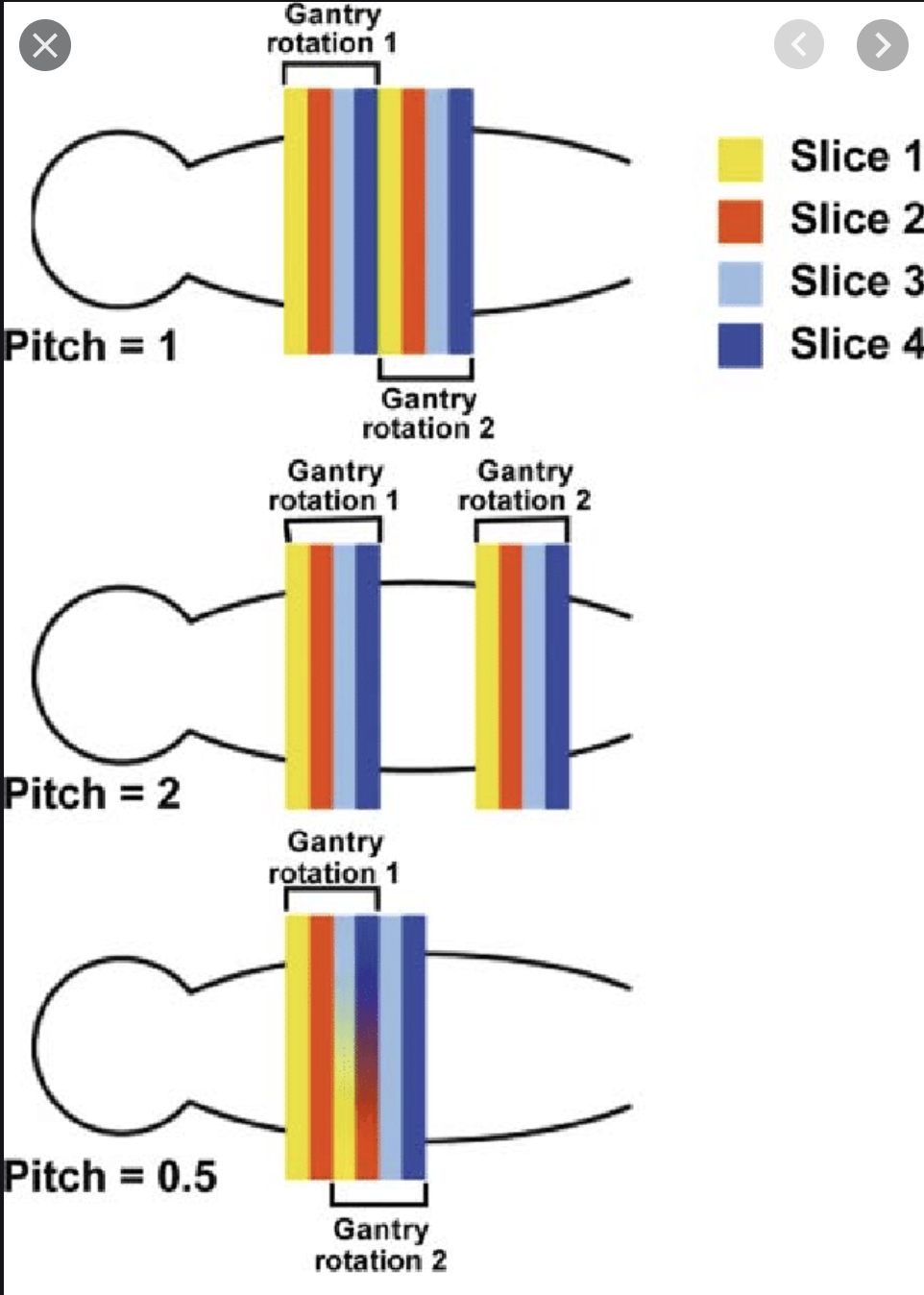
- pitch < 1
- pitch = 1
- pitch > 1
- What is the proportional relationship of pitch and dose?
- What is a good example of a scan done with a pitch <1?
- pitch < 1: sometimes called “over-scanning”
- Slower table.
- Beam has overlap with each rotation.
- Better image (resolution).
- Higher dose.
- pitch = 1:
- No overlap, no spaces b/w beams b/w rotations.
- pitch > 1:
- Faster table.
- Creates a gap: some anatomy missed w/spaces b/w rotations.
- Poorer image (spatial resolution decreased).
- Decreased dose.
- They are inversely proportional: if the pitch is doubled, then the dose is 1/2; if the pitch is halved, then the dose is doubled.
- Cardiac CT, pitch = 0.2; you really care about spatial resolution here.
https://www.youtube.com/watch?v=UNqv0GpigeY
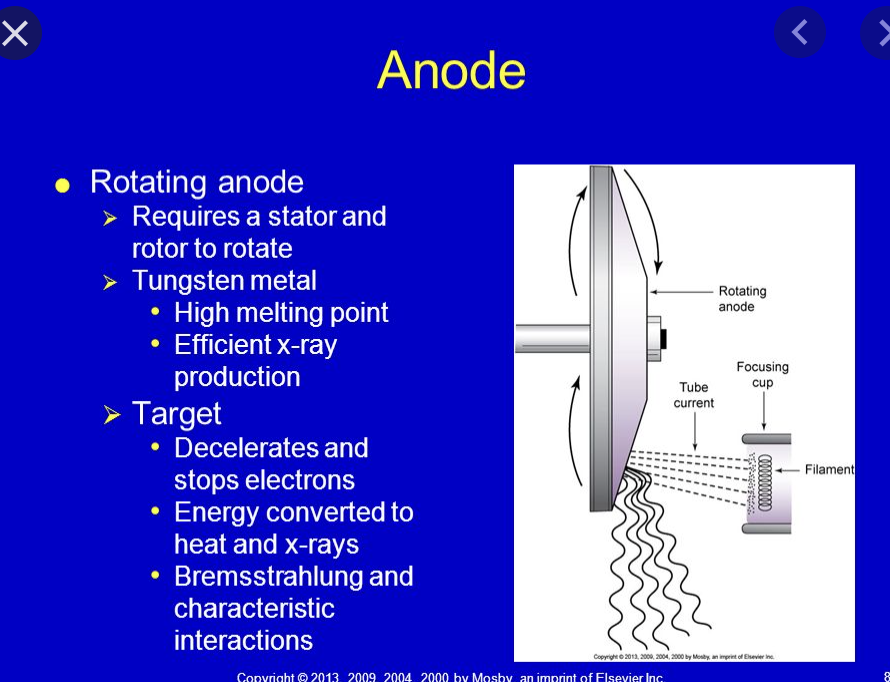
What target material is used in CT XR tubes?
Tungsten alloy (rotating) target placed on high speed rotating anodes.
Draw the table that compares XR to CT re: current, kVP and focal spots:
XRAY
CT
Tube current
200-800 mA
Up to 1,000
kVp
50-120 kVp
80-120 kVp
Focal Tube Spot
- 0-1.2mm
- 6-1.2mm
* So CTs are designed to run at reasonable voltages, but w/very high currents.
DECT:
- What is the basic philosophy behind DECT?
- At what kVps are dual energy scans acquired?
- What is actually recorded during these 2 scans?
- Which 3 material decomposition images (removal) are there?
- 2 different photon energy spectra are used to interrogate materials that have different attenuation properties at two different energies.
- 80 & 140 kVp.
- The HU of each pixel, so twice.
- Iodine, calcium, uric acid.
DECT: List some applications.
- Determine gallstone & renal stone composition.
- Can reduce metallic artifact.
- Create virtual non-enhanced images, which reduces dose by eliminating a true non-enhanced acquisition.
- Use increase the conspicuity of iodine in CEDECT to make free active extrav or endoleak more visible.
How do newer-generation DECT scanners do relative to SECT (single-energy) re: radiation dose?
DECT scanners (newer generation) can deliver equal or smaller doses.
- What is the k-edge value of iodine?
- Soft tissue structures?
- 33.2 keV
- WAY less–all of them contain carbon, etc., so <1 keV each.
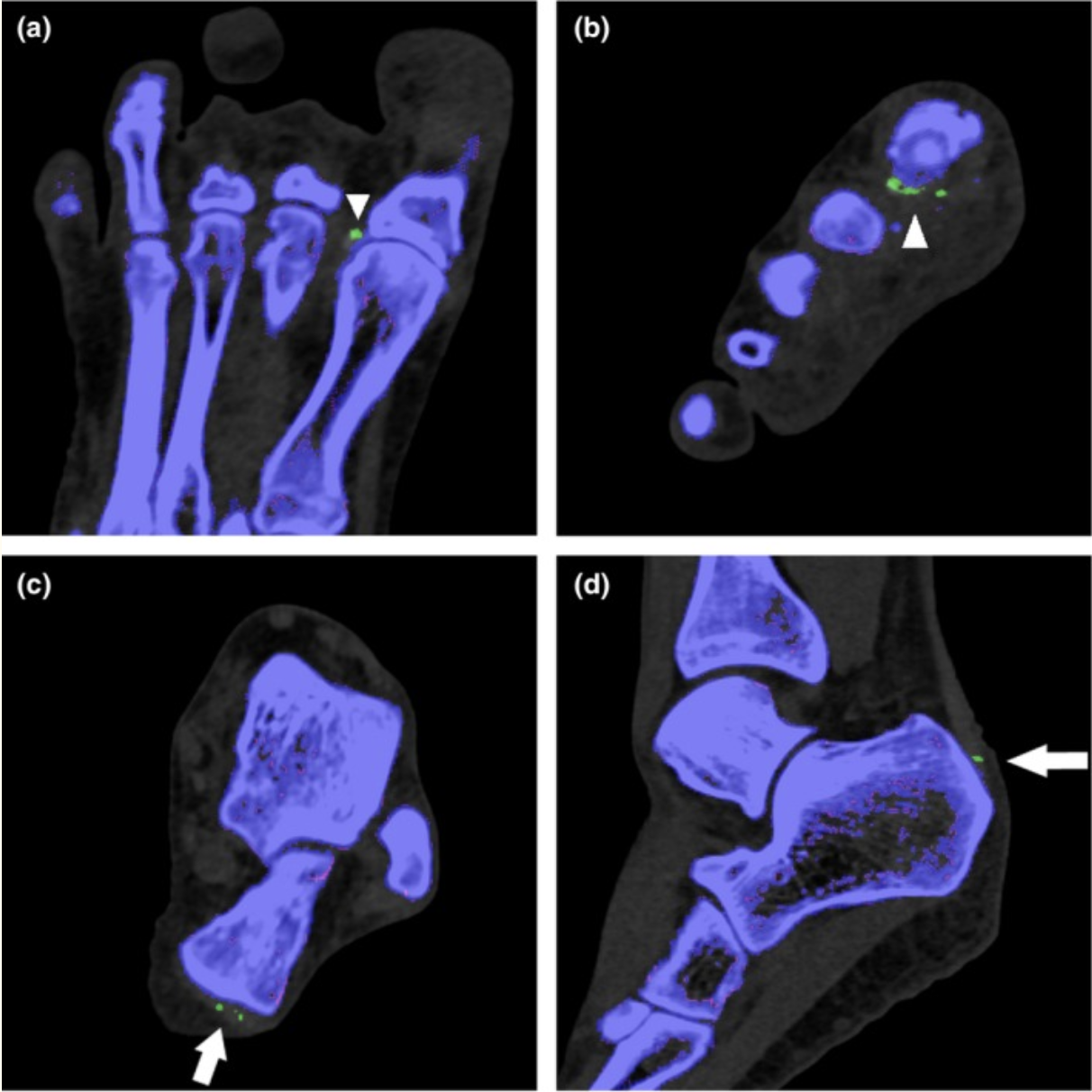
Which crystals (and related clinical condition) can DECT detect?
Monosodium urate crystals = gout
Define k-edge.
- How does k-edge relate to an element’s atomic number (Z)?
K-edge definition:
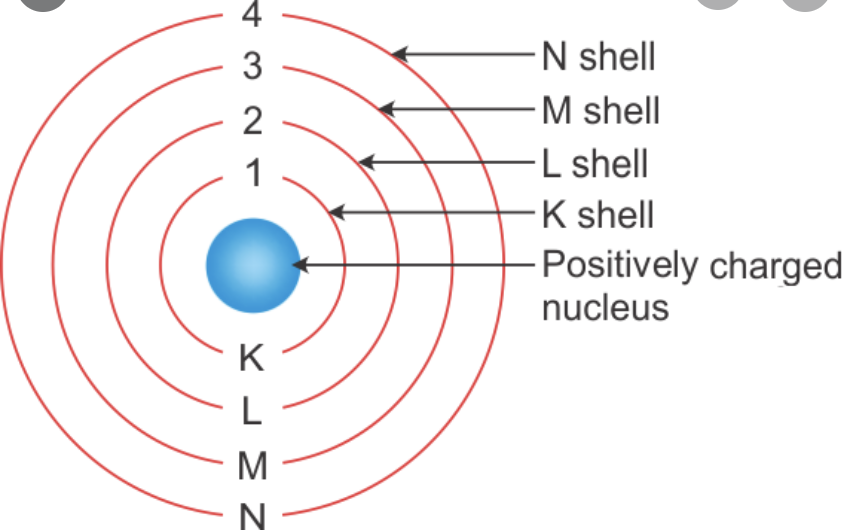
- It is the sudden increase in XR photoelectric absorption that occurs when the energy of the XRs is just above the binding energy of the innermost (k-shell) of electrons of any element.
- The attenuation value of a material hit by a photon beam is at its maximum close to the k-edge value.
- The higher the atomic number, the higher the k-shell binding energy, thus the higher the photon energy at which the K-edge occurs.
- Which type of atomic number is more susceptible to photoelectric effect, high or low?
- What are the atomic numbers of iodine, calcium and molybdenum?
- High.
- Iodine Z=53, K-edge 33.2 keV; Moly Z=42, K-edge = 20.0eV; Ca Z = 20, K-edge = 4 keV.
How does peripheral vs. central CT dose compare in the head vs. body & why?
Head: central dose = peripheral, as the head diameter is relatively small.
Body: central dose < peripheral dose (about half), since the body diameter is much wider, so less radiation reaches the central body.
- Define CT Z-axis.
- What is Z-axis variation?
- Z-axis = the length of the scan, i.e., along the length of the patient.
- The “tails” of radiation along the edge of the area being scanned.
CT phantoms:
- How large is a CT body phantom?
- What happens to the dose if the pt is larger than the phantom?
- Smaller than the phantom?
- 32cm.
- If the pt is larger then the dose is over-estimated, as there is more tissue in the larger person to absorb all the dose, so smaller Deff.
- Smaller: dose is underestimated as there is less internal shielding in the pt, and tissue to absorb all the dose.
- Define CTDI.
- What units are used?
- Define CTDI100.
- Define CTDIw.
- Define CTDIvol.
- CT dose index = a standardized measure of the radiation dose output of a CT scanner which allows the user to compare radiation output of different CT scanners. It is the radiation dose normalized to beam width.
- It is measured as the average phantom dose for a single axial slice (one complete rotation without table motion), including scatter.
- mGy.
- It’s measured with 16cm and 32cm phantoms. The 16cm will always have a higher dose as it’s smaller.
- CTDI100 = linear measure over a 100mm ionization chamber (mGy).
- CTDIw (mGy) = 2/3 CTDI100 periphery + 1/3 CTDI100 center (so this is closer to the human dose profile).
- CTDIvol (mGy) = CTDIw / pitch
- Should be less than reference values:
- Adult head (16cm phantom): 75 mGy.
- Adult abdo (32 cm phantom): 25 mGy.
- Peds abdo (16 cm phantom): 20 mGy.
- Define DLP.
- What does DLP effectively give you?
- How do you estimate Deff (in mSv) from the DLP?
- CTDIvol x the length of the scan in cm (measured in mGy*cm).
- The overall dose output per scan. The DLP and CTDI give no information about actual absorbed or effective doses for any patient. This is the best estimate of radn risk from a CT.
- Deff = DLP x organ weighting factor:
- So if DLP is 900 mGy*cm for an abdo CT, the radn exposure = (900 mGy*cm) x (0.017 mSv/mGy*cm) = 15.4 mSv.
How does skin dose in XR differ from skin dose in CT?
XR skin dose: entrance skin dose is WAY higher than exit.
CT skin dose: b/c the scanner spins 360º, entrance and exit skin doses are similar. However, the center (in body CTs at least) receive less than the periphery (about half).
- Define effective dose for CT.
- What units used?
- Deff = k x DLP where k is a constant for any given body part.
- Because it actually measures dose in human tissue, it’s measured in Sv.
List the typical Deff (mSv) ranges for common diagnostic exams:
- XR
- Fluoro
- IR
- CT
- XR: 0.005 mSV (knee XR) up to 1.5 mSV (lumbar spine XR).
- Fluoro: 6-8 mSV (UGIS to barium enema).
- IR: 1-10 mSv (cerebral angio); 100 mSv (TIPS)
- CT: 2-8 mSV:
- Head CT: 2 mSv
- Neck: 3 mSv
- Chest: 7 mSv
- Abdo: 8 mSv
- Pelvis: 6 mSv
Average CT doses: List the average CTDI and effective doses for:
- Adult head
- Adult abdomen
- Peds abdomen (5yo)
What are the ACR “reference doses” by definition?
List these for :
- Adult head
- Adult abdomen
- Peds abdomen
- Adult head: 58 mGy, Deff 1-2 mSV
- Adult abdomen: 18 mGy, Deff 8-11 mSV
- Peds abdomen (5yo): 15 mGy
ACR “reference doses” by definition: 75th %ile doses, above which should be investigated and reduced if posisble.
List these for :
- Adult head: 75 mGy
- Adult abdomen: 25 mGy
- Peds abdomen: 20 mGy
Effective mAs
- Where is this term used?
- Define.
- Helical scanning only.
- mAs / pitch
- As the pitch increases (all other settings constant), the # of XR photons contributing to the slice data will decrease (effective mAs).
- The effective mAs determines the dose to the slice (CTDIvol) and SNR.



