You are reviewing a 14-year-old boy who has just returned from a holiday abroad.
His mum has noticed a widespread rash on his back. He has complained of some itching but is otherwise well.
On examination, he has a large number of light brown macules and confluent patches affecting most of his back and chest. The examination is otherwise unremarkable.
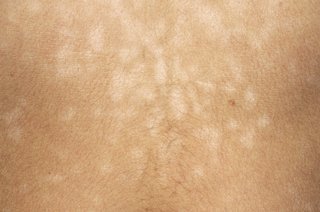
What would be the most appropriate management in this case?
This is a typical presentation of pityriasis versicolor, a common fungal skin infection. It often becomes more noticeable after spending time in the sun - as the healthy skin becomes darker, the white/light brown patches become more prominent.
Treatment consists of topical antifungals - NICE recommends ketoconazole shampoo. If only a very small area is affected, a topical antifungal cream may also be appropriate. In this case, both back and chest are affected, so a shampoo would be much easier to use.
You are seeing a 15-year-old boy who has developed a widespread rash over the last week. It seemed to start from a single patch on his abdomen that he first noticed 10 days ago.
On examination, he has a symmetrically distributed rash consisting of discrete pink/red lesions which are 0.5-1cm in diameter. Most are flat, but some appear slightly raised. Some have fine scales along the edges. They are not painful or itchy.
He is otherwise well and his observations are normal.
What would be the most appropriate management in this case?
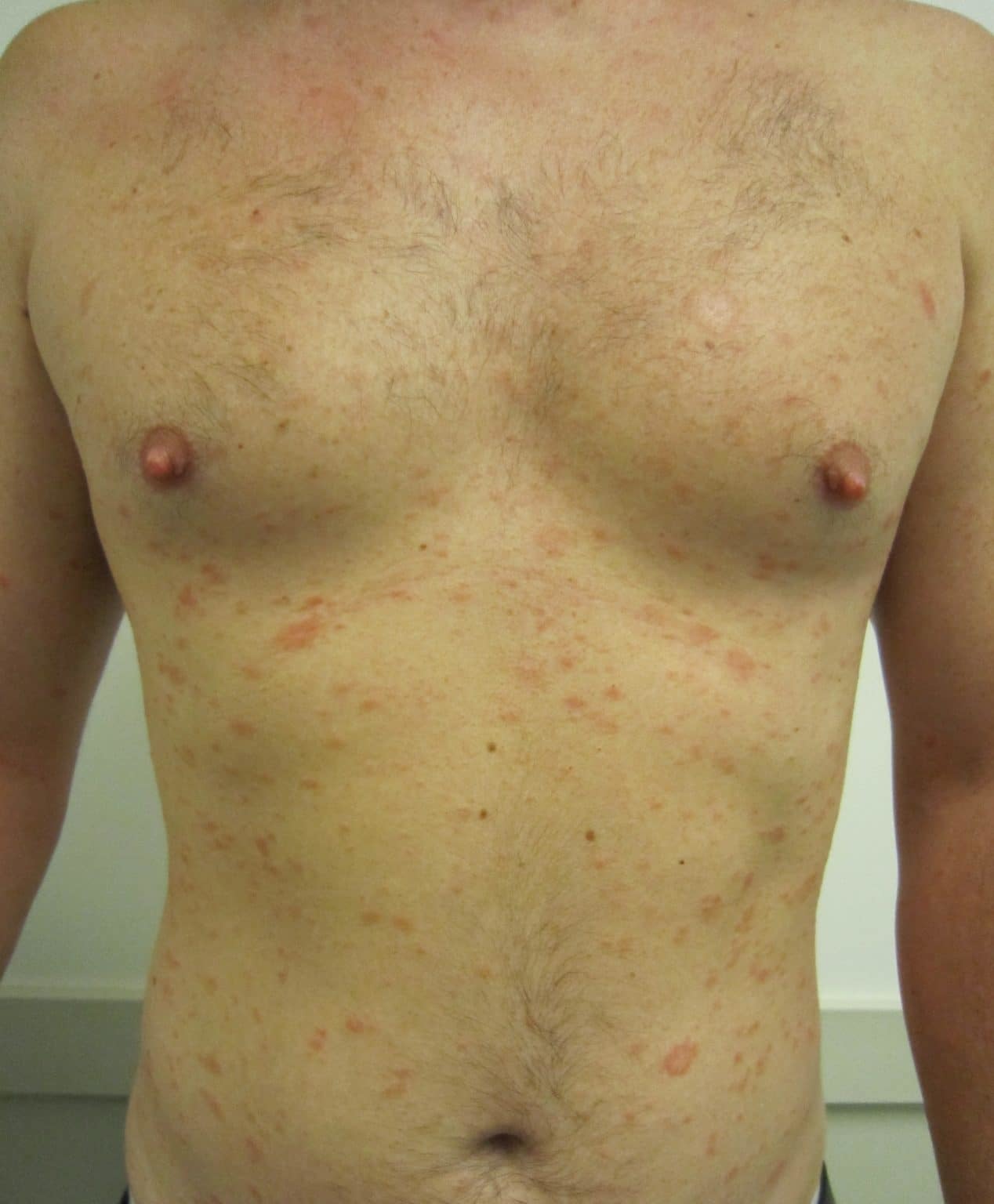
This is a very typical description of pityriasis rosea. The exact cause remains unclear, although there are links to certain viruses. It is a self-limiting disease that tends to resolve within 12 weeks with no long term complications. Most patients will not require any treatment.
If patients complain of itch we can consider emollients, topical corticosteroids or antihistamines. Steroids are unlikely to shorten the duration of the rash itself, so should only really be used if there is pruritus present and for the shortest amount of time.
The correct answer is: No treatment indicated
You are reviewing a 5-year-old girl whose mum has been concerned about a rash. This initially started on the trunk before spreading to the rest of the body. Mum thinks she has had a temperature for 1 or 2 days prior to this.
On examination, you note a generalised, rough-textured, pin-point rash. Her tongue has a white coating through which you can see some red papillae.
She has no significant past medical history and no known allergies.
What would be the most appropriate management in this case?
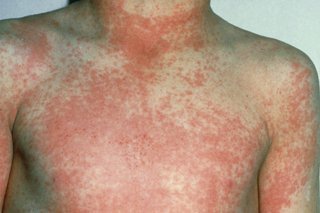
This a description of scarlet fever, a bacterial infection caused by Group A Streptococci. It is highly contagious and usually treated with antibiotics. NICE recommends phenoxymethylpenicillin first line and azithromycin in true penicillin allergy, although this may be different where you work depending on local microbiology policies.
Exam questions often mention a ‘sandpaper-like rash’ or a ‘strawberry tongue’ as described in this scenario.
The correct answer is: Oral phenoxymethylpenicillin
What is this condition?
What is the treatment?
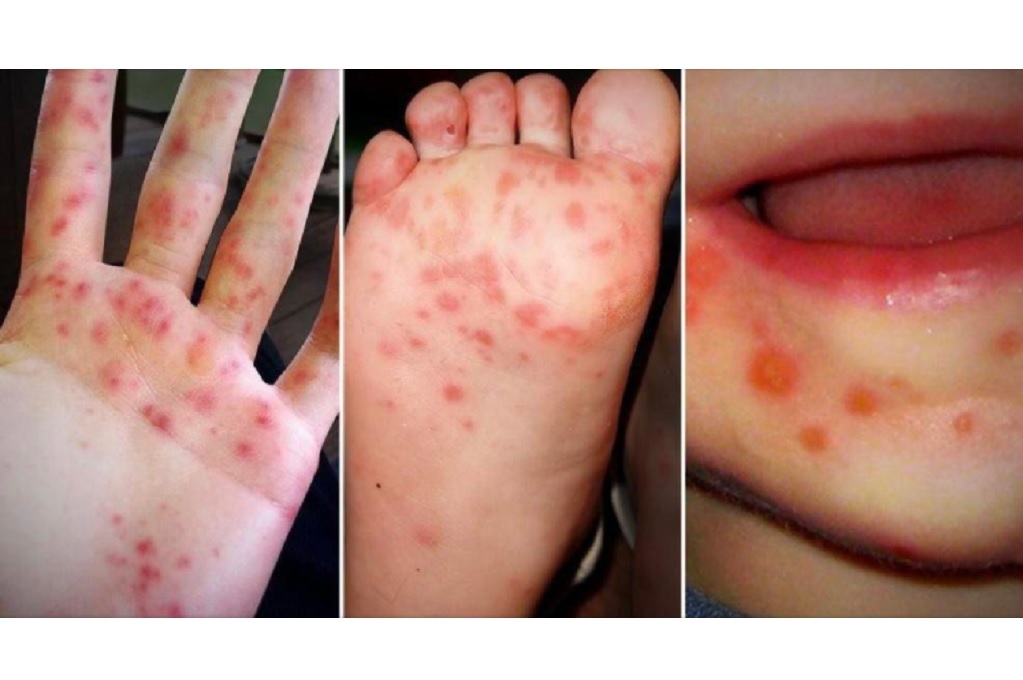
Hand, foot and mouth disease
Caused by the coxsackie A16 virus
Mild systemic upset: sore throat, fever
Vesicles in the mouth and on the palms and soles of the feet
You cannot take antibiotics or medicines to cure hand, foot and mouth disease. It usually gets better on its own in 7 to 10 days.
To help the symptoms:
drink fluids to prevent dehydration – avoid acidic drinks, such as fruit juice
eat soft foods like yoghurt – avoid hot and spicy foods
take paracetamol or ibuprofen to help ease a sore mouth or throat
Methods of reducing serum potassium
(2)
Insulin dextrose bolus
salbutamol nebulizer
A 5-year-old girl is brought to the GP by her mother as she has had a very loud, harsh cough for the last 2 weeks, and has been more lethargic than usual. She appears systemically well, but you witness 2 coughing fits during your consultation, in which the child appears distressed and struggles to take breaths in, making a loud harsh inspiratory noise between coughing fits. The patient has no known allergies or past medical history, but her vaccination record is unclear, having moved to the UK from abroad two years ago. Her observations reveal a fever at 37.5ºC.
What is the most appropriate management plan?
(3)
Whooping cough is a notifiable disease
Notify PHE
Prescribe azithromycin
Whooping cough (pertussis) is an infectious disease caused by
(2)
Gram-negative bacterium Bordetella pertussis
Features of whooping cough
(6)
Features, 2-3 days of coryza precede onset of:
- coughing bouts: usually worse at night and after feeding, may be ended by vomiting & associated central cyanosis
- inspiratory whoop: not always present (caused by forced inspiration against a closed glottis)
- infants may have spells of apnoea
- persistent coughing may cause subconjunctival haemorrhages or even anoxia leading to syncope & seizures
- symptoms may last 10-14 weeks* and tend to be more severe in infants
- marked lymphocytosis
Diagnostic criteria of whooping cough
(4)
Diagnostic criteria
Whooping cough should be suspected if a person has an acute cough that has lasted for 14 days or more without another apparent cause, and has one or more of the following features:
- Paroxysmal cough.
- Inspiratory whoop.
- Post-tussive vomiting.
- Undiagnosed apnoeic attacks in young infants.
Diagnosis of whooping cough
Diagnosis
per nasal swab culture for Bordetella pertussis - may take several days or weeks to come back
PCR and serology are now increasingly used as their availability becomes more widespread
Management of whooping cough
(6)
Management
- infants under 6 months with suspect pertussis should be admitted
- in the UK pertussis is a notifiable disease
- an oral macrolide (e.g. clarithromycin, azithromycin or erythromycin) is indicated if the onset of the cough is within the previous 21 days to eradicate the organism and reduce the spread
- household contacts should be offered antibiotic prophylaxis
- antibiotic therapy has not been shown to alter the course of the illness
- school exclusion: 48 hours after commencing antibiotics (or 21 days from onset of symptoms if no antibiotics )
Complications of whooping cough
(4)
Complications
subconjunctival haemorrhage
pneumonia
bronchiectasis
seizures
Acute lymphoblastic leukaemia poor prognostic factors
(5)
Poor prognostic factors
- age < 2 years or > 10 years
- WBC > 20 * 109/l at diagnosis
- T or B cell surface markers
- non-Caucasian
- male sex
Features of eczema
(5)
Features
- itchy, erythematous rash
- repeated scratching may exacerbate affected areas
- in infants the face and trunk are often affected
- in younger children, eczema often occurs on the extensor surfaces
- in older children, a more typical distribution is seen, with flexor surfaces affected and the creases of the face and neck
Management of eczema
(5)
Management
- simple emollients
- large quantities should be prescribed (e.g. 250g / week), roughly in a ratio of with topical steroids of 10:1
- if a topical steroid is also being used the emollient should be applied first followed by waiting at least 30 minutes before applying the topical steroid
- creams soak into the skin faster than ointments
- emollients can become contaminated with bacteria - fingers should not be inserted into pots (many brands have pump dispensers)
- topical steroids
- wet wrapping
- large amounts of emollient (and sometimes topical steroids) applied under wet bandages
- in severe cases, oral ciclosporin may be used
You are doing the six week check on a baby girl.
Describe Barlow test for developmental dysplasia of the hip.
Barlow manoeuvre: attempted dislocation of a newborns femoral head
Risk factors for developmental dysplasia of the hip
(7)
Risk factors
- female sex: 6 times greater risk
- breech presentation
- positive family history
- firstborn children
- oligohydramnios
- birth weight > 5 kg
- congenital calcaneovalgus foot deformity
Clinical examination for developmental dysplasia of the hip
(2)
Clinical examination
- Barlow test: attempts to dislocate an articulated femoral head
- Ortolani test: attempts to relocate a dislocated femoral head
other important factors include:
- symmetry of leg length
- level of knees when hips and knees are bilaterally flexed
- restricted abduction of the hip in flexion
Management of developmental dysplasia of the hip
(3)
Management
- most unstable hips will spontaneously stabilise by 3-6 weeks of age
- Pavlik harness (dynamic flexion-abduction orthosis) in children younger than 4-5 months
- older children may require surgery
Which hip is DDH more common in?
DDH is slightly more common in the left hip.
Around 20% of cases are bilateral.
A mother presents with her baby to the GP for review. She asks for advice regarding her milestones and explains that her son was born was born prematurely at 32 weeks gestation.
With the premature age in mind, when should this baby begin to show a responsive social smile?
The corrected age of a premature baby is the age minus the number of weeks he/she was born early from 40 weeks
A 3-year-old boy presents to the GP with a widespread, blanching, erythematous rash over his torso, arms and legs. He has had a fever and has been generally irritable and lethargic for around a week. He has also been complaining of abdominal pain for the last few days. On examination, the skin on his palms and soles is desquamated, and his tongue is red with a white coating.
What is the most likely diagnosis?
High fever lasting >5 days, red palms with desquamation and strawberry tongue are indicative of Kawasaki disease
At which age can a child talk in short sentences (e.g. 3-5 words)?
2.5 - 3 years
At which age does a child have a vocabulary of 2-6 words
12-18 months



