Progression of AD
Brakk Stages: Stages1-2 : transetorhinal -Layer II of transentorhinal cortex, Layer I CA1 of the hippocampus
Stages 3-4 : Limbic - Layer IV of entorhinal cortex and CA1 of the hippocampus, Amygdala, temporal association cortex
Stages 5-6: Neocortical -CA2, 3 and 4 of hippocampus,subiculum and isocortex, Neocortical association cortex and dentate gyrus 4-6 is definitive for AD
AD Biomarkers:
CT: temporal lobe thickness
MR: hippocampal volume
PET tracer:
- blood flow glucose metabolism neurotransmitters cell type receptor binding
- PiB for almyloid plaque inclusions
Amyloid beta
made from APP~770 residues to form 38-43 residue protein. 40 is normal 42 is pathogenic
Genetics in AD
gamma secretases: Presenlins 1 & 2 G
APP: trisomy 21
Non dominant form: ApoE-e4
Normal function of Amyloid
secreted from healthy neurons in response to activity to reduce activity
Synaptotoxic pathway
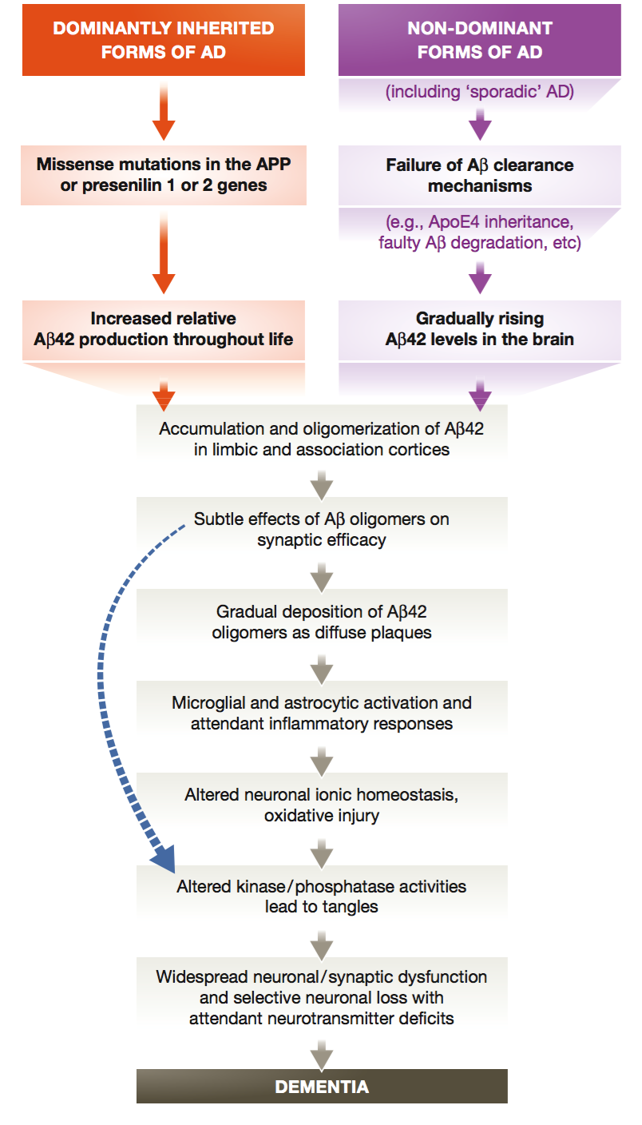
AB42 binds to post synaptic a7 nicotinic receptor Cascade of events lead to phosphorylation of tyr472 on NMDA receptor => phosphorylation and endocytosis Altered kinase and phosphotase activity leads to phosphorylation of tau and tangle formation- these can make it into blood vessels=> immune response => neuronal loss by microglia
Amyloid cascade hypothesis
We define dementia as impairment of the following:
- Memory
- Language
- Visual processing an orientation
- Mood, personality and social skills
- Frontal executive function, including planning and problem solving
Dementia associations and subtypes
- It is a clinical syndrome associated with higher income and age caused by neurodegeneration. 47 million people in the world have dementia
- Alzheimer’s disease cause up to 55-70% of degenerative dementias, 15-25% of vascular dementia and 10-30% is caused by others such as lewy body dementia, Parkinson’s dementia and FTL dementia
Diagnosis
To diagnose dementia:
- First we have to exclude any other causes of dementia e.g. stroke, normal pressure hydrocephaly, HIV, infection, CVD, PD, Huntington’s disease
- Definitive diagnosis is by neuropathological diagnosis: looking for amyloid beta plaques and neurofibrillary tangles
- However, imaging techniques such as PET and Pittsburgh B can be used to help identify presence amyloid beta in the brain.
- PET:
- Okello et al, Pittsburgh B: radio analogue of thioflaven T which is used in PET to image beta-amyloid plaques in neuronal tissue.
- Amyloid PET study in subjects with mild cognitive impairment were followed over 3 years. PIB positive subjects were significantly more likely convert to AD than PIB negative patients
NINCDS-ADRDA
- Memory impairment
- Clinical exam: Neuro-psychological tests that assess communication, concentration, word recall, memory and executive function
- Montreal cognitive assessment
- MMSE
- One or more of the following cognitive disturbances:
- Aphasia
- Apraxia
- Agnosia
- Disturbance in executive functioning
Key differences to take note between AD and VascD
Vascular dementia
Risk factors
- Age
- Hypertension
- AF
- Cardiac abnormalities – MI, CHD
- Stroke
- Atherosclerosis
- However limited evidence have shown a potential link between Apo-E and vascular dementia
- Diabetes mellitus
- Smoking
- Genetic factors
- Male
Clinical feature
- Abrupt and stepwise
- Neuroimaging positive for CVD
- Loss of executive function and presence of focal neurological signs and symptoms
Alzheimer’s
Risk factors
- Age: 65 its 5% risk and this doubles every 10 years
- Family history
- Down’s syndrome – APP on chromosome 21
- Head injury
- Apo lipoprotein E-e4 – 3x risk for 1 allele and 12x for both allele
- Smoking
- Female
Clinical features
- Insidious and gradual onset
- Memory impairment usually late onset
- Early onset dementia tend to get more movement disorders
Genetics
Early onset AD: Autosomal dominant
- APP – Chromosome 21 – An amyloid precursor protein forming normal AB of 40 peptide residues or pathogenic AB of 42 residues
- Kunitz protease inhibitor (KPI) is found within the extracellular domain.
- Zhang et al, 2011: The APP gene is located on chromosome 21 in humans with 3 major isoforms arising from alternative splicing. These are APP695, APP751 and APP770 (containing 695, 751 and 770). APP751 and APP 770 are expressed in most tissues and contain a 56 amino acid Kunitz Proteases Inhibitor (KPI) domain within their extracellular regions. APP695 is predominantly expressed in neurones and lacks the KP1 domain. There are reports showing that the protein and mRNA levels of KPI-containing app isoforms are elevated in AD brain and associated with increased amyloid beta deposition
- Presenillin 1 – Chromosome 14
- Is a subunit of gamma secretase complex
- Presenillin 2 – Chromosome 1
Late onset: Recessive
- ApoE – Chromosome 19
Pathophisiology of Plaque formation
- AB pathology is due to the gain of function and can group together to form oligomers and then AB plaques causing synaptic loss and cognitive degeneration which occurs before plaque formation. Cleavage can be done by 3 different protease, alpha, beta and gamma secretases and theses occur at individual sites.
- Normally, cleavage can occur at 2 sites. There is initial cleavage by alpha secretase forms a non-amyloidogenic protein – sAPPalpha. This is then followed by gamma secretase cleavage which forms P3 which is neuroprotective, neuro-progenitive and neuro-proliferative protein.
- On the other hand, we have the pathogenic amyloidogenic pathway. This involves cleavage by beta secretes and gamma secretase forming either AB40 (normal roles in neuronal excitation) and AB42 (pathogenic and leads to plaque formation)
- Normal function of AB 40: it is normally found in CSF and is secreted form healthy neurons in response to activity by inhibiting fast excitatory synaptic transmission (AMPA,NMDA) which leads to a decrease in synaptic activity and therefore impairs long term potentiation and homeostatic function
- They do this by endocytosis of NMDA receptor following treatment with AB42 and depression of NMDA mediated currents via the synaptotoxic AB pathway
AB Synaptotoxic pathway
- AB42 binds to the nicotinic receptor in the post synaptic neurone.
- AB42 causes phosphorylation and kinase activity
- It leads to phosphorylation of tyrosine 472 on NMDA and leads to endocytosis and break down of the receptor
- Therefore NMDA cannot respond to glutamate and therefore there is reduced synaptic transmissions and LTP potentiation
- The accumulative effects of AB oligomers on synaptic efficacy leads to 2 things:
- Altered phosphorylation and kinase activity cause NFT formation via tau aggregates.
- Causes gradual deposition of AB42 oligomers as diffuse plaques, microglial and astrocytic activation and attendant inflammatory responses. This causes altered neuronal ionic homeostasis and oxidative injury.
- Both these cause widespread neuronal/synaptic dysfunction and selective neuronal loss with attendant neurotransmitter deficits, therefore dementia.
Eisele et al 2010
- Intracerebral inoculation with minute amounts of brain extract containing misfolded β-amyloid (Aβ) from patients with Alzheimer’s disease or from amyloid-bearing b-amyloid precursor protein (APP) transgenic (tg) mice induces cerebral b-amyloidosis and related pathologies in APP tg mice in a time- and concentration dependent manner. However, oral, intravenous, intraocular, or intranasal inoculations have failed to induce cerebral β-amyloidosis in APP tg hosts. These findings suggest that Aβ -containing brain material in direct contact with the brain can induce cerebral β-amyloidosis, but that, unlike prions, either the inducing agent is not readily conveyed from peripheral sites to the brain or a higher concentration or longer incubation period is required for peripherally delivered Aβ seed
Younan et al 2018
- The cellular prion protein (PrPC ) can act as a cell-surface receptor for amyloid-β (Aβ) peptide; however, a role for PrPC in the pathogenesis of Alzheimer’s disease (AD) is contested. Here, we expressed a range of Aβ isoforms and PrPC in the Drosophila brain. We found that co-expression of Aβ and PrPC significantly reduces the lifespan, disrupts circadian rhythms, and increases Aβ deposition in the fly brain. In contrast, under the same conditions, expression of Aβ or PrPC individually did not lead to these phenotypic changes. In vitro studies revealed that substoichiometric amounts of PrPC trap Aβ as oligomeric assemblies and fragment preformed Aβ fibers. The ability of membrane-anchored PrPC to trap Aβ as cytotoxic oligomers at the membrane surface and fragment inert Aβ fibers, suggests a mechanism by which PrPC exacerbates Aβ deposition and pathogenic phenotypes in the fly, supporting a role for PrPC in AD. This study provides a second animal model linking PrPC expression with Aβ toxicity and supports a role for PrPC in AD pathogenesis. Blocking the interaction of Aβ and PrPC represents a potential therapeutic strategy. Anti-PrP antibodies prevent amyloid-β-oligomer binding to PrPC and rescue synaptic plasticity in hippocampal slices from oligomeric amyloid-β. Thus, PrPC is a mediator of amyloid-β-oligomer-induced synaptic dysfunction, and PrPC-specific pharmaceuticals may have therapeutic potential for Alzheimer’s disease.
Current management in AD
- Avoid:
- Statins
- Hypertension medication
- NSAIDs
- Give:
- Acetylcholinesterase inhibitors
- Memantine an NMDA receptor antagonist – given to AD with lewy bodies
Researched managements for AD
- Histone deacetylase (HDAC2) – yamakawa et al
- This negatively regulates synaptic gene expression and neuronal plasticity. It is upregulated in AD, both patient and mouse model.
- Inhibitors don’t work, however targeting the transcription factor of HDAC2 – SP3 (which is already elevated) and found that knock down causes improved synaptic function
- Exogenous expression of HDAC2 fragments containing SP3 binding domain restored synaptic plasticity and memory in mouse models
- Targets for secretases
- Secretases have other functions other than APP cleavage.
- Alpha: cleaves other proteins e.g. TNF alpha, TGF alpha etc.
- Gamma: cleave N- & E-cadherin, ErbB4, notch etc..
- Beta also only codes for sialyl-transferase (and studies show you can live without it) so could be a good target
- BASE trial: β-site APP cleaving enzyme 1. BACE1 KO mice models show that these animals do not produce cerebral Aβ peptides and amyloid deposits, and remain healthy and fertile (Ohno et al., 2004).
- BACE1 KO mice have abnormalities in both spatial and reference memories and impairments in temporal associative memory. They do behave normal in social recognition. These findings suggest that BACE1 not only functions in Aβ production, but also in normal memory processing within the hippocampus (Cole and Vassar, 2007).
- BACE1 inhibition might also cause demyelinating side effects.
- Secretases have other functions other than APP cleavage.
Papers for AD
Investigation:
Okello et al:Pittsburgh B: radio analogue of thioflaven T which is used in PET to image beta-amyloid plaques in neuronal tissue.
Genetics:
Zhang et al, 2011, KPI-containing app isoforms are elevated in AD brain and associated with increased amyloid beta deposition
Pathophysiology:
Eisele et al 2010: Aß is prion like in nature
Younan et al 2018: PrPC stabilises Aß oligomers, making them more neurotoxic
Therapies:
yamakawa et al : Exogenous expression of HDAC2 fragments containing SP3 binding domain restored synaptic plasticity and memory in mouse models
Ohno et al 2004: BASE trial: β-site APP cleaving enzyme 1. BACE1 KO mice models show that these animals do not produce cerebral Aβ peptides and amyloid deposits, and remain healthy and fertile
Cole and Vassar, 2007:BACE1 KO mice have abnormalities in both spatial and reference memories and impairments in temporal associative memory. They do behave normal in social recognition. These findings suggest that BACE1 not only functions in Aβ production, but also in normal memory processing within the hippocampus




