Dermatitis Flashcards

(67 cards)

1
Q

Psoriasis is a x -mediated disease

A

T-cell mediated disease

Pathogenesis:

  • Hyperproliferative disorder
  • • Alteration of keratinocyte with shortening of the cell cycle
  • • Increased production of epidermal cells.
2
Q

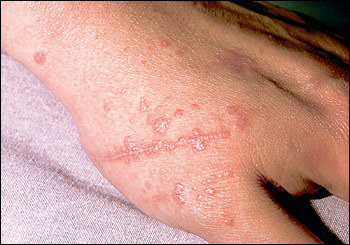
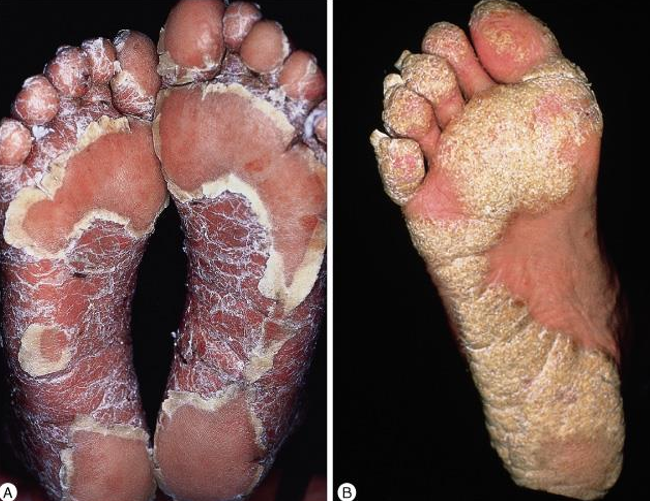
What is this

A

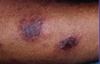
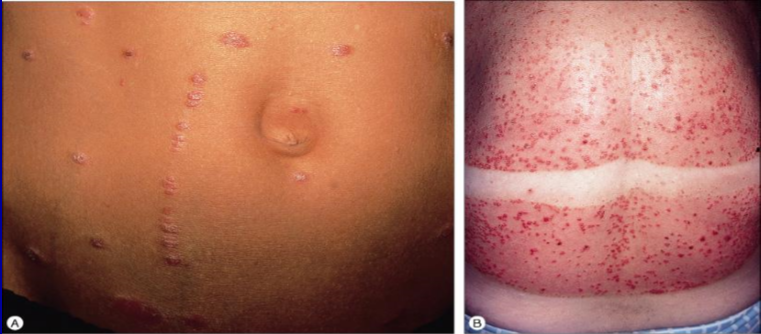
Koebners phenomenom - is the appearance of skin lesions on lines of trauma and is a cause of psoriasis

3
Q

Most common type of psoriasis

A

Psoriasis vulgaris

4
Q

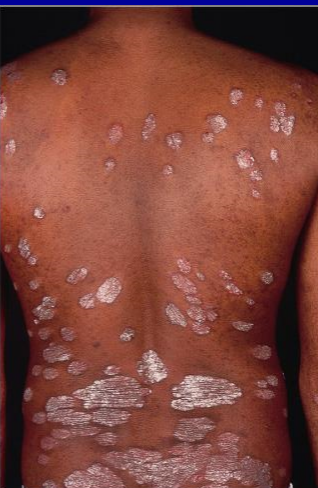
What condition is this

A

Psoriasis Vulgaris

Characteristics:

  • Favours extensors, scalp, intertriginous areas, lower back
  • Usually bilateral and symmetrical
5
Q

What condition is this?

A

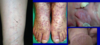
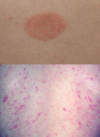
Psoriasis

6
Q

What condition is this and what infection does it usually follow
A

Guttate Psoriasis

Streptococcal infection

Characteristics:

  • Acute
  • Responds to uv light
7
Q

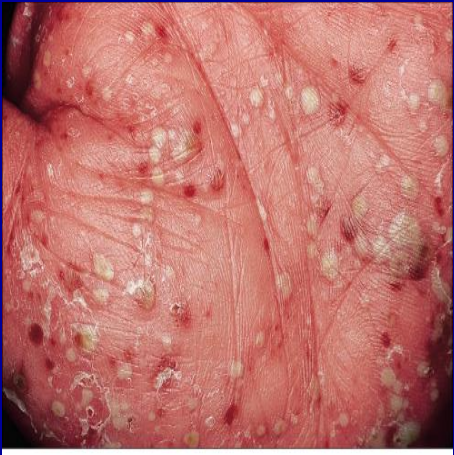
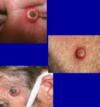
What is this

A

Pustular psoriasis

8
Q

Treatment of pustular psoriasis

A

Usually quite difficult to treat

  1. Steroids
  2. PUVA
  3. Acitretin (retinoid)
  4. Calcipotriol (acts like vitamin D - is antiproliferative, reducing the abnormal proliferation of keratinocytes that occurs in psoriasis, and it induces cell differentiation, normalising epidermal growth)
9
Q

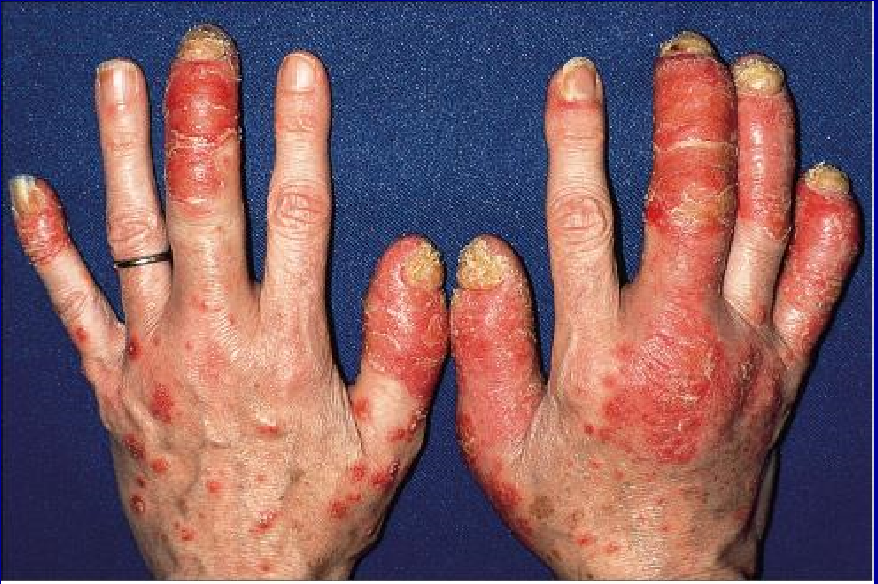
What is this

A

Psoriatic arthropathy

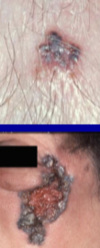
10
Q

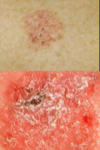
First line treatment for Psoriasis

A

Emollients - reduces scales

2nd line: Topical e.g. Vit d analogues like calcipotriol or topical corticosteroids

3rd line: if severe give immunosuppresants e.g. methotrexate/ciclosporin

Or

Retinoids e.g. acretentin

OR

UVB phototherapy

Or anti-tnfs e.g. infliximab

11
Q

Eczema/Dermititis characteristics

A

pruritic (itchy), redness, papulation (raised area of skin)

12
Q

Atopic dermatitis is an x mediated inflammatory response

A

IgE

13
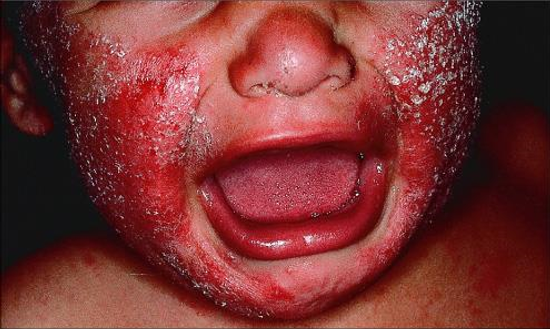
Q
A

Atopic dermatitis

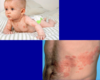
**often starts with face then spreads to trunk and limbs

*usually on flexure surfaces

14
Q

What are the complications of atopic dermatitis

A

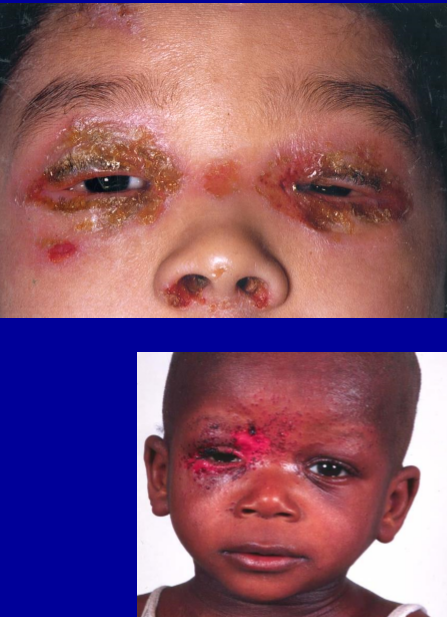
Infection – eg:
• Bacterial – usually Staphylococcal
• Eczema herpeticum
15
Q

Seasonal allergies and/or asthma ora combination are common in patients with

A

Atopic dermatitis

16
Q

Treatment of Atopic dermatitis

A
  1. Advice to stay away from triggers

+ Emollients (reduce dryness: mainstay of treatment: used 3-8 times per day)

  1. Can add steroids if flare-up e.g hydrocortisone
17
Q

Pathophysiology of atopic dermatitis

A

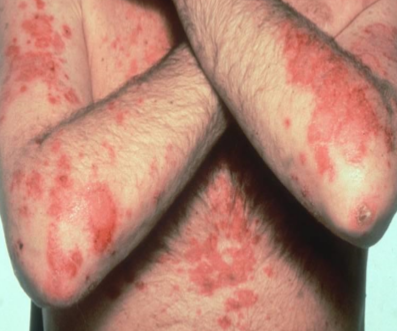
Chronic relapsing inflammatory itchy skin condition

  • as a result of impaired skin barrier - leads to excess water loss through the skin
  • usualyl flexural i.e. politeal and antecubital fossa - exception in kids
18
Q
A

Psoriasis

19
Q

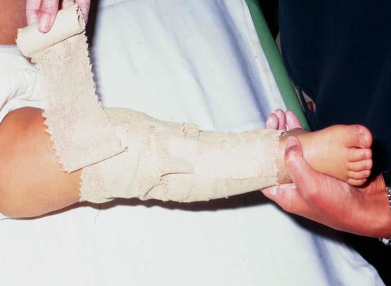
Paste bandaging can help with x in atopic dermatitis

A

Symptom control (particularly children)
20
Q

Contact dermititis is majority:

1) immunological (allergic)
2) toxic (irritant)

Please give examples

A

Irritant (80%) e.g. irritating substances e.g. detergents, acids, oils and sometimes water (strip skin off natural oils)

21
Q

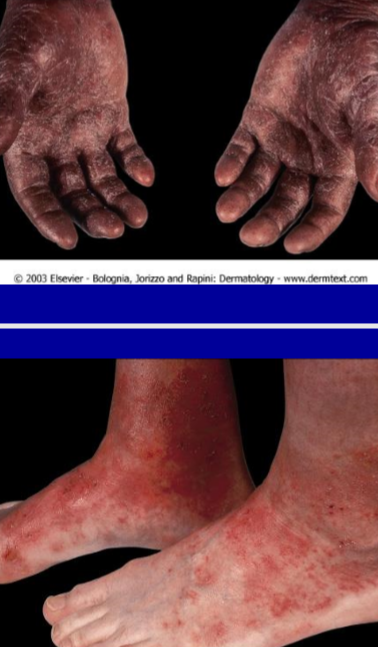
Allergic dermatitis is a type x hypersensitivity reaction

A

4 delayed

  • Needs prior sensitisation to the chemical examples include nickel, rubber , metals, cosmetics, nail varnish or dyes
  • Recurs with each subsequent exposure to antigen
22
Q
A

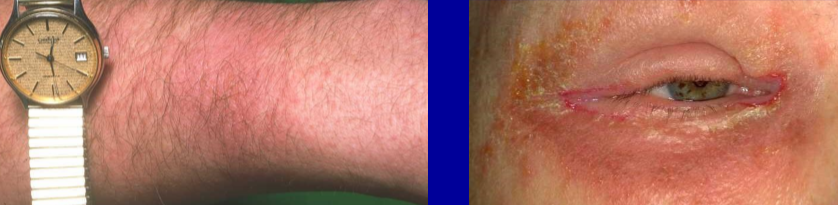
Contact dermatitis (specifically irritant dermatitis)
23
Q
A

Contact dermatitis

24
Q

How to test for allergic contact dermatitis

A

Patch testing
25
Treatment of contact dermatitis
Advise to avoid allergens/irritants (8-12 weeks before improvement seen) 1. Liberal emollient and soaps to maintain skin hydration + improve barrier repair 2. Consider Topical steroids to control symptoms
26
what is pompholyx eczema
Tiny blisters restricted to palms and soles • Intensely itchy Treatment: 1. with emollients and topical steroids
27
Seborrheic dermatitis Characteristics: * greasy/yellow sacle +/- erythema * Typically in men around scalp, nasal-facial creases and beard
28
Treatment of seborrheic dermatitis affecting scupl and beard
Ketoconazole 2% shampoo - 2 x/7 for 4 weeks then once every 1-2 weeks for maintenance)
29
Varicose eczema
30
Discoid eczema - coin shaped lesions often on legs
31
Lichen (small bumps) planus (flat) Characteristics: 1. Itchy and papular eruption with occasional blistering 2. • Affects skin, mucous membranes, nails and scalp 3. • More common in women 4. Oral LP\> cutaneous LP
32
Treatment of lichen planus
Not always needed - usually resolves in 1-2 years * Topical steroids (1st line for oral LP) or can give Tacrolimus ointment (anti-inflammatory) * Systemic – Steroids – Retinoids (diff cases) – PUVA (severe and more widespread)
33
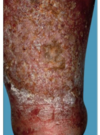
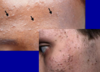
This patient presented with this asymptomatic rash. It started a week earlier with this lesion (herald patch) • Name the lesion and the subsequent rash
Pityriasis Rosea * Lesions follow lines of the dermatomes – ‘Christmas tree distribution * usually symmetrical (on trunnk or plantar skin surfaces
34
Comedonal acne
35
Treatment for Acne
* Mild to moderate: Topical therapies e.g. benzoyl peroxide or azelic acid + topical abx e.g. clindamycin * Mod-severe: consider adding oral antibiotics e.g. doxycycline for a max of 3 months * Review after 8 weeks then every 3-4 months \*\*Maintenance is usually with topical retinoids (1st line)\*\*
36
What is this and its conmmon cause
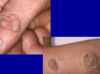
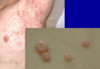
Viral wart Human papilloma Virus (HPV)
37
Common treatment for verrucas/warts
salicylic acid, and/or cryotherapy
38
Differentiating rosacea from Acne vulgaris
Rosacea has other symptoms such as visible dilated blood vessels. bumps may appear inflammed/ blood shot eyes
39
Acne vulgaris clinical features
* comedones e.g. blackheads/ white heads * Inflammatory lesions e.g. papules/postules \<5mm in diameter * Soborrhoe
40
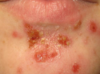
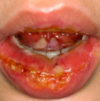
Strep skin infection - streptoco impetigo
41
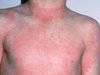
Scarlet fever presentation
* Strawberry tongue * fever * Nause/vomiting * widespread pink/red rash on abdomen, sides of chest and skin folds
42
1. chicken pox 2. shingles \*\*blistering rash cause by herpes simplex Virus
43
Treatment of scarlet fever
antibiotics: * Pencillin/azithromycin if allergiv for a full 10 days
44
Treatment of chicken pox
1. advise adequate fluid intake , first 2 days is most infectious so avoid contact with pregnant women & until crusting over 1. simple analgesia 3. consider aciclivor if pt presents within 24 hrs
45
Molluscum contagiosum
46
infection of dermis and subcutaneous tissue associated with pain/signs of inflammation and either strep or staphy infection
Cellulitis
47
Treatment of cellulitis/erysipelas
antibiotics e.g. flucloxallin/benzyl penicillin - if allergic then erythromycin
48
SLE due to malar flush and vasiculitis \*others include:Raynauds phenomenom (chaging of skin colour in cold) and photsensitivity

49
What blood test would u do to confirm SLE
Anti-nuclear antibodies
50
Toxic epidermal necrolysis
51
Stevenson-johnson syndrome
52
Actinic keratosis \* caused by damage due to prolonged sun exposure \* 10% chance of progressing to cancer

53
Treatment of actinic keratosis
1. Liquid nitrogen cryotherapy 2. Topical therapies e.g 5-FU (Efudex) or Imiquimod (Aldara) to be used 3-5 times a week for 6-8 weeks 3. Curettage for hypertrophic lesions
54
Dyspastic nevi \*\*precursors/markers of melanoma \*\* diagnosed histologically and excised
55
Risk factors for developing skin cancer
Fair skin (Fitzpatrick’s types I-III) – Blue eyes – Red hair • Family history – Genetic syndromes • Chronic sun exposure/ tanning bed • Old age • Chemical exposure (arsenic)
56
Most common skin cancer
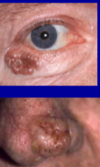
Basal cell carcinoma (80%) - 4 x more frequent than SCC \*\* rarely metastasizes
57
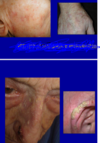
Nodular BCC * Chronic lesion * easy bleeding * pearly white shaped dome * surface talengiectasias *
58
pigmented BCC
59
Superficial BCC
60
morpheaform BCC - resembles scar
61
Treatment of BCC
* small + low risk lesions: topical therapy e.g. imiquimod * Radiotherapy if surgical excision appropriate * Electrosurgery * For high risk + recurrent = mohs surgery(progressive lesion excision of tissue borders until specimens are free from tumor)
62
Keratoacanthoma
63
invasive SCC
64
Bowens disease
65
Treatment of SCC
-Efudex or aldara – Liquid nitrogen cryotherapy – Radiation therapy – Electrosurgery – Surgical excision • Mohs Surgery
66
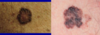
Features of malignant melanoma
1. assymetry 2. poor borders 3. multicoloured 4. Large diameter 5. Evolving size
67
Prognostic features of melanoma is done via the
Looking at the breslow thickness