___________________ techniques include tables, frequency distributions, frequency polygons, measures of central tendency, and measures of variability.
Descriptive.
When using a frequency polygon, scores are recorded on the _______________ axis (abscissa), while frequencies are coded on the _________________ axis (ordinate).
- Horizontal
- Vertical
_______________ refers to the relative peakedness of a distribution;
- _______________: Distribution is MORE peaked than normal
- _______________: Distribution is LESS peaked than normal
- _______________: Distribution is normal
- Kurtosis
- Leptokurtic
- Platykurtic
- Mesokurtic
__________________ skewed distribution: Most of the scores are in the negative (low score) side of the distribution.
Positively.
______________________ skewed distribution: Most of the scores are in the positive (high score) side of the distribution.
Negatively.
Note: “The tail that tells the tale.”
Measures of Central Tendency:
- ______________: The score or category that occurs most frequently; can have more than one; is susceptible to sampling fluctuations
- ______________: Divides a distribution in half when the data have been ordered from low to high; is insensitive to outliers
- ______________: (M or X-bar) the arithmetic average (M=ΣX/N); least susceptible to sampling fluctuations, but is affected by the magnitude of every score in the distribution
- Mode
- Median
- Mean
The ________________ is the preferred measure of central tendency when the data is on an ordinal scale; the _________________ is preferred for interval and ratio scales.
- Median
- Mean
Measure of Central Tendency (from greatest to least) for skewed distributions:
- ________________ skewed: Mean, Median, Mode
- ________________ skewed: Mode, Median, Mean
- Positively
- Negatively
________________ is calculated by subtracting the lowest score in the distribution from the highest score.
Range.
Variance is calculated using the following formula:
S2 (Variance) = SS = Σ(X-M)2
N-1 N-1
Where:
- SS = the _________________, which is calculated by subtracting the mean from each score to obtain deviation scores, squaring each deviation score, and then summing the squared deviation scores
- N-1 = the _______________ minus 1 (when calculating sample variance; N when calculating population variance)
- Sum of Squares
- Number of observations
The ____________________ is more often used as a measure of variability, and is calculated by taking the square root of the variance, which converts it to the same unit of measurement as the original scores:
S = Square Root (SS/N-1)
Standard Deviation.
Identify the Areas Under the Normal Curve:
- 1 to +1 SD: ___________%
- 2 to +2 SD: __________%
- 3 to +3 SD: __________%
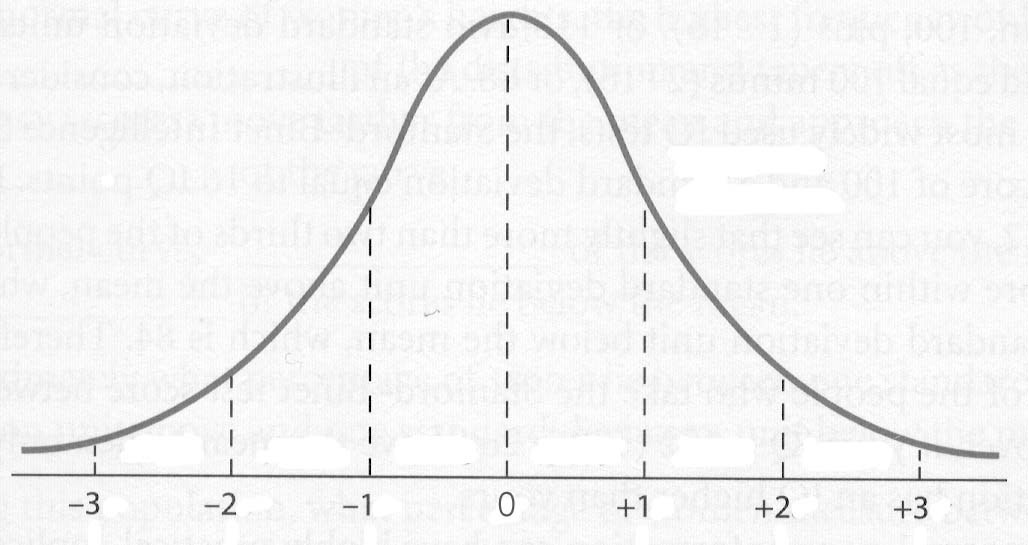
- 68.26%
- 95.44%
- 99.72%
When a constant is added/subtracted to every score in a distribution, the measures of __________________ change, but the measures of _______________ do not. However, when each score is multiplied or divided by a constant, measures of both central tendency and variability are affected.
- Central tendency
- Variability




