When does a patient need to start dialysis?
When the risks of uremic complications exceed the risks of dialysis therapy.
What are possible indications for dialysis?
- Volume overload refractory to diuretics
- Hyperkalemia refractory to medical therapy
- Uremic pericarditis
- Uremic symptoms
- Lethargy, difficulty concentrating (early)
- Coma, seizures (late)
- Nausea, decreased appetite
- Uremic bleeding
- Other metabolic derangements (metabolic acidosis, severe hyperphosphatemia, calcium abnormalities)
What form of dialysis is most common?
Hemodialysis (greater than 90% of patients)
Dialysis vascular access ideally has what characteristics? (6)
- Provides fast blood flow
- Allows repeated access
- Can be used immediately
- Has low infection rate
- Has long lifespan
- Doesn’t cause morbidity
What is an AV fistula?
A surgically placed access which connects a native artery to a native vein. When this happens, the vein gets thicker so that it can withstand being stuck many times. Also, this provides a fast blood flow for the dialysis.
This is typically done on the non-dominant arm.
What are pros for using AV fistula for hemodialysis? (3)
- Lowest infection rate
- longest lifespan
- requires fewest procedures to maintain
What are the cons for using AV fistula for hemodialysis? (4)
- Can take months to mature
- some may never be usable for dialysis
- risk of steal syndrome
- needles
What are 3 typical locations for AV fistulas?
- Radiocephalic
- Brachiocephalic
- Brachiobasilic
What is an AV graft?
Synthetic conduit between artery and vein.
What are pros for AV grafts? (3)
- can be used quicker than AV fistula
- Good blood flows
- lower infection rate than catheters (but higher than AVFs)
What are cons for AV grafts (4)
- High rate of stenosis, requiring interventional procedures
- Shorter life span than AV fistula
- Risk of steal syndrome
- Needles
What is a dialysis catheter?
This is a double lumen catheter that is typically placed in the internal jugular vein and terminates in the SVC.
What are the pros for dialysis catheters? (3)
- Immediate use
- No needles
- Does not require surgery
What are the cons for dialysis catheters? (4)
- Highest infection risk
- High rate of dysfuncion/low blood flows
- Requires insertion site care
- Associated with high mortality in dialysis patients
What are complications of dialysis that can happen during treatment? (5)
- Muscle cramps
- Hypotension
- Headache
- Chest pain
- Air embolism (very rare)
What bacteria most commonly causes dialysis infection?
Staph aureus (or other skin organisms)
What are some limitations of dialysis?
- Difficulty achieving euvolemia
- During in-center hemodialysis treatments, it may be difficult to remove enough volume to achieve “dry weight”
- Abnormal bone and mineral disorders
- Despite regular dialysis, most patients will still exhibit hyperphosphatemia and require oral phosphorous binders.
What are pros and cons for doing frequent or nocturnal dialysis?
Pros
- It can be performed at home
- longer total dialysis time per week
- improved blood pressure/left ventricular hypertrophy
- improved phosphorous control
Cons
- Associated with a higher risk of vascular access complications
What is peritoneal dialysis?
Catheter is placed into peritoneal cavity and exits the abdominal wall. Fluid with a high glucose concentration is instilled in the peritoneal cavity. Water moves into the peritoneal cavity by osmosis and uremic solutes are removed by convection. Patients perform at least 3-4 exchanges per day.
This is usually done at home every day.
It’s common in other countries but not as much in the US (8% of cases)
What is continuous ambulatory peritoneal dialysis (CAPD)?
It’s the type of peritoneal dialysis where the patient manually performs exchanges
What is continuous cycling peritoneal dialysis (CCPD)?
It’s the type of peritoneal dialysis where a cycler machine performs exchanges at night when the patient is sleeping and leaves dialysate in the abdomen in the morning.
What is nocturnal intermittent peritoneal dialysis (NIPD)?
It is the type of peritoneal dialysis where a cycler performs dialysis overnight but does not leave dialysate in the abdomen in the morning.
What are complications for peritoneal dialysis?
- Infection
- peritonitis (PMNs in dialysate, abdominal pain, fever)
- Due to both gram positive and negative organisms
- Exit site infections (purulence and pain at exit site)
- peritonitis (PMNs in dialysate, abdominal pain, fever)
- Catheter dysfunction/problems draining
- may be due to constipation
- may need surgical revision
- Hernias
- Metabolic complications
- Hyperglycema (because you are giving a high dextrose solution)
- Hypertriglyceridemia
- Hypokalemia
- Scarring of the peritoneal membrane
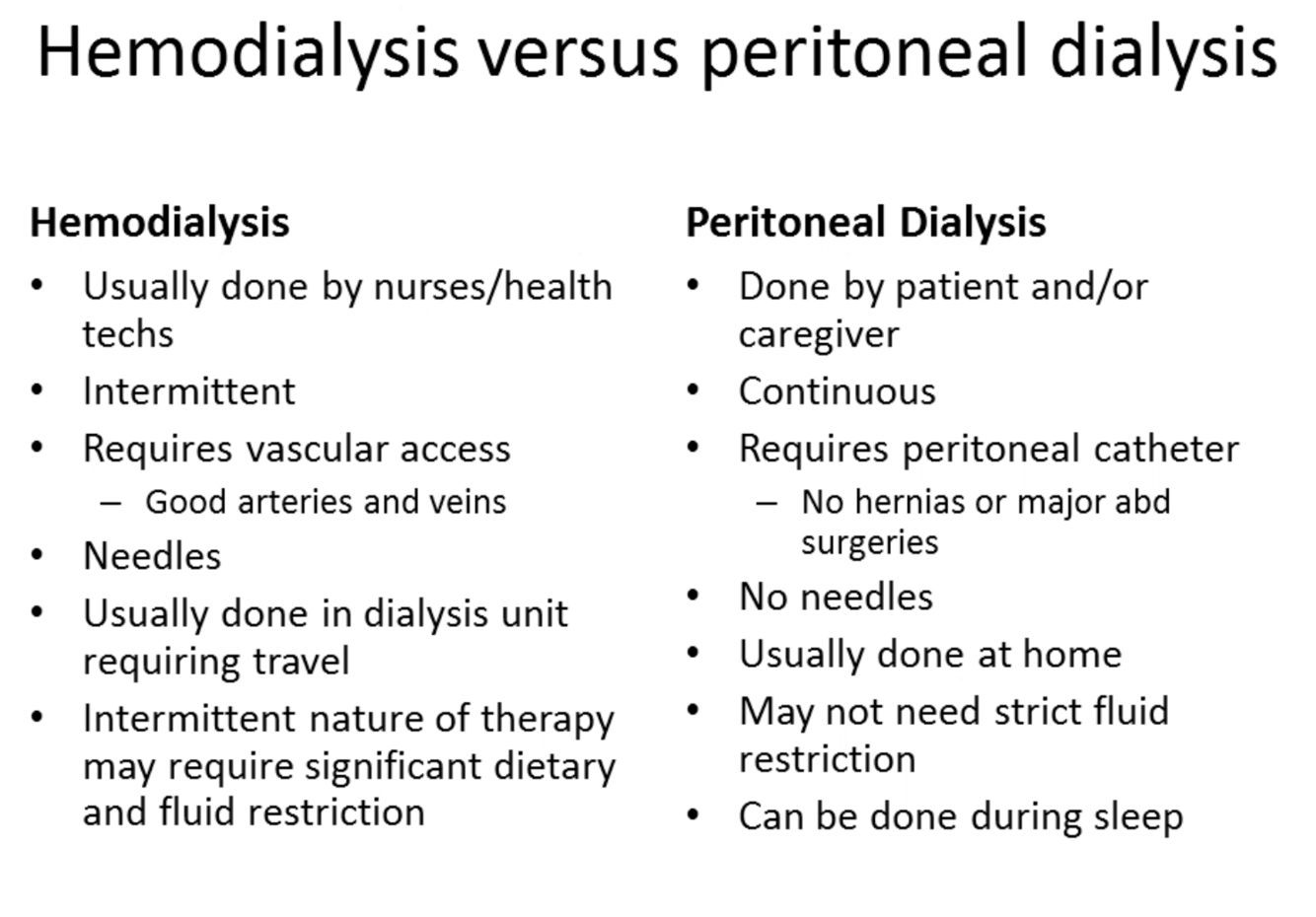
Compare and contrast hemodialysis vs peritoneal dialysis

-
Overview of Renal Physiology55
-
Glomerular Filtration & Renal Blood Flow27
-
Histology of the Kidney11
-
Tubular Transport of NaCl and Water54
-
Kidney Microanatomy20
-
Regulation of Extracellular Sodium & Water61
-
Suicide22
-
Intro to Acute Renal Failure and Clearance89
-
Nephrotic Syndrome65
-
Glomerulonephritis60
-
Pathology of Nephritic Syndrome44
-
Nephrotic Syndrome Pathology31
-
Urinalysis40
-
Pathophysiology of Water Handling43
-
Pathophysiology of Sodium Handling35
-
Renal Regulation of ECF Potassium13
-
Diseases of Potassium Regulation21
-
Water Handling (Small Group)6
-
Hypertension15
-
Secondary Causes of Hypertension10
-
Sodium Handling (Small Group)8
-
Role of the Kidneys in Acid/Base Balance44
-
Acid/Base Disorders20
-
Potassium Regulation & Hypertension Cases (Small Group)5
-
Diuretics and Anti-hypertensives48
-
Acid-Base Cases (Small Group)2
-
Chronic Renal Disease40
-
Dialysis24
-
Transplant13
-
Pharmacology Issues in Renal Failure10
-
Urinary Tract Infection/Interstitial Disease36
-
Tumors of the Kidney & Urinary Tract19
-
Bladder & Micturition30
-
Development of the Kidney22
-
Developmental and Cystic Diseases26
-
Pediatric Kidney & Urinary Tract31



