What are the 2 parts of the enteric nervous system?
- Myenteric (Auerbach’s) plexus: Located in muscularis externa.
- Submucosal (Meissner’s) plexus: Located in the submucosa.
What are the neurones in the ENS?
- Sensory (afferent) neurones: Detects mechanical/chemical stimuli in the lumen of the GI tract.
- Interneurones: Relays information from sensory to motor neurones.
- Secretomotor (efferent) neurones: Stimulate wide range of effectors such as smooth muscle, glands, blood vessels…
What is the clinical significance of the ENS?
- The ENS allows the digestive system to be functionally independent from the CNS.
- This allows bowel transplantation to occur.
What are the general effects of sympathetic stimulation in the GI tract?
- Usually inhibits digestion.
- Decreases gut motility.
- Decreases secretion.
- Decreases blood supply.
- Causes sphincter constriction.
What are the general effects of parasympathetic stimulation on the GI tract?
- Usually promotes digestion.
- Increases gut motility.
- Increases gut secretion.
- Causes sphincter relaxation.
What are the main neurotransmitters used in ENS communication?
- Acetylcholine (ACh): Causes smooth muscle contraction and stimulates glandular secretion.
- Nitric oxide: Relaxes smooth muscles.
- Vasoactive intestinal peptide (VIP): Relaxes smooth muscle and stimulates glandular secretion.
- Noradrenaline (NAd): Released by sympathetic neurones and have the effect of causing sphincter & vascular smooth muscle contraction.
What are some additional NTs used by the ENS?
- Enkephalins
- Somatostatins
- Substance P
- ATP
- CGRP (Calcitonin gene related peptide)
What are the types of proteins present in saliva?
- α-amylase
- Glycoproteins
- Proline-rich proteins
What are the types of saliva?
- Serous: Secreted by parotid glands
- Seromucous: Secreted by subinguinal & submandibular glands
- Mucous: Secreted by minor salivary glands in the submucosa of the oral cavity
What are the functions of saliva?
- Lubrication: Glycoproteins called mucins in saliva produced by mucous-secreting cells aid in lubrication of food. This facilitates taste, speech and swallowing.
- Defence: Lysosomes break down bacterial cells. Lactoferrin sequesters free Fe ions needed for bacterial growth. Proline-rich proteins neutralise plant tannins.
- Buffering: HCO3- in saliva helps neutralise acidic foods in order to protect teeth.
- Digestion: Salivary amylase (α-amylase) breaks down starch. Protected by bolus from the acidic environment of the stomach so that it continues to be active inside the bolus. It can digest up to 75% of ingested starch.
- Thermoregulation: Evaporation of saliva can be used to remove heat.
What is the process of salivary secretion?
- Active transport of Na+ out of the acinar cells by Na+/K+-ATPase creates high [Na+] in ECF, which facilitates secondary active transport of Cl- ions into the cytoplasm of acinar cells through NKCC1 transporters (in ratio of Na+-2Cl—K+).
- Diffusion of Cl- out of cell through channels into the secretory duct lumen results in accumulation of Cl- in the lumen. –ve charge in lumen results in paracellular diffusion of Na+ into the lumen, followed by water. Acinar cells also secrete proteins into the lumen. This produces primary secretion, which is isotonic to plasma.
- Primary secretion is modified by salivary duct cells. Cl- is exchanged for HCO3- and Na+ is exchanged for K+. Salivary duct cells also secrete some proteins into the lumen, such as EGF and nerve growth factor.
- Reabsorption of NaCl by the salivary duct cells exceeds secretion of HCO3- and K+. Watertight junctions between the salivary duct cells mean that the duct walls are impermeable to water. This results in hypotonic saliva being produced.
- Secretion of saliva is mainly driven by bulk flow, but is aided by the contraction of myoepithelial cells in the salivary ducts.
What happens to the composition of saliva as flow rates increase?
Saliva becomes more isotonic with a greater NaCl content because transporters in salivary ducts don’t have enough time to absorb sufficient amounts of NaCl.
What are the roles of the parasympathetic nervous system in the control of salivation?
- PNS stimulation involves the release of ACh/VIP.
Effects include:
- Vasodilation/increased blood supply to salivary glands.
- Promotes growth of salivary glands.
- Open more channels in acinar cells to promote secretion of saliva.
- Stimulates salivation at sight/smell of food as part of feed-forward response.
What are the roles of the sympathetic nervous system in the control of salivation?
- SNS stimulation involves the release of NAd.
- Effects are:
1. Vasoconstriction/decreased blood supply to salivary glands.
2. Stimulates contraction of myoepithelial cells.
3. Stimulates exocytosis in acinar cells, promoting protein secretion.
What are slow waves?
Periodic depolarisations of the gut smooth muscle with amplitudes of 10-50 mV.
What are the differences between slow waves and APs?
- Unlike APs, slow waves do not depolarise beyond 0 mV.
- Unlike APs, the time course of one wave is in the magnitude of seconds, not milliseconds.
Which cells are responsible for producing slow waves?
Interstitial cells of Cajal (ICCs)
How is the amplitude of slow waves increased?
- Increased Ca2+ release from internal stores.
- Increased number of open plasma membrane Ca2+ channels.
How is the amplitude of slow waves decreased?
Opening of hyperpolarising PM K+ channels.
What is segmentation?
Contraction of smooth muscle in alternating segments of the gut aid in the mixing of food.
What causes segmentation?
Slow waves (with modifying nervous and hormonal inputs)
What are the effects of nervous inputs on segmentation?
- Sympathetic stimulation inhibits segmentation.
- Parasympathetic stimulation promotes segmentation.
What is the peristaltic reflex?
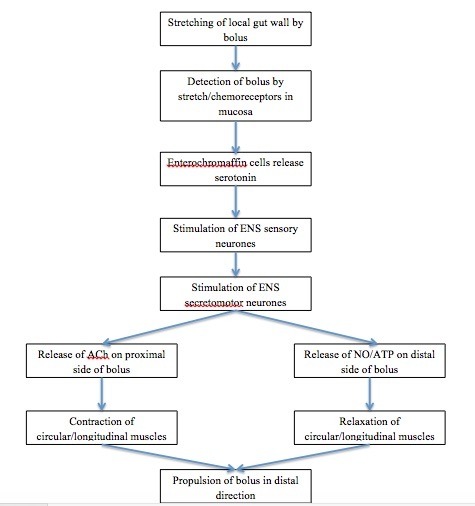
What are the 3 types of sensory neurones associated with the GI tract?
- Intrinsic primary afferent neurones (IPANs)
- Vagal sensory neurones
- Intestinofugal afferent neurones (IFANs)

-
Respiration128
-
Spirometry measurements11
-
Ion channels and inhibitors8
-
Synapses and ion channels51
-
Muscles91
-
Cardiovascular system159
-
Practicals (michaelmas)35
-
Practicals (lent and easter)22
-
Physiological constants (lent)29
-
Digestion109
-
Hormones of digestion7
-
Renal physiology and body fluid homeostasis (part 2)61
-
Renal physiology and body fluid homeostasis (part 1)63
-
Physiological constants (michaelmas)12
-
Physiological constants (easter)10



