What are the 4 main types of dizziness (sensation, temporal characteristics, simulation tests, and differential diagnosis).
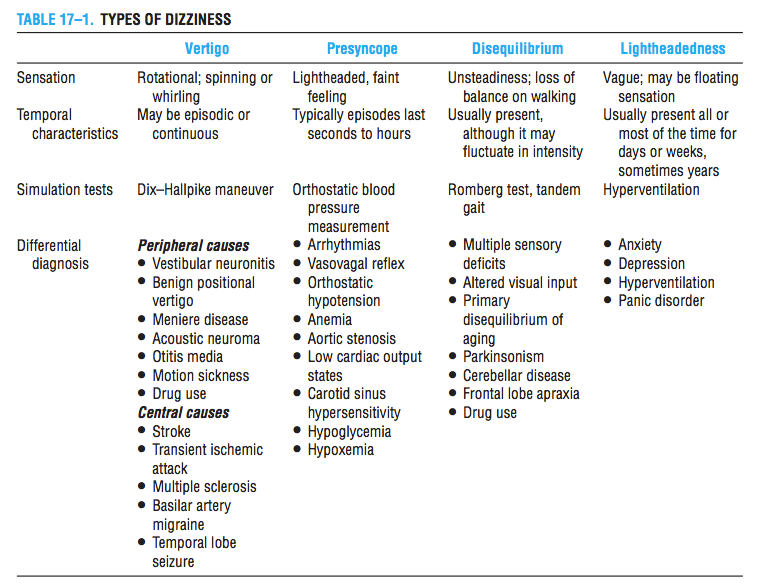
What is important to determine when a patient complains of being dizzy?
- Describe it without the word “dizzy” or “lightheaded”
What is important to determine for all episodes of dizziness on history?
- Time course of episodes – acute vs chronic vs recurrent
- Constant vs Episodic
- Duration of warning
- How long have the symptoms been experienced
- Are things getting worse
- Triggers/Relief
- Assess for medication complications
- Associated focal neurologic findings – CN findings
- Nausea/Vomiting and how severe (less with Central)
- Recent viral illness
- Prodromal leading to headache – Migraine?
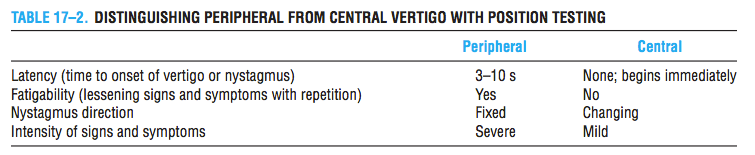
What are 4 ways to differentiate central from peripheral vertigo?
What are 6 causes of central vertigo?
- Vascular ischemia: TIA
- Vascular ischemia: Stroke
- Vertiginous migraine
- Cerebellar degeneration
- Cerebellar tumour
- Multiple sclerosis
What are 3 symptoms commonly associated with vertigo?
- Aural fullness
- Tinnitus
- Hearing loss
Can vertigo be a symptom of a stroke?
- Yes – Inner Ear (in theory)
What are 5 causes of peripheral vertigo, how long does a vertigo episode typically last for each, are there auditory symptoms, and how common are they?
Disorder
Duration
Auditory
Prevalence
BPPV
Seconds
No
Common
Meniere’s disease
Hours
Yes
Common
Labyrinthitis
Days
Yes
Common
Vestibular Neuronitis
Days
No
Common
Acoustic neuroma
Months
Yes
Uncommon
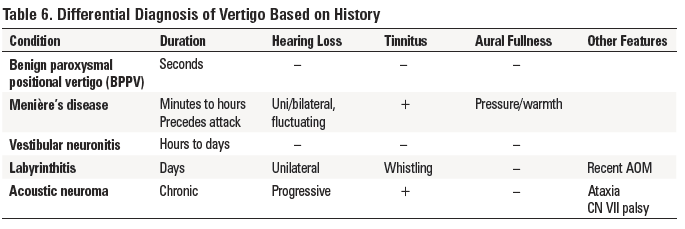
What is a distinguishing feature between Neuronitis and Labyrinthitis
- Neuronitis = No Hearing Loss
- Labyrinthitis = Hearing Loss
Which of Neuronitis and Labyrinthitis is a medical emergency?
- Labyrinthitis – meningitis precursor
What are 4 symptoms seen in Meniere’s disease?
- Vertigo – disappears with time (minutes to hours)
- Hearing loss – persists and later can progress
- Tinnitus
- Aural fullness
What is the diagnostic criteria for Meniere’s disease? (TN)
- Must have ALL 3
- Two spontaneous episodes of rotational vertigo 20 minutes
- Audiometric confirmation of SNHL (often low frequency)
- Tinnitus and/or aural fullness
Differentiate between vestibular neuronitis and labyrinthitis. (TN)
- Vestibular neuronitis: acute onset of disabling vertigo
- May be due to viral infection (30% of cases have associated URTI symptoms)
- Labyrinthitis: acute infection of the inner ear resulting in vertigo and hearing loss
- May be serous (viral) or purulent (bacterial)
- Complication of acute and chronic OM, bacterial meningitis, cholesteatoma, and temporal bone fractures
How do vestibular neuronitis and labyrinthitis present? (TN)
- Vestibular Neuronitis
- Acute phase
- Severe vertigo with nausea, vomiting, and imbalance lasting 1 to 5 days
- Irritate nystagmus (fast phase towards the offending ear)
- Patient tends to veer towards affected side
- Convalescent phase
- Imbalance and motion sickness lasting days to weeks
- Spontaneous nystagmus away from affected side
- Gradual vestibular adaptation requires weeks to months
- Acute phase
- Labyrinthitis
- Sudden onset of vertigo, nausea, vomiting, tinnitus, and unilateral hearing loss, with no associated fever or pain
- Meningitis is a serious complication
What investigations should be considered in a patient with labyrinthitis (but not vestibular neuronitis)? (TN)
- CT head
- If meningitis suspected: lumbar puncture, blood cultures
What is an acoustic neuroma? (TN)
- Vestibular schwannoma of the vestibular portion of CN VIII
What is unilateral tinnitus or SNHL in the elderly until proven otherwise? (TN)
- Acoustic neuroma
How is an acoustic neuroma diagnosed? (TN)
- MRI with gadolinium contrast (gold standard)
What should be asked on history in a patient presenting with dizziness?
- Presyncope
- CP, SOB, palpitations
- With standing
- Disequilibrium
- Is the dizziness in your legs or in your head?
- Recent falls
- Prior neurologic disease (stroke, Parkinson’s, diabetes)
- Medications
- May not find any specific cause
- In elderly population is a multifactorial problem
- Lightheaded
- Floating sensation
- Psychiatric illness
- Mood, Anxiety
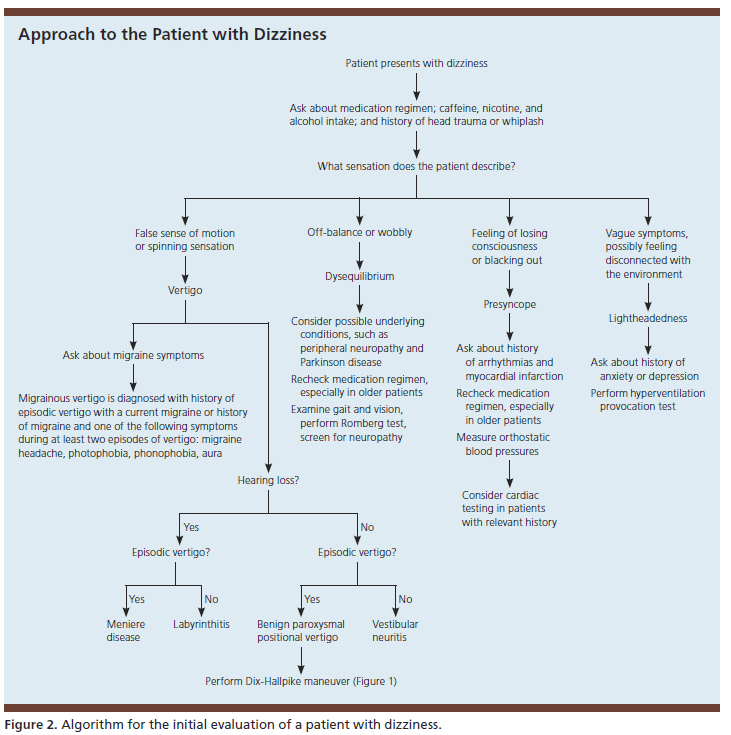
What should be performed on the physical exam in a patient presenting with vertigo?
- Dix-Hallpike – suggestive of BPPV
- Geotropic (upbeat) nystagmus after 5 seconds, goes away within 1 min
- Rare is to have horizontal nystagmus
- Geotropic (upbeat) nystagmus after 5 seconds, goes away within 1 min
- Otoscopy
- Complete neurologic exam for focal signs
- HINTS Exam – if any of 3 is suggest central vertigo then need to rule out stroke
- To INFARCT – Impulse Normal; Fast-phase Alternating; Refixation on Cover Test
- Applicable to Acute Vestibular Syndromes – some require vertigo >24h
- Rapid onset (over seconds to hours) of continuous vertigo, nausea/vomiting, and gait unsteadiness in association with head-motion intolerance and nystagmus lasting days to weeks
- More specific for central vertigo than early diffusion weighted MRI
- Head Impulse – tests VOR by quickly turning head while patient fixated
- Central can fixate – normal exam
- Peripheral with saccade back
- Will often only be with impulse to one side (diagnostic to that side and have fast beat nystagmus to the opposite side)
- Nystagmus
- Central – can look exactly like peripheral
- Changing direction, gaze-evoked, or unidirectional
- Horizontal, vertical or torsional
- Jerk or Pendular (no fast phase, just back and forth – often congenital)
- Peripheral – eyes drift to the sick eye and fast saccade back
- Unidirectional, worse with looking towards fast phase
- i.e. worse looking left with left beating nystagmus, when looking right, it can appear to disappear
- Horizontal/torsional only
- Jerk only
- Suppression with fixation
- Unidirectional, worse with looking towards fast phase
- Central – can look exactly like peripheral
- Test of Skew – cover and uncover alternating eyes as fixated
- Central cause – Vertical misalignment of eyes when not fixated
- The test shows eyes that must realign with uncovering (like testing for strabismus)
What should be performed on the physical exam in a patient presenting with presyncope?
- Orthostatic BP and HR
- Primary – multiple system atrophy, pure autonomic failure, Parkinson’s
- Secondary – volume depletion, medications, alcohol, diabetes neuropathy
- Cardiac exam or AS murmur
- If true hypotensive
- Exclude MI, AAA, Sepsis, GI bleeds, etc.
What should be performed on the physical exam in a patient presenting with imbalance?
- Assess motor, sensory and gait
- Romberg: stand with hands out, close eyes
- Require 2/3: proprioception, vestibular function or sight to remain still
- Pull-Back test: postural instability in parkinsonism
What should be performed on the physical exam in a patient presenting with lightheadedness?
- Can have them hyperventilate for 3 minutes into paper towel 6 inches away
What investigations should be considered in a patient presenting with vertigo?
- None if likely benign peripheral
- MRI if Meniere’s to rule out neuroma (cerebellarpontine angle tumor)
- Also get audiogram
- CT/MRI if considering Central
- Signs of symptoms of central vertigo
- A history of trauma
- Signs, symptoms, or other reasons (e.g. anticoagulation) to suspect a possible serious underlying cause






