What are 6 common differentials for dizziness?
- Benign paroxysmal positional vertigo (BPPV)
- Vestibular neuritis
- Labyrinthitis
- Meniere’s disease
- Vestibular migraine
- Syncope or pre-syncope
What is the difference in aetiology between vestibular neuritis and labyrinthitis?
Vestibular neuritis = inflammation of the vestibular nerve, while labyrinthitis = inflammation of the inner ear structures i.e. semicircular canals and cochlea
What are 5 rare/ urgent causes of dizziness?
- Cholesteatoma
- Vestibular schwannoma
- Central vertigo: cerebellar stroke or cervical artery dissection
- Cardiovascular disease (if syncope + chest pain)
- Multiple sclerosis
What are 11 key things to ask in the history for a symptom of ‘dizziness’?
- Differentiate between dizziness and vertigo: vertigo= rotatory sensation
- Determine whether vertigo better with eyes open or closed. If does not decrease with visual fixation, suggests central origin
- Determine duration - seconds, minutes to hours, hours to days
- Positional triggers - BPPV (head movement), getting up quickly (orthostatic hypotension, syncope)
- Tinnitus
- Hearing loss
- Otalgia - otitis media
- Nausea and vomiting
- How did episodes begin - preceding URTI, barotrauma
- Cardiac symptoms: chest pain, dyspnoea
- Migraine features: aura, visual disturbance, photophobia, phonophobia, ± headaches
What should physical examination involve for a dizziness symptoms?
- Inspect ear
- Otoscopy
- observe eye for nystagmus/eye movements
- Head impulse test
- Dix-Hallpike
- Supine roll - if suspect BPPV but Dix-Hallpike negative
- CN exam
- Romberg and Unterberger
What is the head impulse test and what does it involve? What do the results mean?
- Useful to differentiate between acute vestibular neuritis and cerebellar stroke in patients with acute vertigo
- Examiner turns head as rapidly as possible 15 degrees to one side and observes patient’s ability to keep fixating on distant target
- If peripheral vestibular lesion, saccade occurs as vestibulo-ocular reflex fails
- If cerebellar stroke has occurred, no catch-up saccade occurs
What does the supine roll test invovle and what do the results mean?
If Dix-Hallpike negative in a patient who has a history suggestive of BPPV, perform this test
Position patient supine with head in neutral position, then rotate head 90 degrees to one side, observing for nystagmus
Head returned to face up, alowing dizziness and nystagmus to subside
then turn rapidly to opposite side
What is the diagnosis of benign paroxysmal positional vertigo (BPPV) based upon?
Suggestive history and physical examination with positive Dix-Hallpike manouevre or positive supine lateral head turn
What are 7 common symptoms of BPPV?
- Vertigo provoked by specific head movements e.g. looking up or bending down, getting up, turning head, rolling over in bed to one side
- Episodic - repeated attacks over days - weeks - months
- Brief episodes, lasting <30s
- Sudden onset
- Nausea
- Imbalance
- Lightheadedness
What are 3 features of BPPV on examination?
- Positive Dix-Hallpike manoeuvre or positive supine lateral head turn
- Normal neurological examination
- Normal otological examination
What is the definition of BPPV?
Disorder of the inner ear characterised by repeated episodes of positional vertigo i.e. symptoms occur with changes in position of the head
What are 5 risk factors for BPPV?
- Head injury
- Prolonged recumbent position e.g. during visit to dentist or hairdresser
- Ear surgery
- Following episode of any inner ear pathology e.g. vestibular neuronitis, labyrinthitis, Meniere’s disease
- Sleep position: people with BPPV more likely to lie on side of affected ear
What are 2 demographic risk factors for BPPV?
- Fifth - seventh decades (40s-60s)
- Women
What is the typical course of BPPV?
Relapsing and remitting course: recovery can occur spontaneously without treatment, but recurrence is common
What are 3 things necessary to diagnose BPPV?
- Confirm history of vertigo: symptoms brough on by specific movements of head (turning over in bed, looking upwards, bending over)
- Dix-Hallpike should be used to demonstrate characteristic BPPV findings
- Other causes considered including Meniere’s, vestibular neuronitis, anxiety disorder
Should imaging be used for BPPV?
not required to confirm diagnosis, unless necessary to exclude another condition (e.g. if atypical nystagmus or additional neurological symptoms)
What are 4 aspects of the management of BPPV?
- Option of watchful waiting (active monitoring) discussed to see if symptoms settle without treatment - explain tx may help resolve more quickly
- If pt presers treatment, particle repositioning manoeuvre e.g. Epley manoeuvre should eb offered and Brandt-Daroff exercises considered
- Symptomatic drug treatment not usually helpful
- Advise to return for follow up in 4 weeks if symptoms have not resolved in case BPPV has been incorrectly diagnosed
What are the exercises that patients can do for BPPV called?
Brandt-Daroff exercises
When should urgent admission to hospital in BPPV be arranged?
If there is severe nausea and vomiting and an inability to tolerate oral fluids
What are 3 types of specialist physicians that you may consider referring a patient with BPPV to if required? What determines who you would refer to?
- ENT specialist
- Audiovestibular specialist physician
- Care of the elderly physician with special interest
Depends on local protocol
What are 6 situations when you may consider referral to a specialist for BPPV?
- if expertise to provide canalith repositioning procedure (e.g. Epley) is not available in primary care
- physical limitations affect safety/practicality of carrying out canalith repositioning procedures in primary care
- canalith repositioning procedure has been performed and repeated and symptoms are still present
- symptoms or signs are atypical
- symptoms and signs have not resolved in 4 weeks
- there have been three or more periods during which person has experienced episodes of vertigo
What are the 2 prevailing pathophysiological mechanisms of BPPV?
- Canalithiasis: free-floating endolymph particles called canaliths migrate into semicircular canals. denser than surrounding fluid so respond to gravity. eventually accumulate and drag downwards, which deflects cupula and stimualtes hair cells, activating vestibulo-ocular reflex
- Cupulolithiasis: dense canalth particles adhere to the cupula (within ampullae of each semicircular canal) causing it to be gravity-sensitive. (Particle repositioning not as effective)
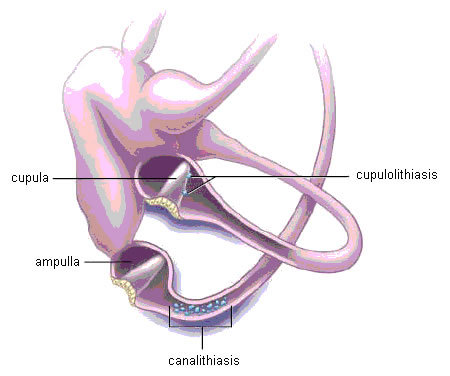
Which cause of BPPV is most common?
Canalithiasis: canaliths (/otoconia, calcium carbonate debris) move into semicircular canals, causing motion in endolymph of inner ear + inducing vertigo
Which semicircular canal is most commonly affected in BPPV?
Posterior semicircular canal: 85-95%


-
Contraception151
-
Hormone Replacement Therapy55
-
Paediatric sepsis31
-
Back pain94
-
Sinusitis43
-
Dizziness90
-
Query COVID22
-
UTI87
-
Gout54
-
Acne33
-
Work and Benefit20
-
Safeguarding15
-
COPD72
-
Osteoporosis85
-
Atrial fibrillation72
-
Headache98
-
Dyspepsia77
-
Depression88
-
Irritable Bowel Syndrome41
-
Chronic Kidney Disease170
-
Constipation67
-
Type 2 Diabetes115
-
Termination of Pregnancy19
-
Haemorrhoids13
-
Statins26
-
Thyroid disease134
-
Benign Prostatic Hypertrophy54
-
Anxiety + insomnia43
-
Eczema & Psoriasis91
-
Type 1 Diabetes137
-
Asthma122
-
Otitis media and externa85
-
Rheumatoid Arthritis86
-
Osteoarthritis52
-
Vaginal thrush34
-
Common STIs79
-
Diarrhoeal illness87
-
Lower respiratory tract infection47
-
Anaemia37
-
Heart Failure89
-
Hypertension103
-
Breast lumps, moles and lymph nodes48
-
Sore throat13



