What is diabetic ketoacidosis?
A state of uncontrolled catabolism associated with insulin deficiency, primarily seen in type I diabetics
What is the pathogenesis behind diabetic ketoacidosis?
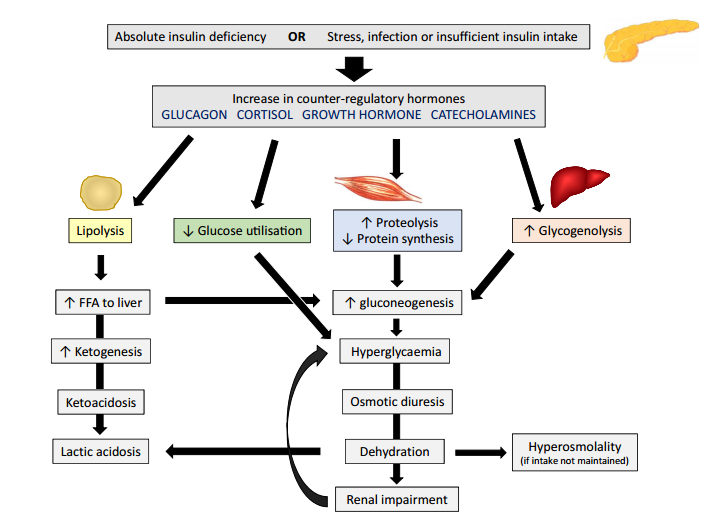
In the absence of insulin, hepatic glucose production accelerates, and peripheral uptake by tissues such as muscle is reduced. Rising glucose levels lead to an osmotic diuresis, loss of fluid and electrolytes, and dehydration. This results in plasma osmolality rising and renal perfusion falling. Vomiting leads to further loss of fluid and electrolytes.
In parallel, rapid lipolysis occurs, leading to elevated circulating FFA levels. These are broken down to fatty acyl-CoA within the liver cells, and are subsequently converted to ketone bodies within the mitochondria. Accumulation of ketone bodies produces a metabolic acidosis.
What factors contribute to the acidosis that develops in DKA?
- Accumulation of ketone bodies produces a metabolic acidosis.
- Progressive dehydration impairs renal excretion of hydrogen ions and ketones, aggravating the acidosis.
Why do individuals become dehydrated in DKA?
- Rising glucose levels lead to an osmotic diuresis, loss of fluid and electrolytes, and dehydration.
- Vomiting leads to further loss of fluid and electrolytes.
What are the most common circumstances which somebody develops a DKA?
- Previously undiagnosed diabetes
- Interruption of insulin therapy
- The stress of intercurrent illness
What are symptoms of someone with DKA?
- Polyuria
- Polydipsia
- Weight loss
- Weakness
- Nausea/vomiting
- Abdo pain
- Breathlessness
What are signs of DKA?
- Dry mucus membranes
- Sunken eyes
- Tachycardia
- Hypotension
- Ketotic breath
- Kussmaul resp.
- Altered mental state
- Hypothermia
Up to 5% can present in coma
Why do individuals with DKA have abdominal pain?
Acidosis causes ileus
What is Kussmaul’s breathing?
https://www.youtube.com/watch?v=TG0vpKae3Js
Also described as ‘air hunger’, Kussmaul’s breathing is typified by deep, rapid inspirations.
What is the mechanism behind kussmaul’s breathing?
Kussmaul’s breathing is an adaptive response to metabolic acidosis. By producing deep, rapid inspirations, anatomical dead space is minimised, allowing for more efficient ‘blowing off’ of carbon dioxide, thus decreasing acidosis and increasing pH.
Why do individuals with DKA get acetone breath?
Build up of ketones
What criteria are used for the diagnosis of DKA?
- Acidaemia
- Hyperglycaemia
- Ketonaemia/Ketronuria
What criteria are used to diagnosis acidaemia in DKA?
Venous pH < 7.3 mmol/L
OR
Bicarb < 15 mmol/L
What criteria would you use to diagnose Ketonaemia in somoene with DKA?
Blood ketones > 3 mmol/L
What criteria would you use to diagnose ketonuria in DKA?
2+ on dipstick
What criteria would you use to diagnose hyperglycaemia in someone with DKA?
Blood glucose > 11.0 mmol/L
What tests would you do in someone with suspected DKA?
- Bedside - Urine dipstick, cap glucose/ketones, ECG
- Bloods - FBC, U+Es, VBG/ABG if GCS <8, CRP, lab glucose, Blood Cultures
- Imaging - CXR
When would you suspect severe DKA?
1 or more of following criteria:
Clinical
- Pulse >100 or <60
- Systolic BP <90 mmHg
- GCS <12 or abnormal AVPU
- O2 saturation <92% on air (assuming no resp disease)
Bloods
- Blood ketones >6 mmol/L
- Venous Bicarbonate <5 mmol/L
- Venous/arterial pH <7.0
- Hypokalaemia on admission <3.5 mmol/L
- Anion gap > 16 mmol/L
What immediate actions would you take in the immediate management of someone with DKA?
http://www.diabetesinscotland.org.uk/Publications/DKA%20Care%20Pathway%201%20v10.pdf
- ABCDE - get 2 large bore cannulas in
- Confirm diagnosis - H+ > 45 or HCO3 < 18 or pH < 7.3 on VBG
- Check - U&Es, lab Blood Glucose, urine or blood ketones
- Record time of arrival

If someone had severe DKA, where would you manage them?
Consider moving to HDU/ITU and call for senior help
What actions should you take within the first 60 minutes of admission in someone with DKA?
http://www.diabetesinscotland.org.uk/Publications/DKA%20Care%20Pathway%201%20v10.pdf
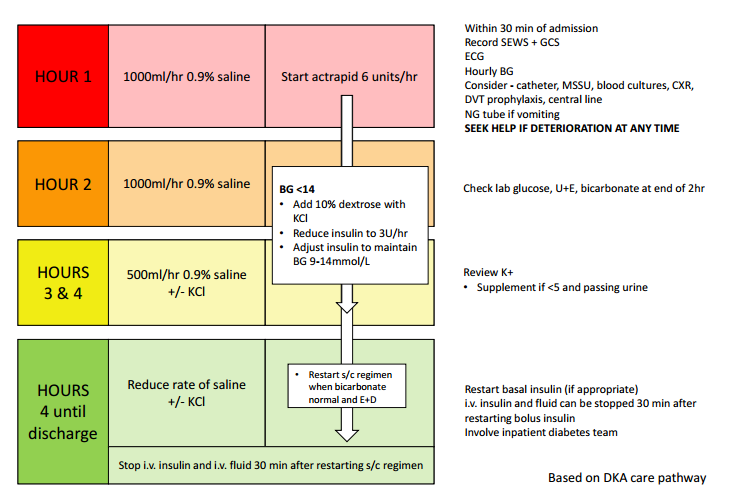
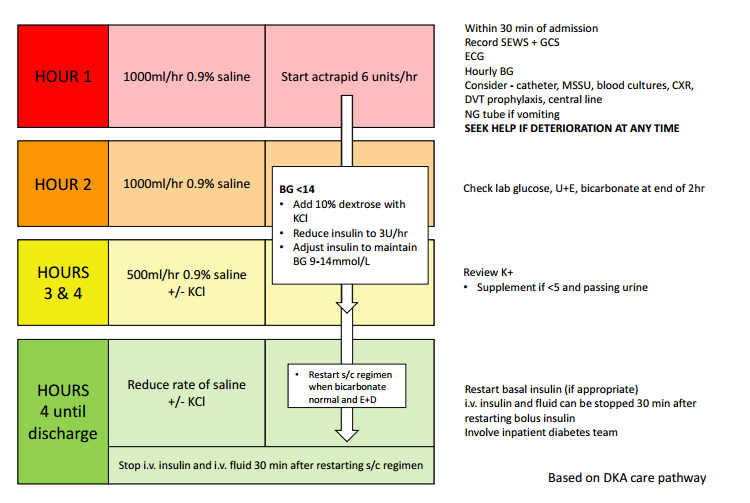
- Commence Fluids - 1L NaCl 0.9% over 1 hr within 30 mins of admission
- Commence soluble insulin - IV 6 units/hour within 30 mins of admission
- Record NEWS score
Following inital management of DKA with fluids and insulin within the first hour of admission, how would you continue management over the next 3 hours (hours 1-4)?
http://www.diabetesinscotland.org.uk/Publications/DKA%20Care%20Pathway%201%20v10.pdf
- Monitoring: SEWS, ECG, GCS, Lab Glucose, U&Es and HC
- Stepwise fluid replacement
- Hour 2 - 1L NaCl 0.9%
- Hour 3-4 - 500mls/hour NaCl 0.9% (+/- KCL based on K+ review)
- Check cap glucose hourly - look for a drop
If, when managing someone for DKA, their blood glucose falls below 14.0 mmol/L within the first 4 hours, how would you manage them?
http://www.diabetesinscotland.org.uk/Publications/DKA%20Care%20Pathway%201%20v10.pdf
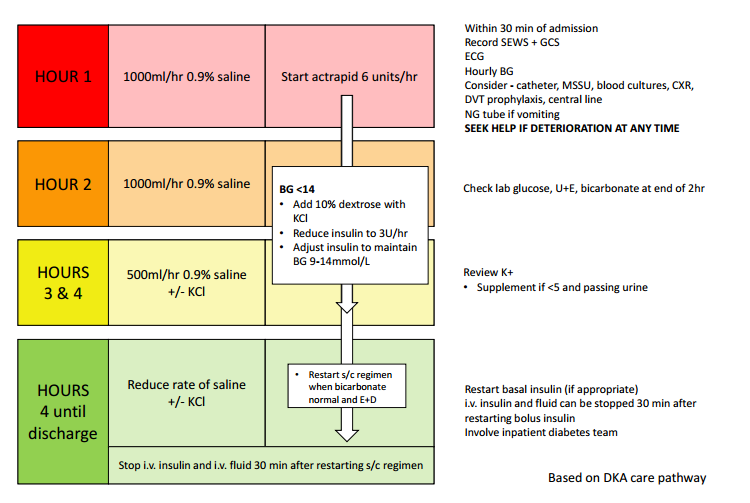
- Maintain Blood Glucose - between >9 mmol/L and ≤14 mmol/L
- Continue NaCl - 0.9% at 400mls/hour + KCL until end of hour 4
- Reduce insulin to 3 units/hour
- Commence Glucose - 500mls 10% glucose with 20 mmol KCl at 100ml/hour
What insulin regime would you initially start someone on in DKA?
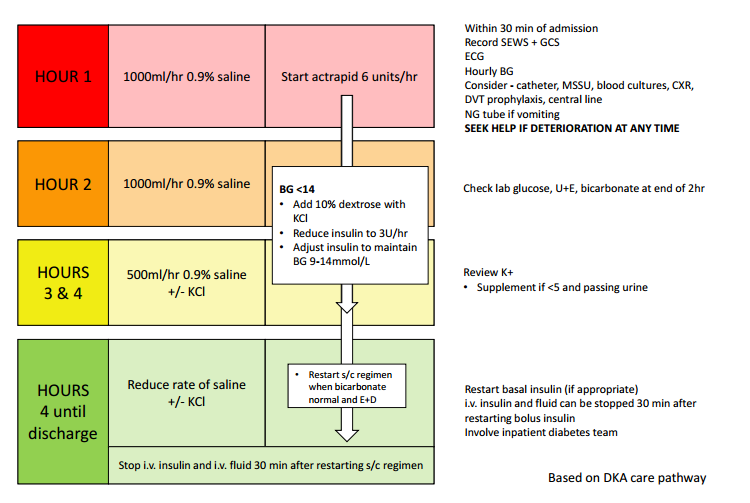
6 units/hour



-
Anaphylaxis25
-
Asthma Exacaerbation42
-
COPD Exacerbation30
-
Hypoglycaemia33
-
DKA43
-
HHS26
-
Acute Stroke and TIA45
-
Acute Seizures38
-
Pulmonary Oedema30
-
Upper GI bleed26
-
Sepsis63
-
Pulmonary embolism and DVT70
-
Burns97
-
Oncological emergencies51
-
Fracture Management45
-
Wound Management121
-
Rapid Tranquilisation9
-
Post-operative complications23
-
Ligament injuries29
-
Arrythmia Management41
-
ALS Management44
-
Differentials for acute presentations - SOB16
-
Differentials for acute presentations - Chest Pain16
-
Differentials for acute presentations - Abdominal pain13
-
Differentials for acute presentation - Headache14
-
Differentials of acute presentations - Collapse/falls5
-
Paracetamol overdose0
-
Compartment syndrome0
-
Hyper/hypokalaemia34
-
Hyper/hypocalcaemia88
-
Opiod Toxicity21
-
Poisoning and Toxidromes38



