What is the importance of DNA?
DNA is the information of life; DNA holds the information necessary for life as weknow it
- DNA diseases, such as cancer, cause lethal problems
- DNA as a molecule is extremely important to the cell based upon the energy,input into the molecule. The cell has devoted considerable resources to maintenance of fidelity of the information contained, as well as energy in storing that information. 6 billion ATPs to replicate the nuclear DNA in a cell.
There are limits to the fidelity of DNA as the storage of this important information
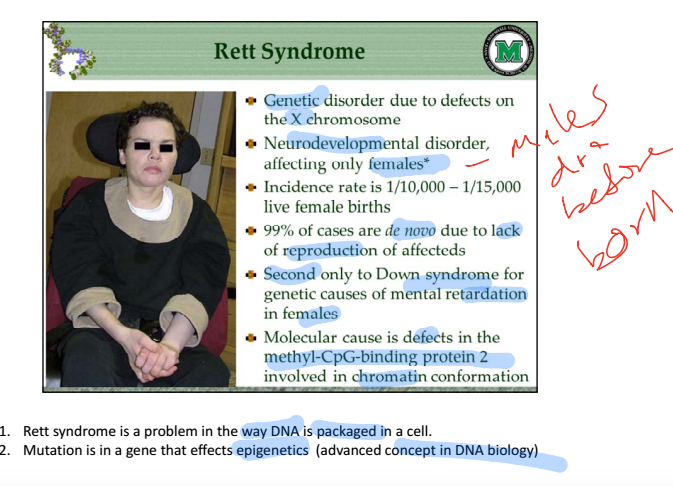
What is Rett Syndrome?
What is the central dogma of DNA?
- Central dogma –deoxyribonucleic acid is the repository of genetic information for almost all organisms. It carries the information necessary for life to exist in a stable form. The flow of information from DNA to RNA and eventually to proteins is termed the central dogma of molecular biology. Unique aspects of the chemical structure make this role possible
- Each point is a potential point of gene expression control
•Cells use these processes to controlexpression of genes present in DNA
- Integration of these processes occur in various places in the cell which you will learn about as you progress through this semester
What is DNA?
A polynucleotide with a specific sequence of deoxyribonuleotide units covalently joined through 3’-5’ - phosphodiester bonds.
It is the carrier of genetic information.
What is the structure of DNA?
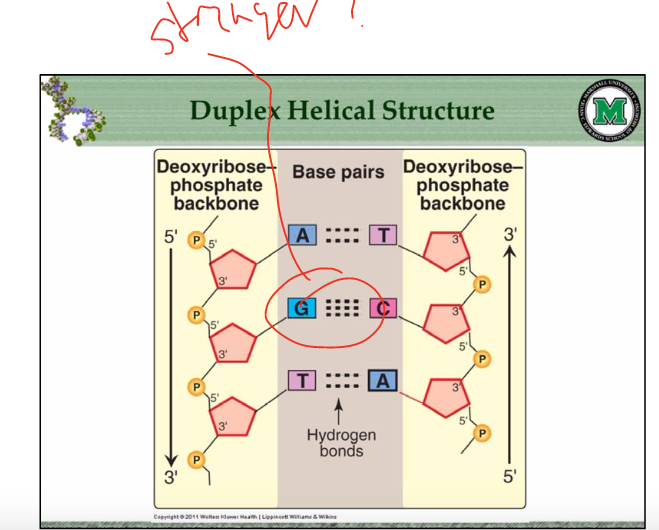
Double-stranded and contains thymine and deoxyribose.
What is the backbone of DNA and how is it binded?
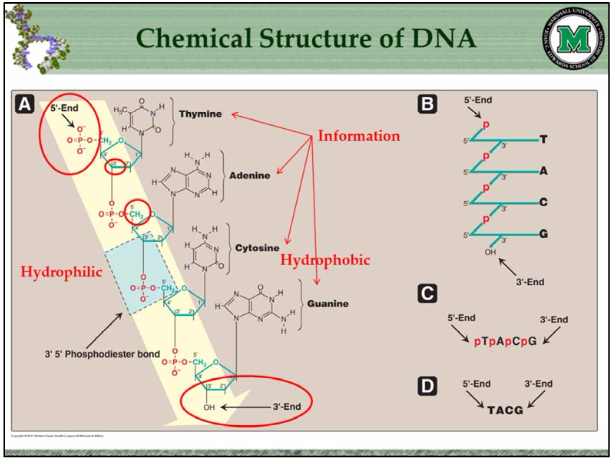
The sugar phosphate backbone of each strand is linked by 3’,5’ phosphodiester bonds. That is, a phosphate group links the 3’ carbon of a sugar to the 5’ carbon of the next sugar in the chain.
What is the makeup of the stands and how are they orriented?
Each strand has a distinct 5’ end and 3’ end, and thus has polarity. A phosphate group is often found at the 5’ end, and a hydroxyl group is often found at the 3’ end/
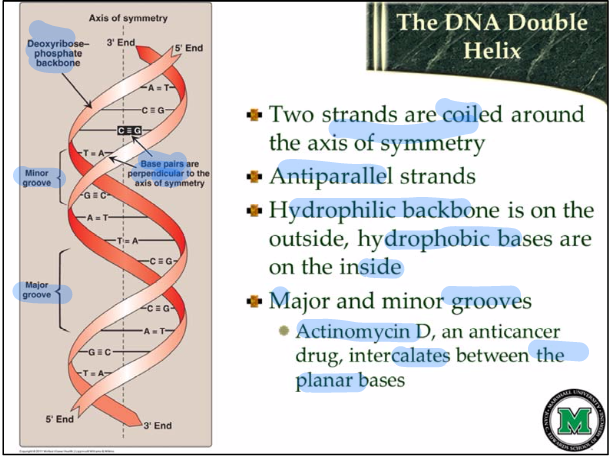
- The two strands are antiparallel (opposite in direction)
The two strands are complementary. A always pairs with T (two hydrogen bonds), and G always pairs with C (three hydrogen bonds). Thus, the base sequence on one strand defines the base sequence on the other strand
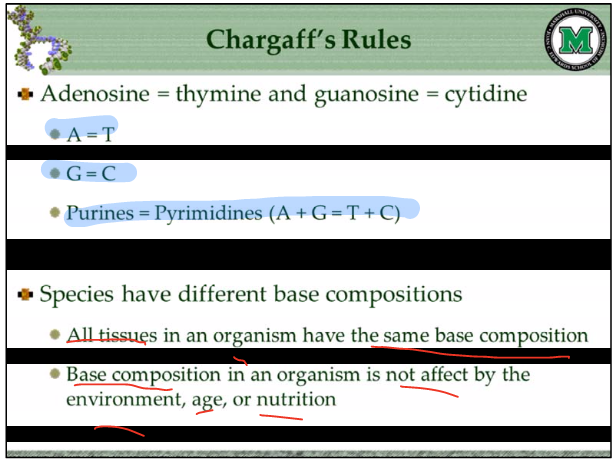
What is Chargoff’s rule?
Because of the specific base pairing, the amount of A equals the amount of T, and the amount of G equals the amount of C. Thus, total purines equals total pyrimidines. These properties are reflected in Chargaff’s rules
Genetic information is carried in the base sequence of a DNA molecule
What is the chemical structure of DNA?
- The primary structure of DNA is the base sequence and covalent makeup. This structure is written, by convention, in the 5’3’ direction (left to right)
Which part of DNA is hydrophilic?
The backbone
Which base paing has stronger/more H bonds?
C—G
What are the 3 secandary forms of DNA and which one is most common?
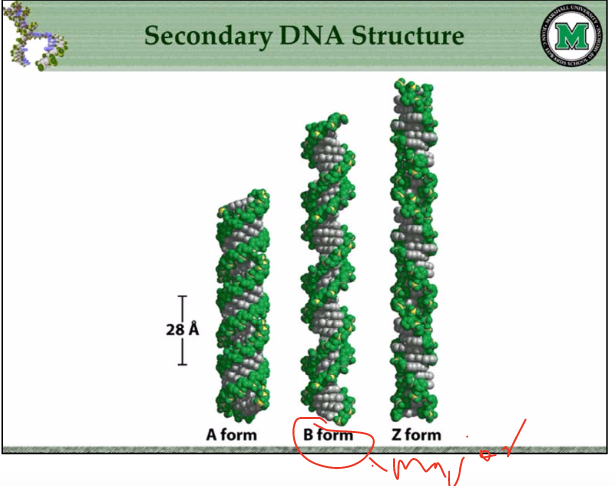
- Most DNA occurs in nature as a right‐handed double‐helical molecule known as Watson‐Crick DNA or B‐DNA. The hydrophilic backbone of each strand is on the outside of the double helix. The hydrogen bonded base pairs are stacked in the center of the molecule. There are about ten base pairs per complete turn of the helix
- A rare left handed double helical form of DNA that occurs in G‐C rich sequences is known as Z‐DNA. The biological function of Z‐DNA is unknown, but may be related to gene regulation
- Another DNA form is the A form, which is produced by moderately dehydrating the B form. It is also a right handed helix, but there are 11 base pairs per turn, and the planes of the basepairs are tilted 20°away from the perpendicular to the helical axis. The biological significance of this form is that the conformation found in DNA‐RNA hybrids or RNA‐RNA double‐stranded regions is probably very close to the A form.
What is denaturation of DNA and how is it caused?
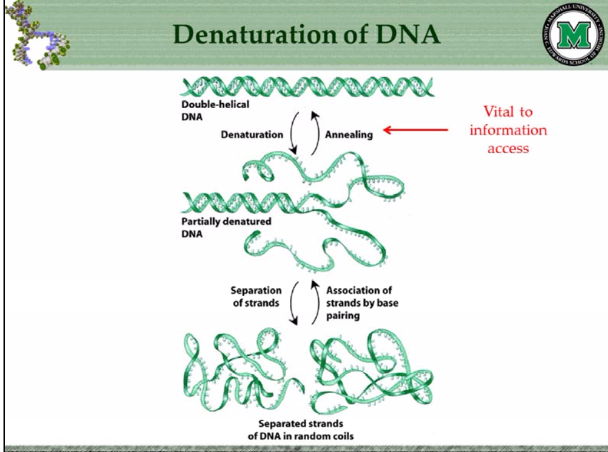
- denaturation of DNA is the disruption of the non‐covalent interactions which hold the DNA duplex together. This can be caused by heat, extremes of PH, urea, and other denaturing agents.
- Denaturation effects viscosity and absorption of UV light on solutions it is dissolved in.
Describe the Hyperchomic affect.
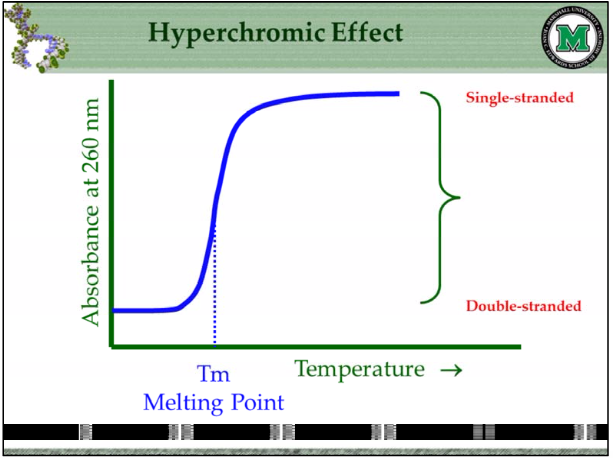
- Upon denaturation DNA solutions become less viscous and they absorb more ultraviolet light (hyperchromiceffect)
- Used as a standard to measure purity of DNA in preparations A260/280 1.8
How does primary sturcture affect helix stability?
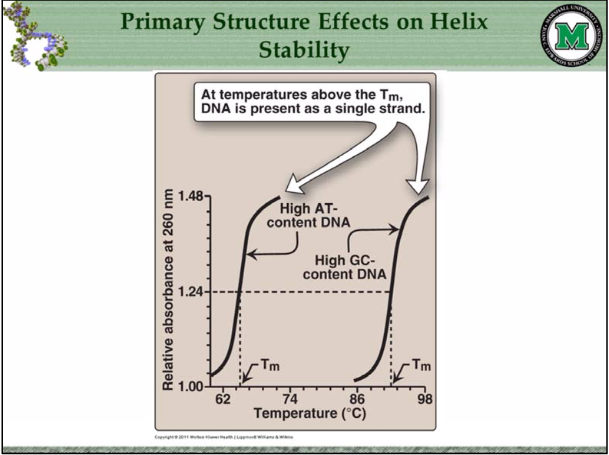
Different regions of DNA will have different melting temperatures (Tm), based upon their relative amounts of GC base pairs.
- This is a result of 3 hydrogen bonds vs. two
Describe DNA packing and how many basepairs does the human genome contain?
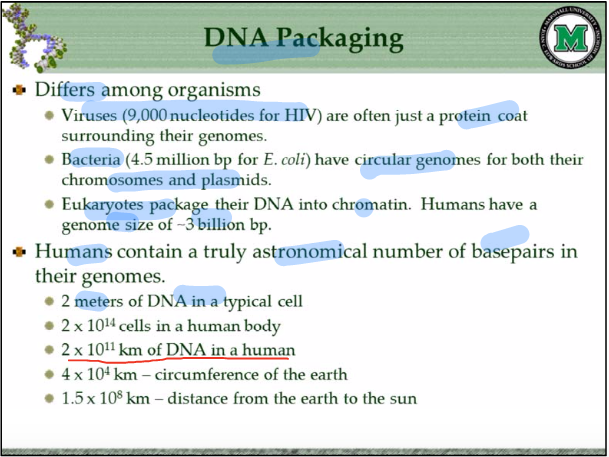
- Chromosomal DNAs are often orders of magnitude longer than the cells or viruses in which they are located. This is true of every class of organism or viral parasite
Viruses often consist of no more than a genome surrounded by a protein coat. The genome of HIV is about 9,000 nucleotides
Bacteria usually have a single circular chromosome housed in their nucleoid and smaller circular DNAs called plasmids that often have no function, but can give antibiotic resistance. The genome of E. coli is about 4.5 million bp
•The human genome is approximately 3 billion bp, with most cells having 2 copies. Eukaryotic DNA is packaged into chromatin
What is Chromatin and describe the two different types?
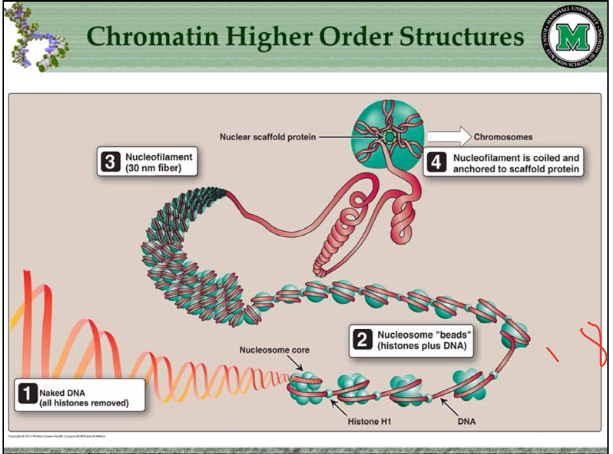
Chromatin-the complex of nucleic acids (DNA and RNA) and proteins (histones and nonhistones) comprising eukaryotic chromosomes. DNA wraps around histone complexes to form the basic structure of chromatin –the nucleosome –that can form more complex and condensed structures that are chromosomes
- There are two types of chromatin with the particular chromosome regions varying as far as type among the cells types of the body
- Euchromatin–loosely packaged and transcriptionally active –beadson a string DNA
- Heterochromatin- tightly packaged and transcriptionally inactive
What are histones and describe how they function?
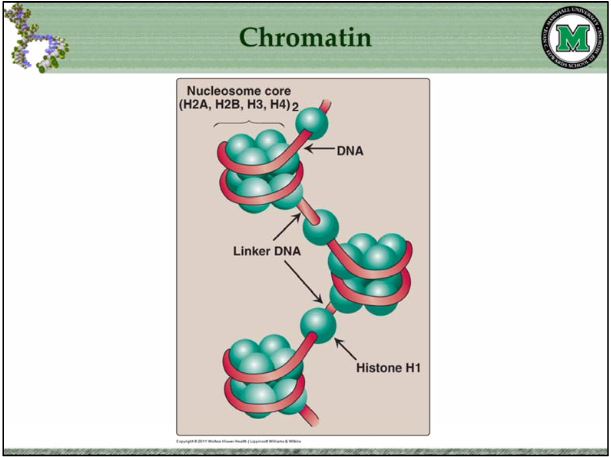
Histones are DNA- binding proteins that contain large amounts of basic amino acids (positively charged) such as lysine and arginine which attract negatively charged DNA
- Nucleosomes are the structural unit for packaging chromatin consisting of a DNA strand wound around a histone core. This histone core consist of two copies of the histones H2A, H2B, H3 and H4. Histone H1 is associated with the linker DNA found between nucleosomes to help package chromatin into higher order structures that eventually form chromosomes
- Winding of DNA around nucleosomes induces positive supercoiling in the linker regions
Describe supercoiling and why it is important.
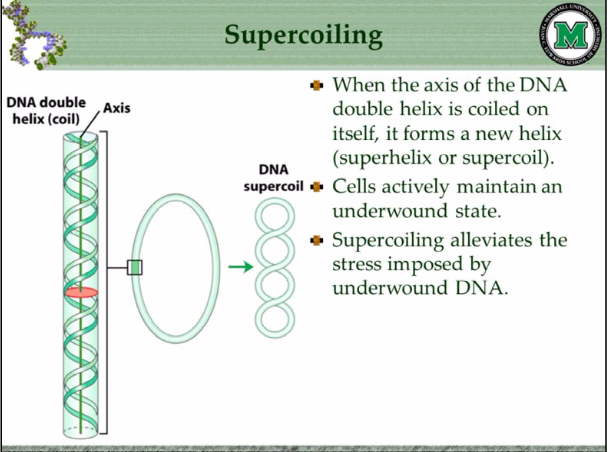
Supercoiling -the twisting of a helical (coiled) molecule on itself, i.e. a coliedcoil. Winding of the DNA duplex in the same direction as that of the turns of the double helix is called positive supercoiling. Twisting of the duplex DNA molecule in a direction opposite to the turns of the strands of the double helix is called negative supercoiling. The biological significance of supercoiling is:
Cells actively maintain negative supercoiled state necessary to facilitate access to DNA.
This “underwinding” of the DNA double helix allows easier seperationof the strands for processes such as replication and transcription
What are topoiomerases?
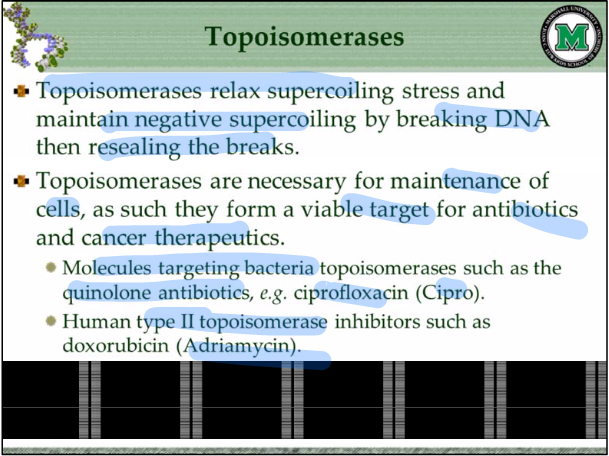
Topoisomerases are enzyme critical to maintaining underwindingof DNA and relaxing supercoiling effects. Antibiotics such as the quinolones (ciprofloxacin) and anti cancer drugs such as doxorubicin target these critical enzyme
Describe chomosome structure and name the 3 parts?
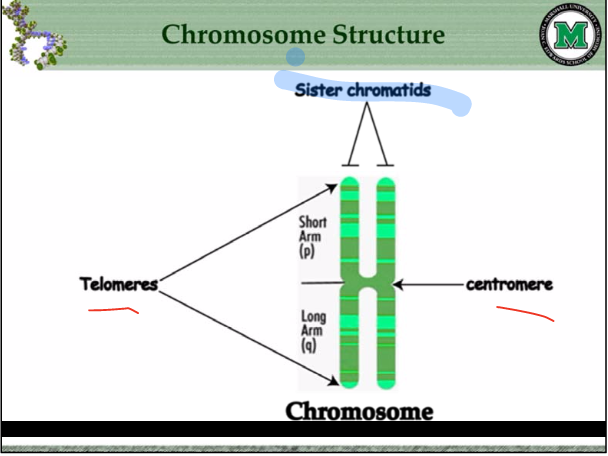
- Chromosome architecture –linear chromosomes contain three structures necessary for their propagation (prokaryotic chromosomes only contain an origin of replication). This was deduced by the construction of mitotically and meioticallystable artificial chromosomes with just the following three regions. Artificial chromosomes are important molecular genetic tools for cloning large sections of the human genome
- Centromere -a region of a chromosome to which spindle traction fibers attach during mitosis and meiosis. A replicated chromosome consists of two chromatids joined at the centromere region. The centromere of metaphase chromosomes is narrower than the regions distal to it, and therefore it is called the primary chromosomal constriction
- Telomere - a specialized repeated DNA sequence, along with specialized proteins, found at the ends of eukaryotic chromosomes. Chromosomes lose about 100 nucleotides from their ends per cell division suggesting that the shortening of telomeres may provide cells with a mitotic clock
- Origins of replication - a nucleotide sequence at which DNA synthesis begins; termed an orisite. These are spaced about every 50,000 bp in humans, while bacteria have only one because of their circular genomes
- The human karyotype(the chromosomal complement of a cell, individual, or species) includes 23 pairs of chromosomes
What is epigenetics?
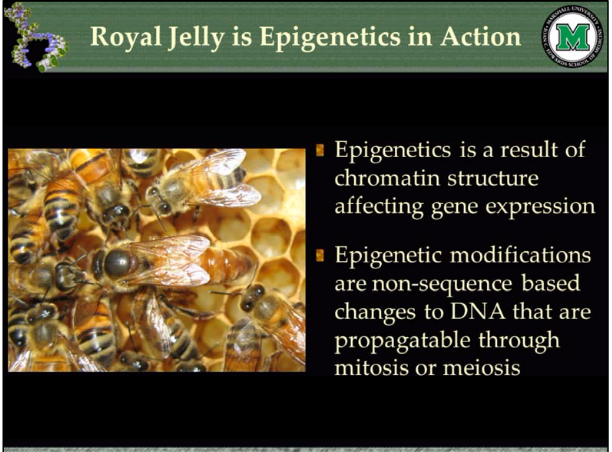
- Epigenetic modifications to DNA can occur that affect the ability of the cell to access the information contained. Epigenetic modifications are non sequence based changes to DNA that are propagatablethrough mitosis or meiosis
- Epigenetic modifications control gene expression critical during development, disease states such as cancer, and during cellular differentiation. Environmental influences such as diet can elicit changes in gene expression through epigenetic modifications. A particularly noteworthy example is in honey bees, where the morphology and lifespan of the queen bee is a result of epigenetic changes elicited by feeding the larvae royal jell.
Describe DNA methylation and how it acts.
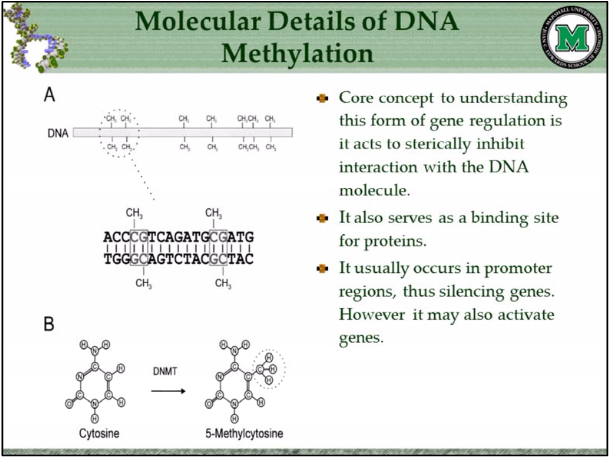
DNA methylation acts by either 1) stericallyinhibiting the binding of trans acting factors, typically repressing transcription if at promoter sequences, but sometimes methylation affects the binding of repressive factors and thus activates transcription or 2) serving as an recognition motif for binding of specific factors
- Figure legend
(A) The human genome is decorated with methyl groups, which occur nearly exclusively at cytosine residues within the symmetric CpG dinucleotide.
(B) The postreplicativeaddition of a methyl group to cytosine is catalyzed by DNA methyltransferase (DNMT), using Sadenosyl‐L‐methionine (SAM) as a substrate.
Describe Histone modifications and what they do.
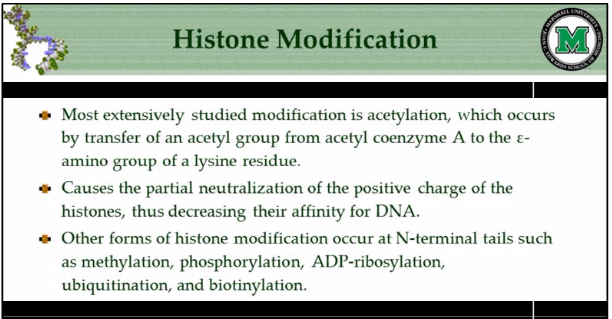
Histone modifications such as acetylation affect the ability of nucleosomes to interact and form repressive complexes. Epigenetic modifications can take the form of posttranslational modifications to the amino terminal tail and internal sites of histones. These modifications include phosphorylation, acetylation, methylation, ADP‐ribosylation, glycosylation, and ubiquination.

-
DNA Structure26
-
Nucleus6
-
Nucleotide Metabolism14
-
DNA Replicaton 119
-
DNA Replication II7
-
Gene Regulation22
-
Nucleotide Structure and Function10
-
Dna Repair And Recombination9
-
Transcription and RNA processing I16
-
RNA Replication II16
-
Protein Synth 126
-
Secretory Pathway I24
-
Protein synth II16
-
Secretory pathway 220
-
Secretory pathway 321



