How many limb leads are there?
Which colour goes where?
there are 4 limb leads
Ride Your Green Bike
- Red- right arm
- Yellow- left arm
- Green- left leg
- Black-Right leg
How many chest leads are there?
what are their names?
where will you find these leads on the chest?
6 limb leads
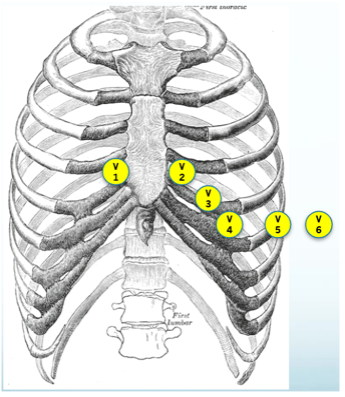
V1: 4th intercostal space right sternal border
- V2: 4th intercostal space left sternal border
- V3: Between V2 and V4
- V4: 5th intercostal space, mid clavicular line
- V5: Same horizontal line as V4 and V6, anterior axillary line
- V6: Same horizontal line V4, mid axillary line
value of red (mm/mv)
value of black (mm/s)
value of green one little box (seconds/ms)
valule of blue one big box (secs/ ms)
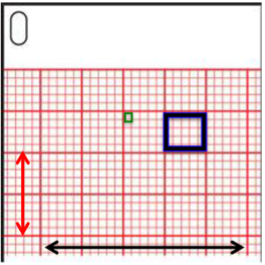
red- 10 mm/mv
black- 25 mm/s
one small box- -.04seconds 40ms
one big box- 0.2 seconds/ 200ms
normal HR
PR interval
QRS duration
normal QRS axis range
where on the ECG is the absolute refractory period
HR 60-100bpm
PR interval- 120-200ms
QRS duration- <120ms
QRS axis is between- -30 to 90
absolute refactory period= beginning of the QRS complex to the apex of the t wave
ways to calculate HR on an ECG
300/ no. of big squares between R-R
1500/ no. of small squares between R-R
Numbers of QRS complexes per 10 second strip x6 to give bpm
bradycardia
bpm
involves which disorders
bradycardia
rate< 60bpm
includes:
- sinus bradycardia
- sick sinus syndrome
- Afib/ flutter with slow ventricular response
- 2nd and 3rd degree heart AV block
- escape rhythm (intrinsic ventricular pacemaker backup rhythm of 20-40 bpm)
- asystole
what is sick sinus syndrome
bradycardia with episodes of sinus arrest that may laso present with episodes of tachycardia
First degree AV heart block
impulses take longer to reach the AVN (consistently late)
prolonged QT interval of >200ms
Still one P wave for every QRS
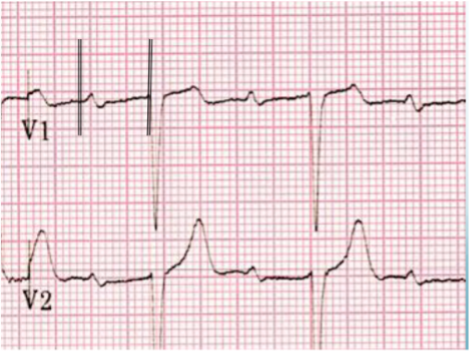
Second degree AV block type 1
AVN intermittently fails to conduct impulses
not every P wave has a QRS
has 2 types: Mobitz 1 (Wenkebach) and Mobitz 2
2nd degree heart block–Mobitz type 1 (Wenkebach)
- impulse reaches the AVN but doesnt fully conduct the impulse
- PR interval progressivley elongates
- eventually a QRS is dropped as AVN is unable to conduct
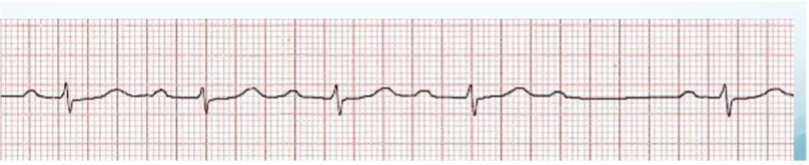
2nd Degree heart block- Mobitz 2
A form of 2nd degree AV block in which there is intermittent non-conducted P waves without progressive prolongation of the PR interval
The PR interval in the conducted beats remains constant
The P waves ‘march through’ at a constant rate
The RR interval surrounding the dropped beat(s) is an exact multiple of the preceding RR interval (e.g. double the preceding RR interval for a single dropped beat, triple for two dropped beats, etc)

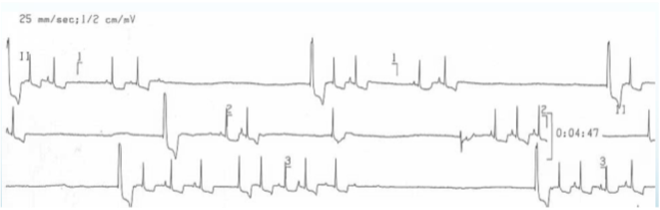
Third degree AV block
example of a bradycardia
aka complete heart block
the AVN is unable to conduct any impulses from the atria
there is no relationship between P waves and QRS complexes
2 kinds of escape rhythm
- AV junctional
- QRS morphology will look like a normal narrow QRS
- Rate 40-60 bpm
- Ventricular escape
- Broad QRS
- Rate 15-40 bpm
Both act as a safety net
Asystole
No electrical activity
Normally not a completely flat line!
Is a medical emergency and need immediate treatment. BLS/ILS training chest compressions, treat underlying cause.
Non shockable
A fib
- Atrial rate between 300-600 bpm
- Ventricular rate is irregular and often fast
- Can be caused by increased BP, heart disease, valve disease (swelling of the atria)
- 5x risk of stroke (pooling of blood, thrombus formation, sent to brain)
No P waves- fibrillatory waves seen in stead
QRS is irregularly irregular
Can have fast or slow ventricular response
A flutter
- Rentrant circuit in the LA or RA
- Atrial rate = 300 bpm
- Ventricular rate can be regular or irregular
- Causes are that of AFib
- Risk of clot formation and therefore stroke high
sawtooth baseline
look for a systolic rate divisible by 75

Atrial tachycardia
Depolarisation of atrial form an ectopic focus
Rate between 120-200 bpm
Can have AV block
Atrial ectopics
AKA atrial extrasystoles
a P wave earlier than expected usually with a QRS following
delayed PQ interval on the following shoter PQ
can sometimes fall in the AV refractory period (R- T peak) resulting in no QRS
Ventricular ectopics
An early QRS complex without a preceding P wave
P wave can follow QRS if VA conduction occurs
Can be unifocal or multifocal
Can be single or more frequent
AKA ventricular extrasystole, premature ventricular beats
Broad complex tachycardia
3 or more successive beats at >120 bpm
- AV disassociation
- QRS duration >120ms
- Ventricular rate of >120 bpm
- Can be monomorphic or polymorphic
- Concordance of the chest leads
- Can be sustained >30secs
- Potentially life threatening arrhythmia
- Can quickly degenerate into VF
ventricualr tachycardia
Broad complex tachycardia originating in the ventricles
VT may impair CO with consequent
Hypotension
Collapse
Acute cardiac failure
This is due to extreme heart rates and lack of coordinated atrial contraction
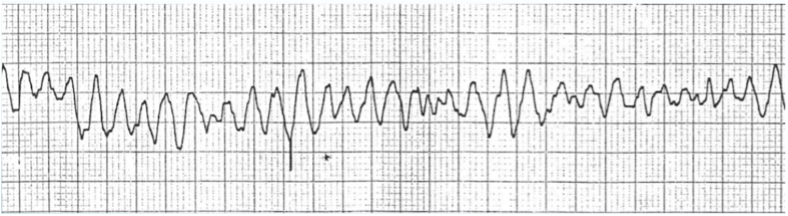
ventricular fibrillation
- Most important shockable rhythm
- Ventricles suddenly try to contract at rates up tp 500bpm
- Rapid and irregular electrical activity renders the ventricles unable to contract in a synchronised manner, results in immediate loss of cardiac output
- Heart is no longer an effective pump and is reduced to a quivering mess
how can broad complex tachycardias be terminated
cardioversion- drugs or DC
pacing
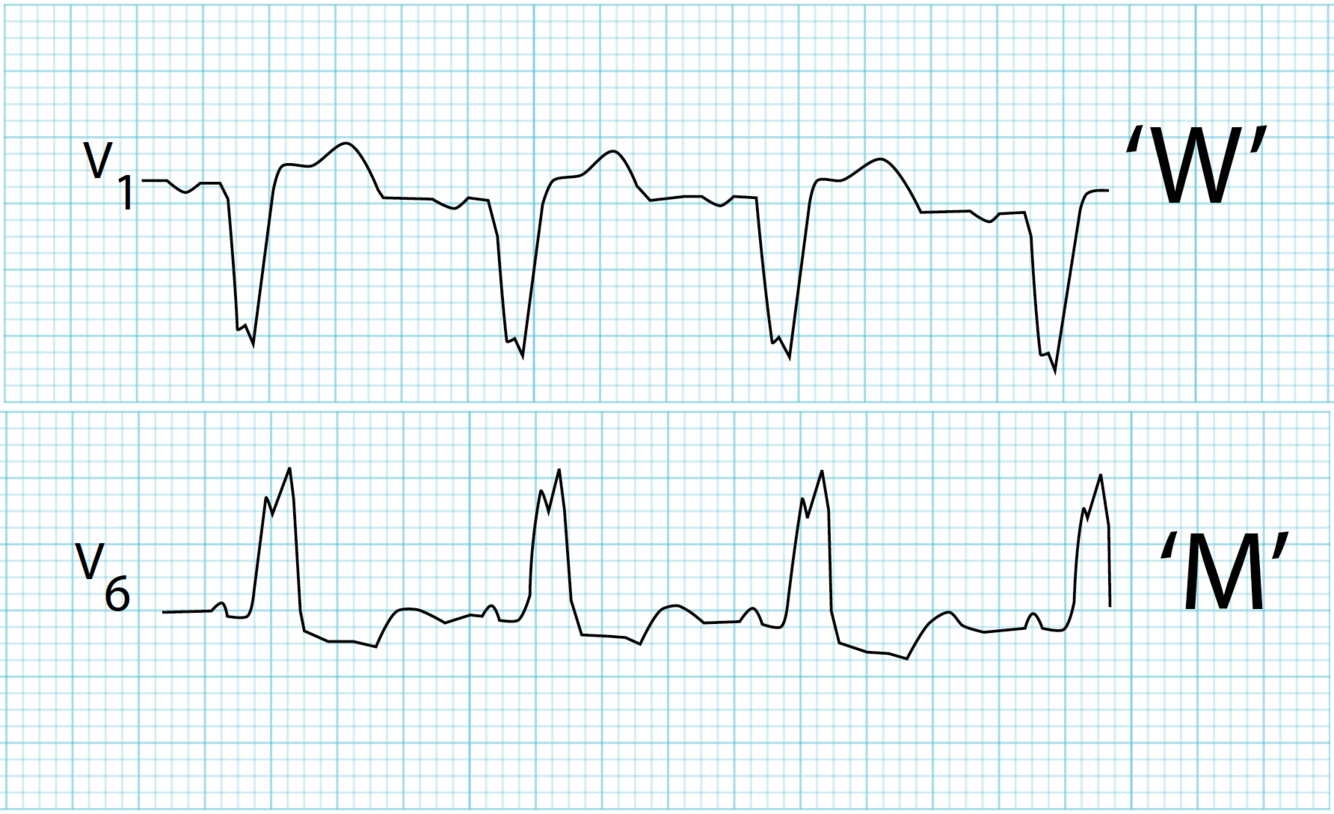
left bundle branch block
sequence of conduction
- QRS duration > 120ms
- Dominant S wave in V1 (W of William)
- Broad monophasic R wave in lateral leads (I, aVL, V5-6)
- Absence of Q waves in lateral leads
- Prolonged R wave peak time > 60ms in leads V5-6 (M or William)
Conduction delay means impulses travel first via the right bundle branch (black arrow)
2) Septum is activated from right-to-left (yellow arrows)
3) Overall depolarisation vector is directed towards lateral leads (red arrow)