R-R Method
Count number of large boxes between two R waves:
1 = 300 b/m
2 = 150 b/m (about 155b/m)
3 = 100 b/m
4 = 75 b/m
5 = 60 b/m
6 = 50 b/m
Pathological Q Wave
>1mm wide (1 small square); or
>2mm deep (2 small squares); or
>25% depth of preceeding QRS complex
indicates have had a previous STEAC or advancing STEAC or ACS
ECG Basics
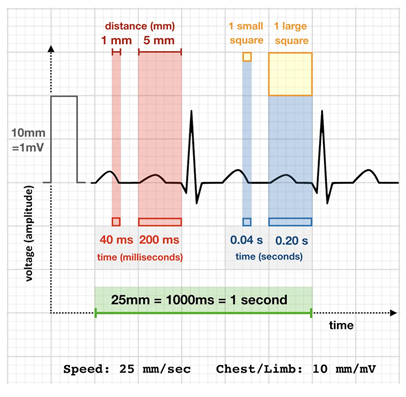
Speed: 25mm/sec
Small square: 0.04sec & 1mm x 1mm
Large square: 0.2sec & 5mm x 5mm
3 seconds between short vertical lines
P Wave
should be present, upright, rounded and precede each QRS complex
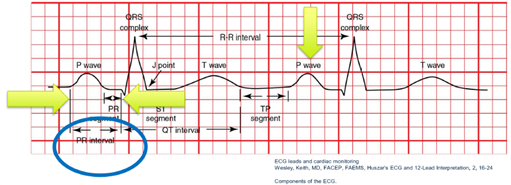
PR Interval
0.12-0.2 sec (3-5 small squares)
HR <60, maybe >0.2 sec (>5 small squares)
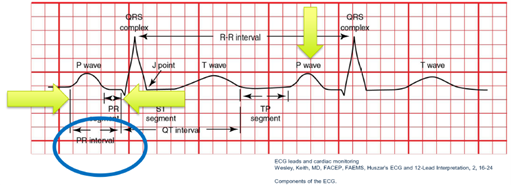
QRS Complex
upright and narrow in Lead I & II (for a normal axis)
< 0.12 sec (<3 small squares)
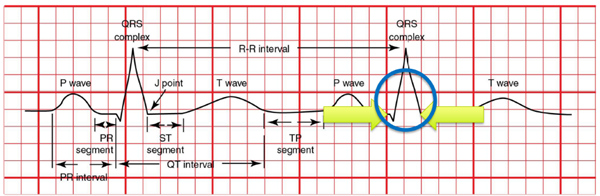
T Wave
should be upright and rounded
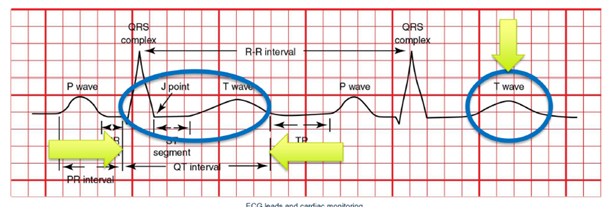
Q-T Interval
should be <0.44 sec (normally between 0.4 and 0.44)
(1 - 11 small boxes)
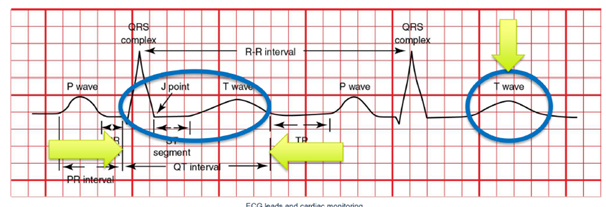
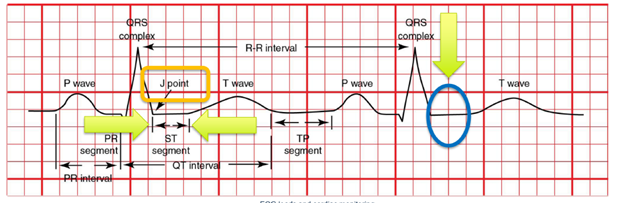
ST Segment/J Point
should return to isoelectric line and NOT be elevated or depressed
J point is where S wave changes shape or direction
What are the 12 lead ECG orientation/groupings?
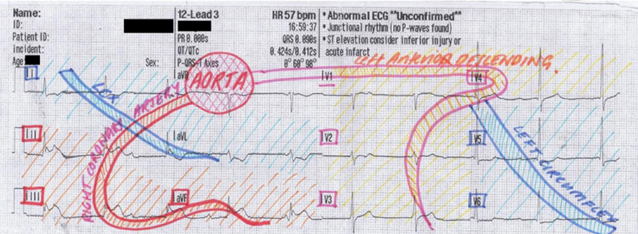
HISAL
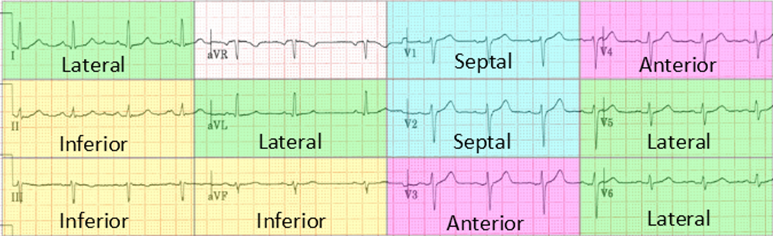
Heart Vessels Lead I, aVL, V5 & V6
left circumflex coronary artery
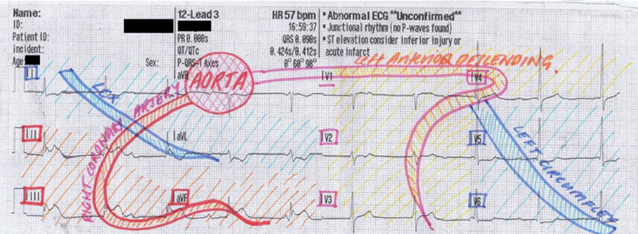
Heart Vessels Lead aVR
aorta
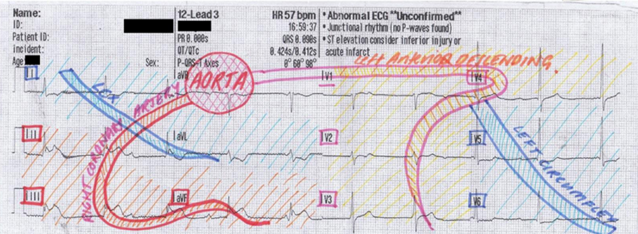
Heart Vessels Lead V1, V2 V3 & V4
left anterior descending coronary artery
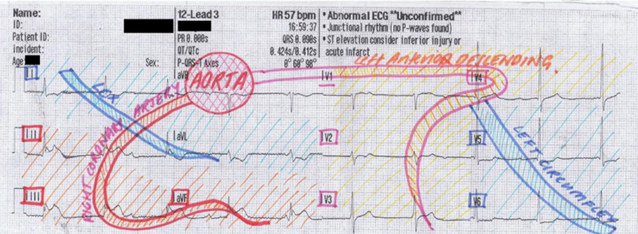
Heart Vessels Lead II, Lead III & aVF
right coronary artery
AV Heart Block Poem
1st Degree = far away P (long PR interval)
2nd Degree 1 = longer longer drop (PR gets longer then a QRS drop)
2nd Degree 2 = drop randomly (QRS drops)
3rd Degree = beat independently (no correlation between P and QRS)
Smith-Modified Sgarbossa Criteria
- Concordant ST elevation ≥ 1 mm in ≥ 1 lead
- Concordant ST depression ≥ 1 mm in ≥ 1 lead of V1-V3
- Proportionally excessive discordant STE in ≥ 1 lead anywhere with ≥ 1 mm STE, as defined by ≥ 25% of the depth of the preceding S-wave
What rhythm characteristics do we defibrillate?
fast & wide
chaotic and disorganised
What rhythm characteristics do we disarm?
slow & wide
fast & narrow
slow & narrow
flatline




