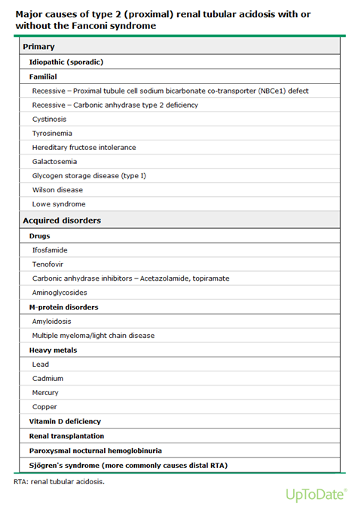
Causes of proximal RTA?
- Primary
- Idiopathic/sporadic
- Familial:
- Recessive (proximal tubule Na/HCO3 co-transporter defect, carbonic anhydrase type 2 deficiency)
- Dominant, isolated HCO3 wasting
- Cystinosis
- Tyrosinemia
- Hereditary fructose intolerance
- Galactosemia
- Glycogen storage disease type I
- Wilsons
- Lowe syndrome
- Acquired
- Drugs: Ifosfamide, tenofovir/ARTs, carbonic anhydrase inhibitors, aminoglycosides, cisplatin/oxaliplatin
- Monoclonal: MM/light chain, amyloidosis
- Heavy metals: lead, mercury, copper, cadmium
- Vitamin D deficiency
- Renal transplant
- Paroxysmal nocturnal hemoglobinuria
- Sjogren’s (more commonly distal RTA)
DDx for Fanconi’s syndrome - congenital and acquired
- Inherited:
- Cystinosis
- Wilson’s disease
- Acquired:
- Paraproteinemia – light chain nephropathy (proximal tubular uptake of light chains)
- Drugs – carbonic anhydrase inhibitors (acetazolamide, topiramate), tenofovir, aminoglycosides, ifosfamide)
- Heavy metal toxicity – lead, mercury, copper
- Post-renal transplant
- PNH
- Sjogren’s (more commonly distal RTA)
Causes of distal RTA?
- Primary
- Idiopathic/sporadic
- Familial
- Autosomal dominant
- Autosomal recessive
- Secondary
- Autoimune: Sjogren’s, SLE, RA, AIH/PBC
- Drugs: Ibuprofen, lithium, amphotericin B, ifosfamide
- Hypercalciuric conditions: hyperPTH, VitD intoxication, sarcoidosis, idiopathic hypercalciuria
- Other: medullary sponge kidney, obstructive uropathy, RTx rejection, Wilson’s disease
Causes of type 4 RTA
- Decreased aldosterone production
- Decreased renin
- CNI
- NSAIDs
- DM
- HIV
- Decreased aldosterone
- ACE/ARBs
- Heparin
- Addison’s
- Gordon’s syndrome (pseudohypoaldo type 2)
- Decreased renin
- Increased aldosterone resistance
- Aldo blockade
- MRA
- ENaC blockade
- Amiloride
- Triampterene
- Septra
- Pseudohypoaldosteronism type 1
- Aldo blockade
What is the equation for total free water deficit?
Free water deficit = TBW x (Na-140)/140
TBW =0.6 male or 0.5 female x weight (kg)
DDx for nephrogenic DI?
- Congenital: Inherited mutations in genes for AVP V2-receptors or AQP2.
- Acquired
- Drugs: Lithium (most common), demeclocyline, amphotericin, foscarnet
- Hypokalemia, hypercalcemia
- Tubulointerstitial disease (problem with urine concentrating): CKD, post-ATN, post-obstruction, amyloid, Sjogren’s, medullary cystic
- Sickle cell disease (sickled RBCs occlude vasa recta, cause papillary damage -> medullary infarcts)
- Pregnancy/gestational DI (placenta producing AVPase)
- Protein malnutrition+excessive water intake
4 Non-drug reasons for increased ADH
1) Increase in serum osmolality
2) Volume contraction
3) Effective circulating volume depletion (despite low plasma osmolality): vomiting, cirrhosis, heart failure
4) Non-osmotic/Non-volume related: Nausea, Pain, Pregnancy
SIADH diagnostic criteria
- Clinical euvolemic
- Serum Osm low <275 mOsm/kg H20
- Urine Na high (usually >40)
- Urine Osm >300
- Normal TSH and AM cortisol
- Serum ADH high or in “normal” range (but inappropriately normal, given hypo-osmolar state)
8 drugs causing hyperkalemia and mechanism for each
- ACE/ARB - Blocks aldosterone production, decreased GFR
- Spironolactone – Blocks aldosterone receptor
- Septra – block EnAC
- Heparin – Impaired aldosterone metabolism
- NSAIDS – impaired release of renin, decreased GFR
- Beta-Blockers – impaired release of renin
- CNI – increased NCC at DCT, decreased delivery of sodium, impared na-k a principal cell, inhibit ROMK
Mechanisms of drug-induced hyperkalemia
1) Block ENac sodium channel in DCT Amiloride, triamterene, trimethoprim, pentamidine
2) Block Na-K ATPase in DCT Calcineurin inhibitors
3) Block aldosterone production ACEi, ARB, NSAIDS, Heparin
4) Block aldosterone receptors Spironolactone, eplerenone
5) Block K disposal Beta-blockers, digoxin, somatostatin
Function of principal cells and intercalated cells
- Principal cells responsible for Na reabsorption and K excretion (ENAC channels and ROMK). Main Na+ reabsorbing cells and the site of action of aldosterone, K+-sparing diuretics, and spironolactone.
- Type A and B intercalated cells make up the second cell type in the collecting duct epithelium.
- Type A intercalated cells mediate ACID secretion and bicarbonate reabsorption.
- Type B intercalated cells mediate BICARB secretion and acid reabsorption.
Tenofovir-induced RTA biopsy findings?
- Biopsy shows proximal tubule eosinophilic inclusions with giant mitochondria, +/- HIV-findings
How does hypercalcemia affect the kidney?
- Vasoconstriction of afferent arteriole and decreased GFR
- Activation of Ca sensing receptors in loop of Henle -> inhibit NKCC channel -> volume contraction
- Inhibit ADH-dependent water reabsorption in collecting duct -> nephrogenic DI
- Distal RTA
- Nephrocalcinosis
- Nephrolithiasis
Pathophysiology of alkalosis in milk alkali syndrome for 1) initiation and 2) maintenance of alkalosois
- Initiation
- Alkali load from calcium carbonate
- Hypercalcemia-induced decreased GFR
- Maintenance
- Hypercalcemia-induced volume depletion/diuresis (CaSR LOH NKCC and AQP2) -> secondary hyperaldo
- Vomiting
- loss of H+
- volume contraction -> secondary hyperaldo
Factors influencing proximal bicarb reabsorption
- Intracellular acidosis -> more available for luminal Na/H exchanger -> basolateral Na/HCO3 cotransporter
- Metabolic acidosis
- Hypokalemia
- Decreased extracellular volume -> increased Na/HCO3 cotransporter reabsorption
- Hormones:
- Angiotensin II -> increase Na/HCO3 reabsorption
- Glucocorticosteroids -> same
- Endothelin-1 -> same
Calculation for FENa
FENa = [Urine Na x Serum Cr] / [Serum Na x Urine Cr] x 100%
Limitations of FENa
- High FENa:
- CKD - maximal tubular reabsorption of Na in response to volume depletion is impaired to begin with
- Diuretic use - can use FEUrea (<35%) instead (proximal absorption urea vs. loop/thiazide affect more distal), but has its own limitations too
- Non-reabsorbable anion - will impair proximal Na reabsorption (maintain urinary electroneutrality)
- Low FENa
- Neurohormonal activation leading to sodium retention/low FENa despite ATN eg. severe HF, liver failure, extensive burns
- Acute GN - low urine Na b/c tubular reabsorptive ability is intact and there is an acute decrease in glomerular surface area available for filtration ie. normal tubular function responding to acute decrease in GFR
- Non-oliguric interstitial nephritis - normal tubular function responding to acute decrease in GFR
- Also: Variability in timing of measurement
When is FEUrea not accurate?
When proximal salt and water reabsorption impaired:
- acetazolamide
- glycosuria eg. DM
- osmotic diuresis eg. mannitol
- cerebral salt wasting
- increased urea excretion (high protein intake or catabolism)
Studies on FEUrea have not included patients with AIN, GN, obstruction, contrast
Causes of low FENa that is NOT pre-renal?
- Early ATN
- Acute GN
- Acute nonoliguric AIN
- Radiocontrast dye (ionic)
- Rhabdo
- TTP
Renal causes of hypomagnesemia
- Think about sites of loss - prox tubule, TAL, and DCT
- DDx:
- Proximal tubule
- Fanconi’s
- TAL
- Loop diuretic
- (Barters - not really)
- Hypercalcemia (stimulate basolateral CaSR in TAL)
- Hypokalemia
- DCT
- Thiazide
- Gitelmans
- Other:
- Gentamicin
- Chemo (cisplatin)
- CNIs
- Proximal tubule
What is Gordon’s syndrome?
Pseudohypoaldosteronism type 2 (PHA2): Genetic mutation involving the NaCl transporter in DCT, causes hyperkalemia, hypertension, NAGMA, normal renal function, and low or low-normal plasma renin activity and aldosterone concentrations due to volume expansion.
Presents in childhood
Stimuli for ADH release?
- Osmotic stimuli:
- Hypertonic saline, mannitol
- Non-osmotic stimuli:
- Decreased effective circulating volume
- Nausea
- Pain
- Pregnancy
- Fructose
How many ADH receptors and where are they located?
- 3 receptors:
- V1a - vascular and hepatioc
- V1b - anterior pituiatry and pancreatic islet
- V2 - renal
Where are the AQP1, AQP2, AQP3, AQP4 channels located
AQP1- apical and basolateral proximal tubule and descending loop of Henle (not regulated by ADH)
AQP2 - apical collecting duct (regulated by ADH)
AQP3 - basolateral collecting duct(all)
AQP4 - basolateral collecting duct (in the inner medulla)
Hormonal and physiologic factors that affect HCO3 reabsorption
- Hormonal
- Aldosterone
- Angiotensin II
- Cortisol
- Endothelin-1
- Physiologic
- Hypovolemia
- Hypokalemia
- Acidosis





