Which enzyme is considered highly important in the regulation of insulin secretion and why is this?
Glucokinase - it is the rate limiting step in glucose metabolism.
Metabolism of glucose is required to produce ATP and switch off the ATP dependent K+ channels.
What is the MoA of sulfonylurea drugs?
Inhibition of the ATP-sensitive K+ channel on beta cells leading to insulin secretion
What is the MoA by which glucagon activates glycogenolysis?
It activates a GPCR –> adenylyl cyclase activation. There is a cascade of events that results in the activation of glycogen phosphorylase a that starts to break down glycogen.
What is the MoA by which glucagon activates gluconeogenesis?
- Increased amino acid uptake
- Increased amino acid conversion to glucose, possibly via conversion of pyruvate to phosphoenolpyruvate which is a rate limiting step in gluconeogenesis.
What are the respective effects of hypercalcaemia and hypocalcaemia on the nervous system?
Hypocalcaemia exites the nervous system due to its threshold potential lowering effect. (Na channels become more permeable to Na when Ca is not present)
Hypercalcaemia depresses nervous activity for the opposite reason.
What percentage of ECF calcium is ionised?
50%
Where in the nephron is filtered calcium re-absorbed?
late DCT and collecting duct
What is the main form in which calcium and phosphate is stored in bone?
Hydroxyapetite crystals (these bind to proteoglycans)
Why do calcium and phosphate not normally complex in the ECF?
There are inhibitors such as pyrophosphate that prevent this from occuring.
What are the roles of the following molecules in calcium homeostasis?
- TNAP
- NPP1
- ANK
- Tissue non-specific alkaline phosphatase = breaks down pyrophosphate thus allowing hydroxyapetite crystal formation on the surface of bone
- Nucleotide pyrophosphatase phosphodiesterase 1 = results in production of pyrophosphate in the ECF. thus contributing to the reduction in hydroxyapetite crystal formation.
- Ankylosis protein = transports pyrophsophatase outside of the cell. thus contributing to the reduction in hydroxyapetite crystal formation.
What are the roles of the following signalling molecules in calcium homeostasis?
- RANKL
- M-CSF
- OPG
- Promotes the differentiation of preosteoclasts into osteoclasts
- Promotes the differentiation of preosteoclasts into osteoclasts
- Inhibits RANKL thus impeding the development of preosteoclasts into osteoclasts
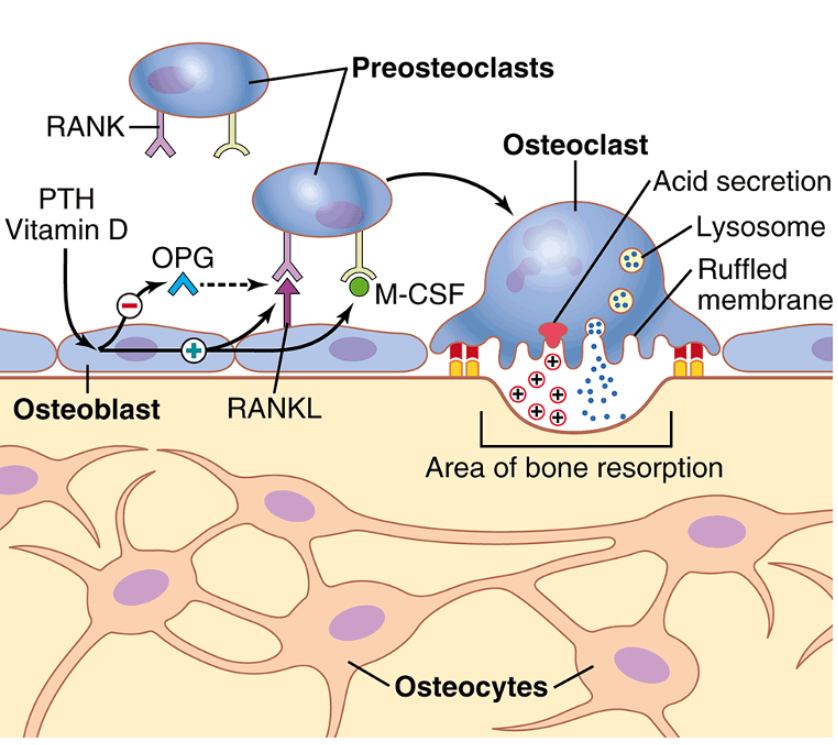
What are the impacts and mechanisms of the following hormones on bone resorbtion?
- PTH
- Cortisol
- Oestrogen
- Promotes: increases RANKL and decreases OPG production by osteoblasts
- Promotes: increases RANKL and decreases OPG production by osteoblasts
- Inhibits: increases OPG production by osteoblasts
What is converted into cholecalciferol in the skin?
7-dehydrocholesterol.
What is the form of vitamin D that is prodcued after activation in the liver?
25-hydroxycholecalciferol (calcidiol)
What is the role of PTH in vitamin D activation?
Allows formation of 1,25-hydroycholecalciferol (active vitamin D3/calcitriol) by the kidneys
What is the cellular mechanism by which vitamin D exerts its effect?
Combined with the VitD receptor which complexes with the retinoid-X-receptor and alters gene transcription.
What is vitamin D’s main impact on calcium homeostasis?
It promotes absorption of calcium from the GIT.
Also important is its synergistic/permissive function on bone resorbtion in combination with PTH.

-
Gastrointestinal Physiology44
-
Metabolism53
-
Endocrine Physiology17
-
Membranes, Nerve, Muscle and Neurophysiology57
-
Renal Physiology90
-
Respiratory Physiology36
-
Cardiovascular Physiology9
-
Haematology (The Basics/Physiology)19
-
Immunology: Cytokines, Cell Markers53
-
ECG19
-
Cardiology: Clinical45
-
EBVM/Stats/Epidemiology4
-
Miscellaneous Pharmacology3
-
Infectious Disease26
-
Endocrine Clinical80
-
GI Clinical65
-
Pancreatic Disease3
-
Hepatic Disease53
-
Renal/Urinary Clinical75
-
Haematology and Immunology: Clinical95
-
Respiratory: Clinical35
-
Oncology35
-
Neuro: Clinical24
-
Pharmacology: Miscellaneous7
-
Renal Physiology COPY90
-
Gastrointestinal Physiology COPY44
-
Metabolism COPY53
-
Membranes, Nerve, Muscle and Neurophysiology COPY57
-
Renal/Urinary Clinical COPY74
-
GI Clinical COPY63
-
Haematology and Immunology: Clinical COPY91
-
Reproduction: Clinical1



