What is a recombinant protein?
Protein produced from the transcription and translation of recombinant DNA
What is recombinant DNA?
DNA produced via bringing together DNA from multiple sources to create sequences not found in the genome
Name some examples of recombinant proteins
- Insulin
- Interferon - Group of signaling proteins made and released by host cells in response to the presence of several viruses
- G-CSF (Granulocyte-colony stimulating factor) - Glycoprotein that stimulates bone marrow to produce and then release granulocytes, a type of white blood cell, into the bloodstream.
What is a transgenic organism?
An organism with an altered genome
What are some of the uses of transgenic organisms?
- Produce disease models
- Improve agricultural yields - genetically modify crops to be resistant to certain pests
What is the function of a nuclease?
An enzyme that cleaves nucleic acids by the phosphodiester bonds between the nucleotides
What are the two different types of nuclease enzyme?
- Ribonuclease (RNase): Cleaves RNA
- Deoxyribonuclease (DNase): Cleaves DNA
What are the 2 types of deoxyribonuclease?
- Exonuclease: Cleaves the DNA from the end of the molecule
- Endonuclease: Cleaves the DNA from within the nucleotide chain
Why are restriction endonucleases (restriction enzymes) called that?
Because they are expressed in bacteria and their function in bacteria is to limit (restrict) the transfer of nucleic acids from the bacteria to phages.
Explain the basic mechanism for how a restriction endonuclease works?
- They recognise a specific sequence
- Then cleave that specific sequence at a recognition site
Name an example of a restriction enzyme. What is the specific recognition sequence that this restriction enzyme recognises?
- EcoRI
- Specific recognition sequence: G/AATTC
- Palindromic complementary sequence: CTTAA/G
What does it mean when it is said that recognition sequences are “palindromic?”
- It means that they can be read the same way in both directions - from 5’ to 3’ or from 3’ to 5’
- It also means that every recogntion sequence also has a complementary palindromic sequence which is the same sequence as the recognition sequence but is read in the opposite direction.
Where specifically does EcoRI cleave within the recognition sequence?
It cleaves between the Guanine and adenine nucleotides of the recogniton sequence
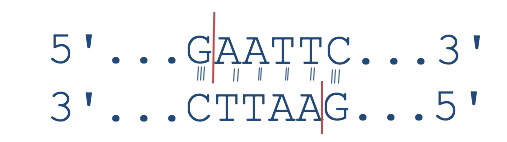
What are the effects of the cleavage from EcoRI on the recognition sequence?
- It creates a 5’ overhang on both the recognition sequence and the palindromic sequence
- Due to the hydrolysis rection that occured on the 3’ end of the guanine nucleotides there are OH groups attached while at the 5’ end of the adenine nucleotides there are phosphate groups attached
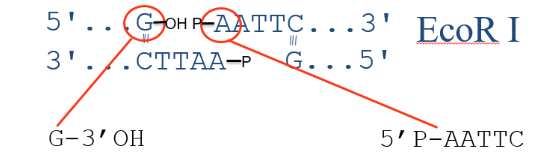
What is an overhang?
- A stretch of unpaired nucleotides within a DNA molecule
- Can be 3’ or 5’ overhang
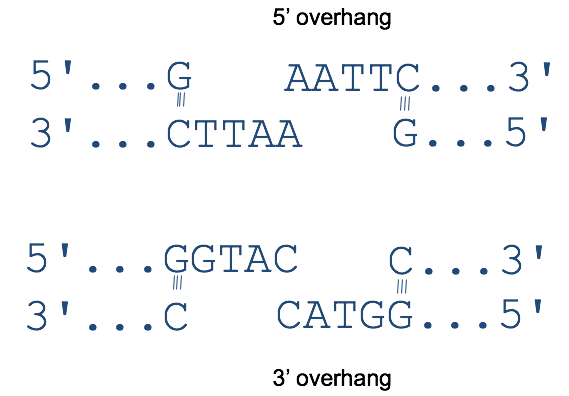
Apart from overhang what other effect can a restriction endonuclease produce within the recognition sequence?
- Can also produce blunt ends which is when both strands of a DNA molecule end in a base pair.
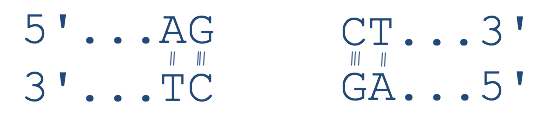
What is a restriction map?
A map of known restriction sites within a sequence of DNA.
Describe a method that can be used to produce a restriction map for a particular plasmid?
- You have a plasmid of known size within a set of test tubes
- To each of the plasmid test tubes you add a different combinations of restriction endonuclease - E.g. In one test tube you add EcoRI; in another you add BamHI and in the final test tube you add both restriction endonucleases.
- You then run PCR for each of the different test tubes at 37 °C for a period of time.
- After this you then use gel electrophoresis to separate the fragments produced within each test tube onto a DNA gel.
- You then work out the size of each of the fragments produced from each restriction enzyme and use these to produce a restriction map
What does the result of the EcoRI lane for gel electrophoresis tell you about how it digests the pDTL3 plasmid?
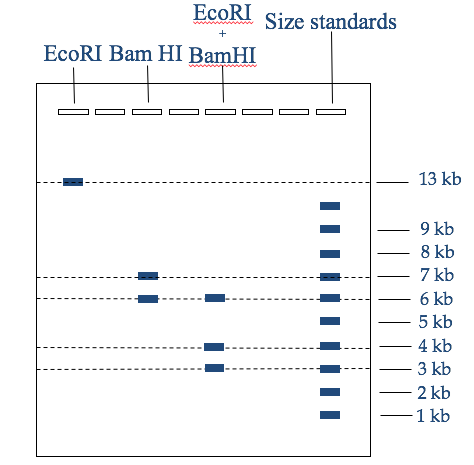
- EcoRI only has one band at 13kb which is the same size as the plasmid
- This means that it didn’t digest the particular sample or if it did it only cleaved the sample at one position
What does the result for the BamHI lane for gel electrophoresis tell you about how it digets the pDTL3 plasmid?
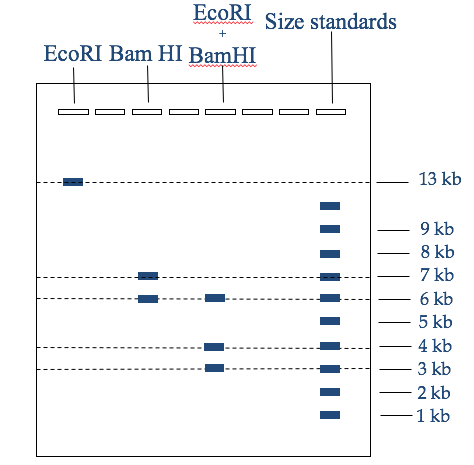
- BamHI produced 2 fragments, one of which is 6kb and the other 7kb
- This means that it cleaved the pDTL3 plasmid twice
What are size standards and why are they run on the DNA gel during gel electrophoresis?
- Size standards are DNA fragments which we know the length of.
- They are used to determine the length of the different DNA fragments produced from the restriction enzyme-plasmid reactions so a restriction map can then be produced
How can the results from the BamHI lane for gel electrophoresis be used to locate the restriction sites for BamHI on a pDTL3 restriction map?
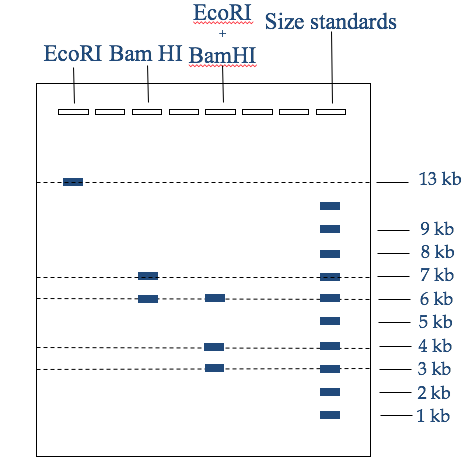
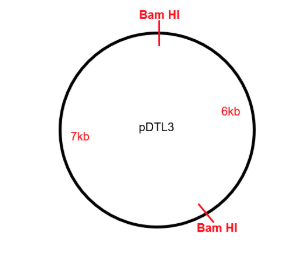
- You know that BamHI produced a 6kb fragment and a 7kb fragment
- You also know that the entire pDTL3 is 13kb in size
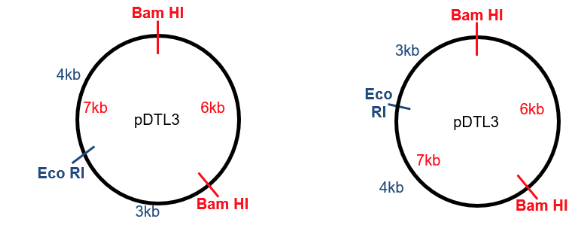
- With this information on a restriction map you simply place one of the restriction sites on the top of the map.
- You can then work out where on the map the other restriction site is because you know the length of the two fragments produced.
Can the results from the EcoRI lane be used to locate where its restriction site/s are on the pDTL3 restriction map?
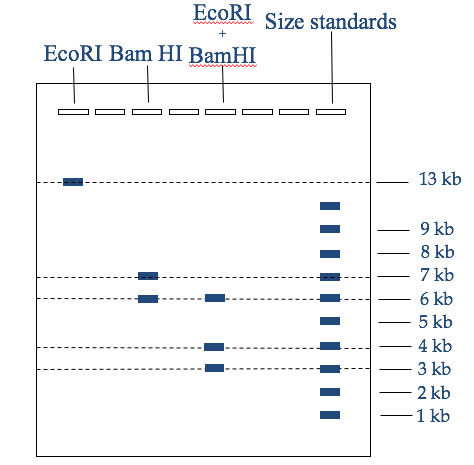
No because the EcoRI only produced one fragment which was the same length as the plasmid so you have no indication of where exactly EcoRI cleaved the plasmid
In this example what can be used to locate the restriction site for EcoRI on the pDTL3 restriction map? Explain how it can be used to do this
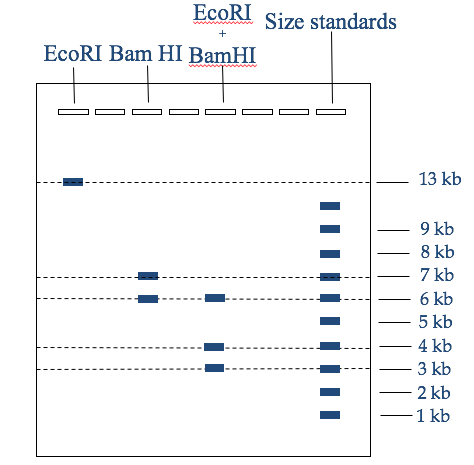
- You have to look at the size of the fragments produced when both restriction endonucleases were used.
- In this example the 6Kb fragment is still produced meaning that within that fragment there is no EcoRI restriction site present.
- However, the 7Kb band produced by BamHI is now split into a 3 and a 4Kb fragment which means the EcoRI restriction site is located within the 7kb fragment produced by BamHI


-
DNA complementarity, hybridisation and its effects30
-
PCR and its roles in diagnostics25
-
Molecular Evolution36
-
Genome structure34
-
Genome variation32
-
Inheritance patterns42
-
Enzyme and restriction mapping42
-
Recombinant DNA and cloning vectors30
-
DNA Sequencing by Dideoxy-chain termination18
-
Linkage Analysis30
-
Microarrays36
-
Next generation sequencing24
-
The Metagenome25
-
The functional genome30
-
The Mitochondrial Genome35
-
The Epigenome31
-
Mapping Mendelian Disease28
-
Genetics of common disease32



