When is market functioning properly?
When S=D and Social Surplus is max.
4 types of goods and their characteristics
- Private Goods - Excludable + Rival e.g. Clothing 2. Public - e.g. Street Lights 3. Common Resources - Rival e.g. Fish in the sea 4. Natural Monopolies - Excludable e.g. Cable TV
How do Gov. decide whether to supply a public good?
Cost-benefit analysis Difficult to estimate: - Absence of prices - Value of life/time? Therefore: - Willingness to pay/accept - Earnings over lifetime?
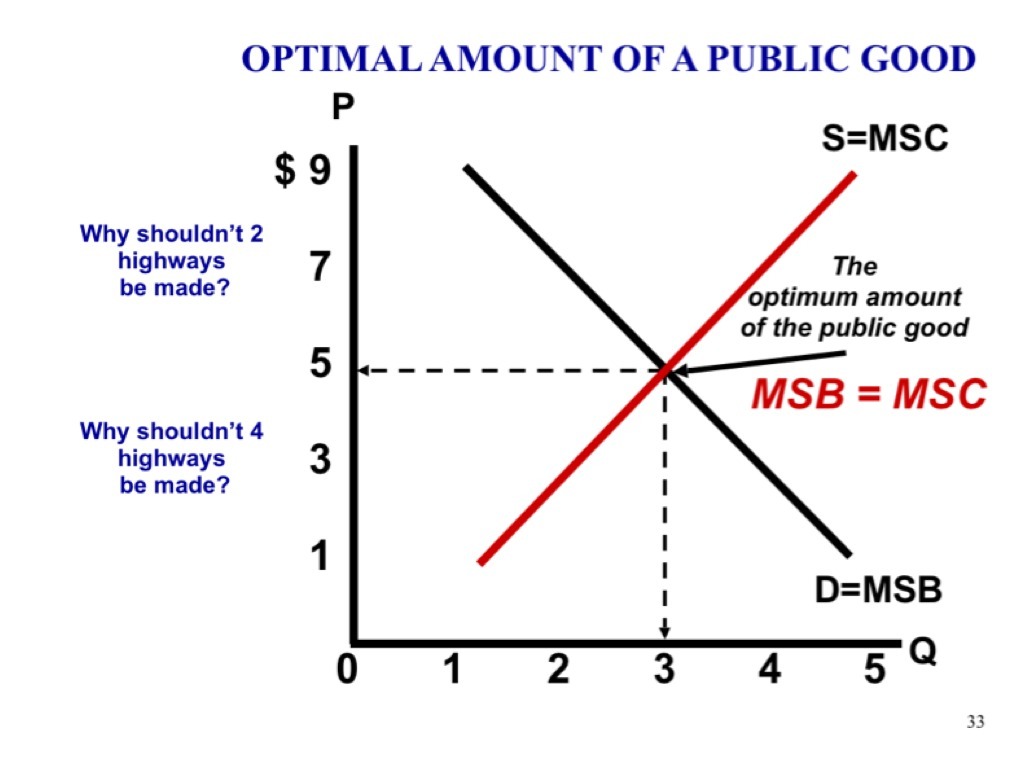
Public Goods Graph
Tragedy of the Commons
The Tragedy of the Commons is a parable that illustrates why common resources get used more than is desirable from the standpoint of society as a whole.
Merit Goods
Goods that provide benefits that the consumer is not fully aware of and therefore underconsumes e.g. College education.
Intertemporal choice = where decisions made today can affect choices facing individuals in the future.
De-merit Goods
Goods that generate both private and social costs which are not taken into account by the decision-maker and are therefore overconsumed e.g. Alcohol.
Internalizing an externality
Altering incentives so that people take account of the external effects of their actions e.g. Using tax
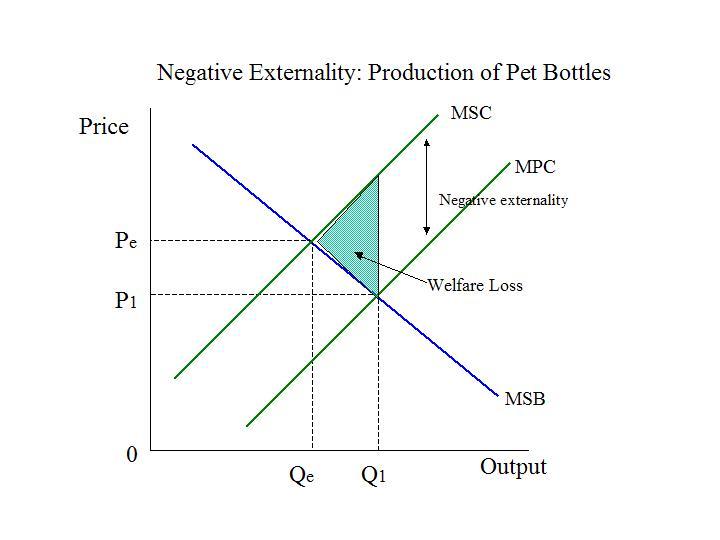
Negative Externality Graph
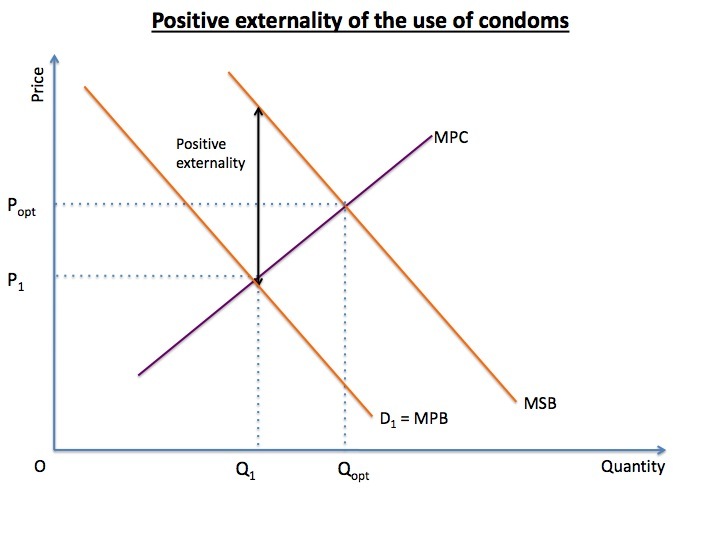
Positive Externality Graph
Why sometimes the market for externalities regulates itself?
Social norms and Moral Behaviour
- Do unto others as you would have them do unto you.
Charities
Self-interest
- Where two firms gain from each other’s presence
Social Contracts
The Coase Theorem
The Coase Theorem is a proposition that if private parties can bargain without cost over the allocation of resources, they can solve the problem of externalities on their own.
But:
- Each party tries to hold out for a better deal.
- Asymmetric Information and Irrational Behaviour.
- Transaction costs are incurred in the process of agreeing to and following through on a bargain.
2 types of policies tackling externalities
- Command-and-control policies.
- Regulation - Market-based policies.
- Taxes
Pigovian Tax
Pigovian taxes are taxes enacted to correct the effects of a negative externality.
4 Ways of tackling negative externalities
- Regulation
- Pigovian taxes
- Trade Permits
- Property rights
Public Choice Theory
Public choice theory is the analysis of governmental behaviour, and the behaviour of individuals who interact with government.
Factors affecting government rational behaviour
- The special-interest effect may lead to minorities gaining significant benefits but the cost is borne by the population as a whole.
- Logrolling is a term used to describe vote trading in government. 3. Rent seeking is where individuals or groups take actions to redirect resources to generate income (rents) for themselves or the group.
- Public sector inefficiency.
- Cronyism (returning favours).
- Inefficiency in the Tax System
Moral Hazard
In economics, moral hazard occurs when one person takes more risks because someone else bears the cost of those risks.
Adverse Selection
When buyers and sellers have different information, it is known as a state of asymmetric information. Traders with better private information about the quality of a product will selectively participate in trades which benefit them the most, at the expense of the other trader. A textbook example is Akerlof’s market for lemons.
Example of signalling
University degree
Example of screening
Insurance companies looking into people’s driving history
Prospect theory
Prospect theory is a behavioral economic theory that describes the way people choose between probabilistic alternatives that involve risk, where the probabilities of outcomes are known. The theory states that people make decisions based on the potential value of losses and gains rather than the final outcome, and that people evaluate these losses and gains using certain heuristics.
Endowment effect
Where the value placed on something owned is greater than on an idenical item not owned.
Why do natural monopolies come about?
An industry is a natural monopoly when a single firm can supply a good or service to an entire market at a smaller cost than could two or more firms.






