What is epidemiology?
Epidemiology- The branch of medicine which deals with the incidence, distribution, and possible control of diseases and other factors relating to health.
Epidemiology- study of the distribution (trends and risks) and determinants (identifying risk factor for COD) of health-related states or events in specified populations and the application (control of this problem) of this study to control the health problem
What is population thinking?
Population thinking: We cannot predict what will happen to an individual, but can predict the outcome of a group
What is group comparison?
Group comparison: To observe effects of treatment or exposure, compare those treated/exposed with those who were not
Why do we need epidemiology
- Many potential causes of disease, for practical or ethical reasons, cannot be studied experimentally
- Epidemiology allows us to monitor and explain changes in trends of disease within a population
- Epidemiology allows us to quantify the potential impact of efforts to maintain and improve population health
Reasons why the shift from infectious to chronic disease in the early 20th century posed a challenge to the discipline of epidemiology?
- Chronic disease is not pathogenic, identifying the cause is harder
- Chronic disease tend to be multifactorial so cause must be disentangled
- Long latency means that temporal directions will be harder to establish
What are the two ways to prevent disease? Why is one way favoured?
Geoffrey Rose- contributes to understanding how to prevent disease in the population. E.g. target prevention at high risk. Other approach is to target prevention at the wider group- more people at lower risk than higher risk of the disease
Higher BP, higher risk of CHD. Given the risk and size of the group is the amount we expect to die. Can see lower risk you save more.
What is the prevention paradox?
“A preventive measure that brings large benefits to the community offers little to each participating individual.”
What is the definition of incidence?
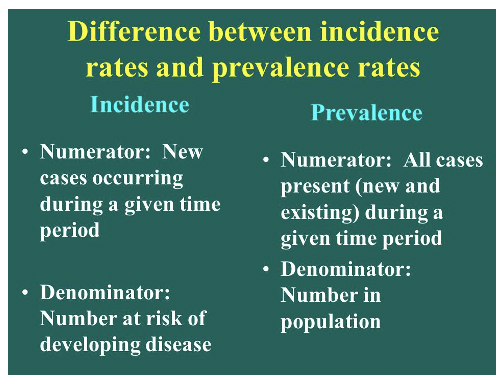
Incidence is the rate at which people contract a disease in the population. It counts the number of new cases over a given period of time, and divides it by the number of people who were at risk of contracting the disease over that time period. It is usually expressed as n cases per N population per t time.
Prevalence defintion?
Prevalence is a measure of how widespread a disease is at a given point in time, or over a given period of time. It counts the number of existing cases and divides it by the total number of people in the population. It is usually expressed as a point or period percentage, i.e., the number of cases per 100 population.
Difference between incidence and prevalence?
Prevalence = Incidence x Disease duration
Definition of absolute risk?
The absolute risk of a disease is the number of occurrences of the disease divided by the number of people at risk. We can therefore only calculate the absolute risk when the size of the population that produced the cases is known (i.e., in a population-based study).
What is relative risk?
The relative risk is a ratio of two absolute risks - the first in a group who were exposed or treated, and the second in another group who remained unexposed or untreated - and can therefore be used to quantify the effect of an exposure or treatment on a disease outcome.
What is risk difference?
A risk difference is the difference in absolute risk among those who were exposed or treated compared with those who remained unexposed or untreated. It is an estimate of the additional number of cases we may expect to arise due to a given exposure, or the number of cases we may expect to be able to prevent with treatment. As such, it can tell us something about the potential impact of a given exposure or treatment.
What is the equation for measure of occurence?
Measure of occurrence = numerator / denominator
What does measure of impact mean?
MEASURE OF IMPACT–> risk difference
What does measure of association mean?
MEASURES OF ASSOCIATION–> Odds ratio and relative risk
What is a numerator in terms of disease occurence?
- Numerator: defines and counts the cases
What is the denominator for disease occurence?
Denominator: population that produced the cases and / or the time over which the cases arose
What does occurence mean?
OCCURRENCE –> incidence and prevalence
What can affect the numerator when couting disease?
Problems can arise when the conditions are difficult to diagnose
- The classification that was used for the diagnosis –> take into account difference in diagnostic criteria / a change in classification
- Take into account pathways to care when estimating disease prevalence based on primary or secondary data
- Take into account stigmas-> will people always tell the truth? Will clinicians be less willing to diagnose a condition?
- Ethnic differences
How can problems affect counting the denominator correctly?
- Selective undercounting of certain groups in a population –> certain groups may be geographically mobile and so less likely to register an address (e.g., travellers)
- Political reasons –> people may be less inclined
- Deaths may not be recorded equally well in certain communities such as indigenous people
- Denominator should not include anyone who cannot become a case –> e.g., if counting uterine cancer, it cannot include women who have had their uterus removed
What is the equation for prevalence?
Prevalence = incidence x disease duration
Suppose that 2,000 people are screened for tuberculosis using chest x-rays: half of those screened live in town A and have higher incomes, the other half live in town B and have lower incomes. The x-ray screens are positive for 100 out of 1,000 people in town A, and for 60 out of 1,000 people in town B (Table 3).
Consider whether we can conclude that the risk of tuberculosis is higher in town A than in town B.
We cannot.
- The reason is that the x-ray results give us a point prevalence (from first two columns).
- They tell us about the number of cases of TB in both towns at the time of screening.
- Because we do not know when the disease started for each individual (i.e., whether they are recent or chronic cases) we can’t conclude anything about the risk of TB in either town.
What is the relative risk?
The relative risk is a ratio of two absolute risks.



