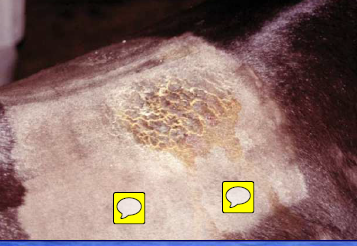
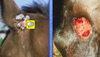
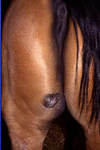
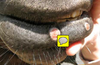
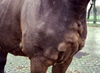
- what condition is this
- discuss clinical appearance
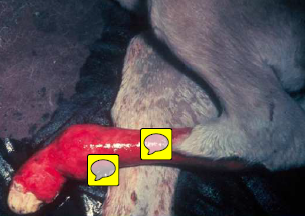
- epitheliogenesis imperfecta =
aplasia cutis congenita
- it is inherited
congenital
simple autosomal recessive trait causing discontinuity of the epithelium in folas - there can be more problems than the skin eg heart problems
- midly affected animals may develop normaly, their ulcers healing by scar formation
*
what condition is this and hown do u tx it
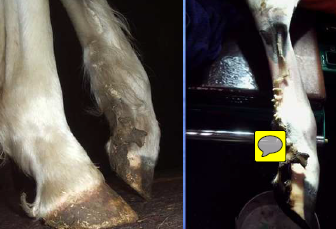
Cornu cutaneum
little horns from the skin.can sx remove it
- what condition is this
*
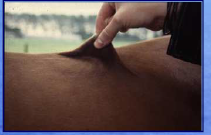
- Hyperelastosis cutis is a congenital connective tissue abnormality that has been described in arabs and quater horses bt has been seen in other breeds incidentally
the skin is hyperelastic(usually on the back and neck) and tears easily. wounds are slow to heal or fail to heal at all. foals with this abnormality will die quickly but sometimes it only becomes clinically obvious and significant at a later age. there is no therapy but when the disease is not too extended horses may useable when txd carefully
- more important in belgian horses
discuss the mechanism for Hyperelastosis cutis
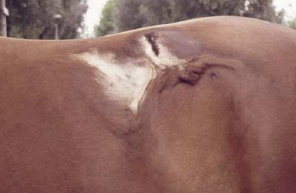
= dermatosparaxis = Ehler-Danlos =
hyperelastosis cutis
in the Quarter horse it is an autosomal
recessive trait
gene mutation in a protein structure of
collagen (cyclophilin B mutation)
is seen in many breeds
in Quarter horse there is DNA test for
congenital and hereditary problems
took the bx and horse got more skin.
they get more big wounds wen they get wounds
what condition is this
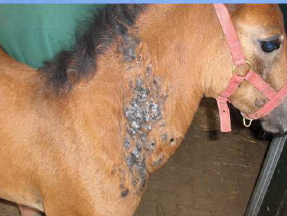
Melanocytic nevi = congenital melanoma
in a newborn foal
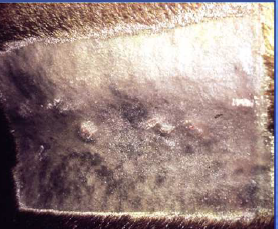
ermoid cyst
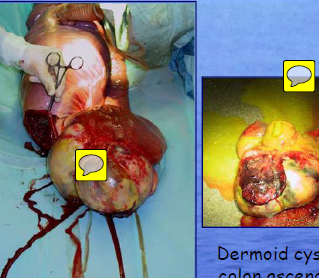
dermoid cyst
in gut.can be in different places
can be removed by sx if necessary
bt heal by primary intentions
discuss mechanism for this dz
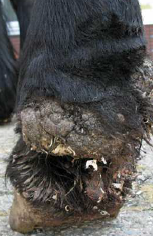
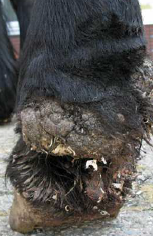
Congenital progressive lymphoedema
starts mostly with Chorioptic mange
all four limbs (often hind worse)
starts 2-4 years at plantar sides and
progresses
develop plaques, tuberous skin masses
and ulcerations
secondary infections worsen the problem
lymphangitis is common
cant tx it never try sx it gets worse
mechanisms for Congenital progressive lymphoedema
pathological degradation of elastic fibres
in the dermis and the lymphatic vessels
leads to a deficient support of the distal
lymphatics
lower elastine concentrations
affected horses have increased levels of
serum anti-elastin antibodies
lymph drainage is defective
interstitial fluid stasis and delayed
lymphatic drainage
which dz is this
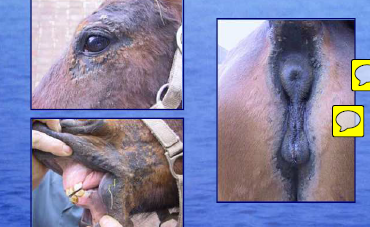
- pemphigus foliaceus is the commonest form occuring in horses of all ages.
clinical features includes vesiles,pustules and crusts in the body and there may be concurent signs of systemic illness eg depression, poor appetite pyrexia and limb oedema - if u clean the skin u wont get the dx
- tx usually involves long term of high doese of corticosteroids. the px is poor for all affected horses but s somewhat better for yun yun horses where the dz is dx early and tx aggressively
how do u make dx for this dz
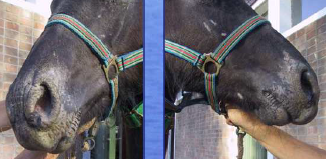
bx
pemphigus foliacus
what condition is this
alopecia areata
idiopathic non inflamatory skin disoder characterised by often more or less patches of alopecia.affected horses are often refered for non responsive dermatophytosis9ring worms).the skin is however grossly normal and just the hairs are missing.
the condition is symptomlessas far as the horse is concerned.
skin bx is unrewarding
tx for alopecia areata
do nothing
may heal after amny yrs
what condition is this
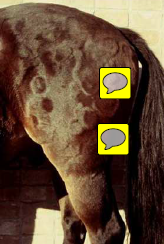
Erythema multiforme
it looks like uticaria
can only dx with bx
it is rare acute self limiting urticaria like dz of unknown etiology characterised by annularelevations covered with intact skin,rather like donuts under the skin. the eruptions are non pruritic and will often disappear within 1-3 mnths. there is usually a very poor response to corticosteroids therapy even at high doses
what condition is this
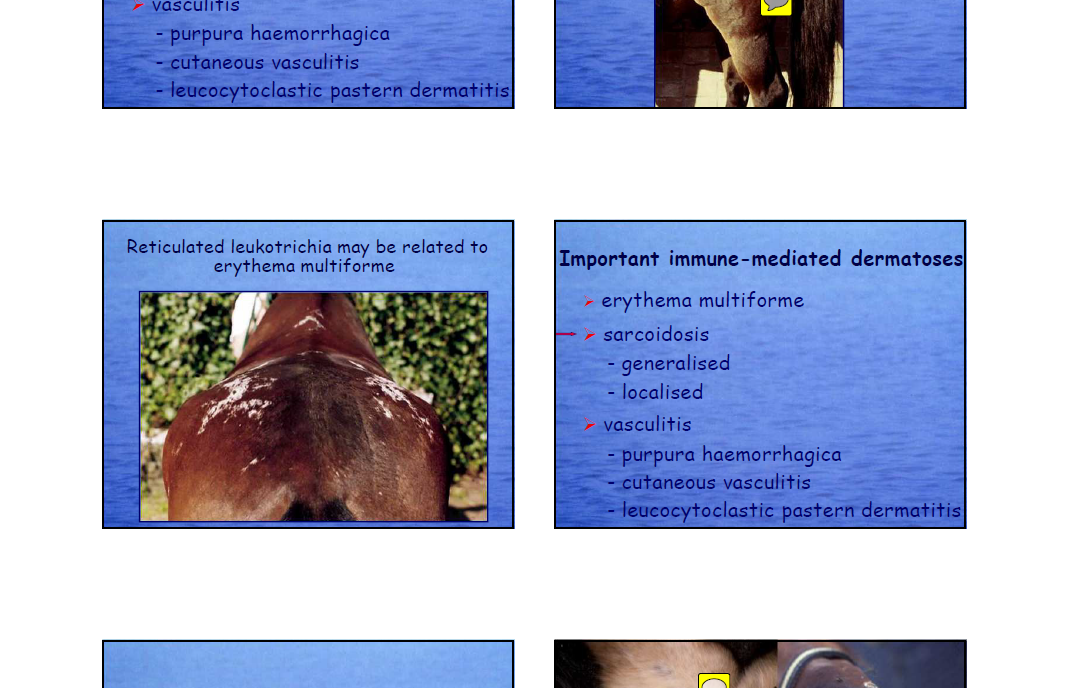
Reticulated leukotrichia may be related to
erythema multiforme
what condition is this
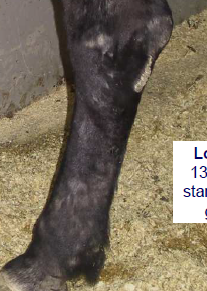
Equine sarcoidosis
equine sarcoids is described as a systemic dz associated with exfoliative dermatitis, severe wasting and sarcoidal like dermatitison only one or two lower limbs. the dz starts with scalling,crusting and thinner hair coat on the affected limb. those horses are nt systemically ill and may perform well. if untreated the dermatitis deteriorates and the crusting gets more severe. then the horse gets lame.
the dx is confirmed histopathologically in a skin bx. the px for full recovery is poor, bt on a low dose of corticosterids after an initial txment weeks with a high doses corticosteroid theses horses are useable for plesure riding
nb. no local tx should be done as the skin is already fragile
it doesnt heal
what condition is this
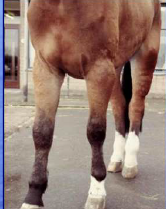
vasculitis is nt a dx bt a symptom in which there are histological evidence of inflammatory changes in the walls of the bvs. etiology is unknown and associated with a broad spectrum of dzs
in some instances, equine cutaneous vasculitis hav been restricte to the pink skinned and white haired areas of the pasterns and face, suggesting a photo induced process.
it is common and affect mature horses bt no sex predilection.
what are the lesions of vasculitis
lesions are initially erythema,oozingcrusting, erosionsand superficial ulcerations develop followed by edema.
in chronic cases the lesions develop a rough “warty” surface
vasculitis may come after other dz like influenza,strangles etc
they may be very ill, fever etc
pathogenesis of vasculitis
the pathogenesis is uncertain bt it is probably an immune dz.
the dz is nt a true photosensitization
dx based on bx
what is the lesions of this dz
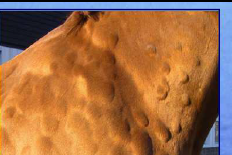
usually manifests as transient, elevated patches known as wheals. these wheals are the result of oedema in the corium.lesion may show amber colored fluid as a result of serum leakage
when the transdudate dries thick crusts between
uticaria has multiple causes but they all cause degranulation of mast cells within the skin.
tx for urticaria
tx is only indicated when the lesions are exudative (indicating a more severe response).
use corticosteroids
dnt tx unless u see oozing of serum
cnt dx uticaria by test
what condition is this
and where does it occur
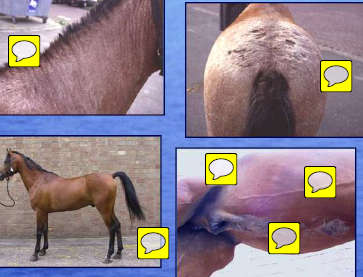
insect hypersensitivity
nt only mane and tail bt sometimes abdomen
it is by far the commonest cause of pruritus in a horse
there is a strong seasonality to the disorder
repeated episodes results in moderate or severe hair loss,skin theckening and even exudation with open self inflicted skin excoriation.
culicoids is the causative factor
best way to dx it is to put a horse in a clean dark more less bug free stable.in most cases the symptoms will disappear in 2-4 wks.
signalment ,cs , dx,tx, px of atopy
rare, often young horses
genetically predisposed?
dominant sign is pruritus
diagnosis on exclusion of other causes
intradermal or serum ELISA tests??
treatment limited to corticosteroids
prognosis guarded,
what causes sadle
it is associated with insufficient hygine but individual horsesseems to be more liableto the dz and there may be individual sensitivity or predilection.
the condition is mostly seem in late winter and early spring when there is a combination of circumstances involving a thick haircoat, lack of grooming hygyiene and dirty tack.dirt between the saddle and the skin results in irritation and inflamation. the distribution of the scabs and alopeciaare characteristic and the area may be painful.secondary bacterial infection may occur causing folliculitis.
the condition occurs in experienced horses that havent been riden for some time and now they are suddenly riden again.
tx is skin hygyine measures and rest