Describe the growth chart with the 4 different curves on it.
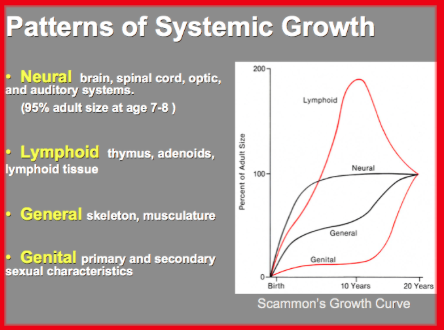
What is the least accurate assessment of growth development?
Chonological age - birthday candles
Describe the growth patterns of the maxilla and mandible.
- Maxilla
- Intramembranous ossification
- Moves out from under cranium - downward and forward
- Mandible
- Endochondral and Intramembranous ossification
- Chin - downward & forward
- Condyle - upward & backward
- Ramus - grows away from chin
What is the primary growth of the cranium, when does most of it happen?
- The first few years
- Sutures & synchondroses
- Fontanelles
When are the first signs of tooth initiation show up?
6 weeks in utero
What is the sequence of eruption for primary teeth?
ABDCE
What is the sequence of eruption for permanent maxillary and mandibular teeth?
- Maxillary - 6-1-2-4-5-3-7-8
- Mandibular - 6-1-2-3-4-5-7-8
What are the 3 different types of inlcusions cysts?
- Epstein’s Pearls
- Bohn’s nodules
- Dental Lamina cysts
What can be found on buccal and lingual aspects of dental ridges/junction of hard and soft palate and are also remnants of mucous gland tissue?
Bohn’s nodules
What inclusion cyst can be found at the crest of the alveolar ridge and are remnants of dental lamina?
Dental Lamina Cysts
What inclusion cyst can be found trapped along midpalatal raphe and are remnants of epithelial tissue?
Epstein’s Pearls
Describe the way occlusion is assessed in primary teeth.
- Molar to Molar
- Mesial Step - Class I
- Distal Step - Class II
- Exaggerated Mesial Step - Class III
What is the formula to calculate total space available?
Tanaka Johnson
Mandibular incisors/2 +11 (max, 10.5 mand)
for full arch X2 + measured space
What type of space management would you use on the mandible for multiple teeth with bilateral loss?
Lower Lingual Holding Arch (LLHA)
What space management would you use for bilateral loss on the maxilla?
Nance or Transpalatal
What space management would you use for a single tooth, out of occlusion?
Band & Loop
What space management would you use for unilateral single tooth?
Distal Shoe
*Careful in medically compromised
Describe the “Tell-Show-Do” method.
Tell-show-do - teaches aspects of visit and familiarizes, desensitizes and covers expectations
Tells - patient what will happen
Shows - on patient’s hand, etc
Do - the treatment as said
What is the appropriate use of passive restraint?
- Hands over patients hands or arms
What is the appropriate use of active restraint?
- Holding hands, legs, shoulders, etc
- Knee to knee
- Mouth props are not protective stabilization**
What is the primary source of Strep Mutans in children?
Maternal Vertical Transmission
What are the indications for a stainless steel crown?
- Coronal breakdown
- Marginal ridge break through
- Cervical caries
- Multiple proximal surfaces
- Hypoplasia
- Pulp therapy
- Caries risk, other materials likely to fail
- Special needs
- General anesthesia
What are the indications for filling restorations?
- Proximal caries
- No marginal ridge break-through
- No cervical caries
- No MOD’s in proximal molars!!
What makes a crown stay on a tooth?
Cement and contours of the crown (undercuts)




