What is the formula for finding the determinant of a 2 x 2 matrix?
ad-bc
How do you find the determinant of a square matrix that is larger than 3 x 3?
- Eliminate any row
- Eliminate any column
- Find the cofactor of resulting 3x3 matrix
- Weight the cofactor by scalar at cross section of deleted row and column
- Repeat steps 2-4 for other 3 columns
- Sum the 4 weighted cofactors
Note: Step 3 can be broken down into two steps if you want to be more specific (the minor step, and then the (-1)i+j step).
How do you calculate the inverse of a matrix?
Just remember, My Cat Does Tricks:
Matrix of Minors - create a matrix that is the same size as the matrix you want the inverse of, with each cell consisting of minors (these minors were calculated by finding the determinant of each submatrix formed by deleting one row and one column of the larger matrix)
Matrix of Cofactors - create a similarly sized matrix consisting of the cofactors of the larger matrix
Determinant Division - divide the previous matrix by the determinant of the larger matrix
Transpose - transpose the previous matrix
What is the formula for converting an eigenvector to a normalized eigenvector?
ei= xi/ √(x’x)
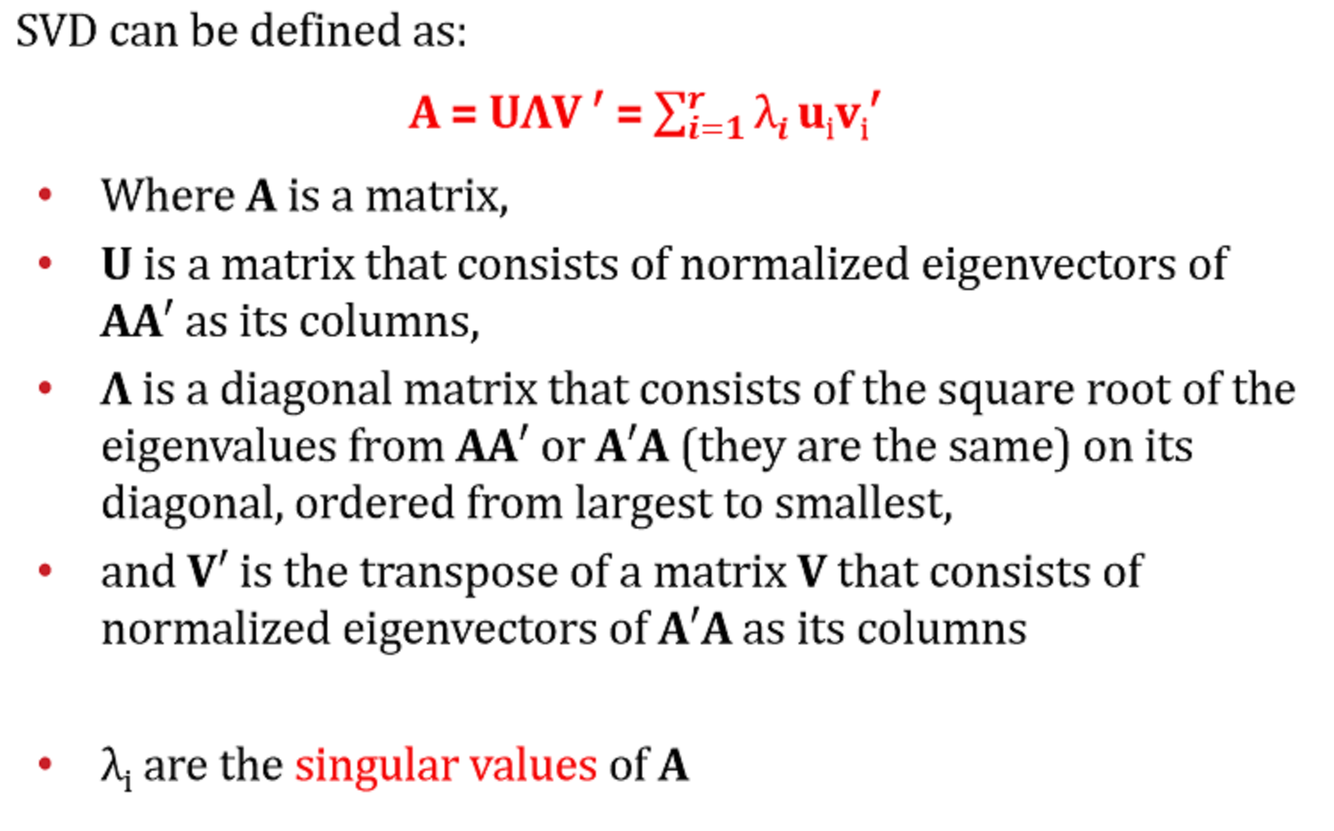
How do you formulate the SVD of a matrix?
What is the matrix equation for latent variables in the general SEM model?
- η = Bη + Γξ + ζ, or
- η = (I – B)‐1(Γξ + ζ)
What are the equations for the measurement model in the general SEM model?
- x = Λxξ + δ
- y = Λyη + ε
What is the fundamental equation for SEM with observed variables?
y = Βy + Γx + ζ
Note the following as well:
- Βy + Γx = hypothesized explanation for the covariances of y and x
- ζ = unexplained variance in y (residual)
- so, from now on, the observed x and y are assumed to equal the corresponding ξ and η
- and, the implicit measurement model is
y= η
x = ξ
What are some of the “cardinal sins” of SEM?
- Don’t run a model without drawing it first
- Don’t look at the path coefficients or factor loadings of a model if the general model fit is poor
- Don’t use automodify when using software packages because then you are creating models that may not make theoretical sense
- Only make changes to a model based on MI values if the changes would make theoretical sense
- If a model has Heywood cases (negative variances or standardized loadings above 1), it is most likely misspecified so do not assume it is a good fit even if otherwise it looks great
- Never put unstandardized estimates within a paper or presentation
- You can only allow errors to correlate it it makes theoretical sense
- Don’t use a measure in your general SEM if your CFA provided evidence of it being terrible
- Don’t cherry pick model fit indices, have ones you are using beforehand and stick to them.
- Never look at the fit of a model only, make sure you also look at the path coefficients, factor loadings, error variances, etc.
- Both overall (absolute) and individual fit (relative) should be assessed, NEVER ONE OR THE OTHER!
What is the difference between a relative/incremental fit indice and an absolute fit indice?
Relative fit indices compare a chi-square for the model tested to one from a so-called null model (also called a “baseline” or “independence” model). The null model is a model in which all measured variables are uncorrelated (there are no latent variables) - which should have very poor fit. Relative fit indices are analogous to R2.
Absolute fit indices do not use an alternative model as a base for comparison - they are just derived from the fit of the obtained and implied covariance matrices and the estimation function. These measures are really a “badness” of fit index in that bigger is worse.
What are some examples of absolute fit indices, and what cutoffs are associated with different qualities of fit?
Examples
- Root mean square residual (RMR)
- Standardized root mean square residual (SRMR)
- Goodness of fit index (GFI and AGFI)
- Chi square
Cut-offs
- above .10 = poor fit
- between .08 and .06 = moderate fit
- below .06 = good fit
- NOTE: She also has said that below .08 = good fit (on one slide)
What are some examples of relative fit indices, and what cutoffs are associated with different qualities of fit?
Examples
- Normed fit index (NFI)
- Incremental fit index (IFI)
- Relative fit index (RFI)
- Tucker-Lewis Index (TLI) or Non-normed fit index (NNFI)
Cut-offs
- below .90 = poor fit
- between .90 and .95 = moderate fit
- above .95 = good fit
- NOTE: She also has said that above .95 = good fit (on one slide)
What are some problems with using modification indices (MIs)?
- You may free a parameter that does not make sense theoretically. This occurs when you do this simply because the MI was high. If you do this then you are using an EXPLORATORY style of model evaluation, CAPITALIZING ON CHANCE, and should make it clear that this was done POST-HOC.
- If you do choose to modify based on MIs alone then you should cross-validate (test the model with another sample)
- A MI for one path may actually be dependent on several parameters
- This is because the estimation techniques used in SEM programs are what is known as full information estimators
- This means that they use information from one part of the model in obtaining estimates for the other parts
- Because of this, misspecification in one part of the model can be spread to other parts
- An additional implication of this is that adding a path to “correct” a misspecification in one part of the model might actually introduce misspecification into another part of the model
- MI problems become even larger if the N is small
- MI problems become larger the more misspecified the model is
When can you multiply two matrices and how do you know what size your resulting matrix will be?
When?
- If the # of columns of the first matrix is the same as the # of rows in the second matrix
Size of resulting matrix?
- Your resulting matrix will have an order of the following
- Row # equal to the row # of the first matrix
- Column # equal to the column # of the second matrix
*
What is the formula for finding the determinant of a 3 x 3 matrix?
aei + dhc + gfb - (ceg + fha + idb)
What is the purpose of calculating the Singular Decomposition Value (SVD) of a matrix?
It is a data reduction technique that can helps us reduce the data down to “x” unique pieces of information. This technique not only reduces the data to a more easily digested format, but it also indicates how important each piece of information is towards predicting future similar data.
How is general SEM different from SEM with observed variables and confirmatory factor analysis (CFA)?
General SEM contains both measurement models AND a path model (this path model connects the various measurement models). That is, SEM with observed variables and CFA are both special cases of the general model. Thus, it provides researchers with the ability to both assess how well their measures relate to their proposed latent constructs (via a linear function to the construct and the error of the measure) and whether there are causal relationships among said latent constructs.
Bulleted answer
General SEM models contain:
- Measurement models that operationally define a set of theoretical concepts (latent constructs), allowing for fallible measurement
- A path model that explains complex relationships among a set of (mostly) latent variables
How is SEM with observed variables different from general SEM and CFA?
- SEM with observed variables is a special case of general SEM.
- SEM with observed variables assumes that all variables are measured without error
- From a measurement perspective y and x may be considered “single-indicator latent variables”).
- Thus, it is focused on understanding the causal relationships between various measures.
- There is no emphasis in SEM with observed variables on how good your measures are.
- SEM with observed variables is also called path analysis.
- All error terms are uncorrelated
How is CFA different from general SEM and SEM with observed variables?
- CFA is a test of the measurement model, which can include 1 latent variable or all of the latent variables you are including in your study
- This helps us identify how well our items (indicators, measures, etc.) represent our latent constructs




