“n”
Designation
The number of chromosomes in a cell.
Diploid = 2n
Haploid = n
“N”
Designation
The amount of DNA in a haploid genome.
3x10⁹ base pairs
Bivalent
Sister chromatids attached at the centromere.
Cell Cycle
Stages
- Interphase
- Prophase
- Prometaphase
- Metaphase
- Anaphase
- Telophase and cytokinesis
Interphase
- G1: makes proteins needed for replication
- S: DNA replication
- G2: grows, makes microtubules
Prophase
- Chromosomes condense and coil
- Becomes visible by LM
- Centrioles migrate to opposite poles
- Centrosomes start to form mitotic spindle
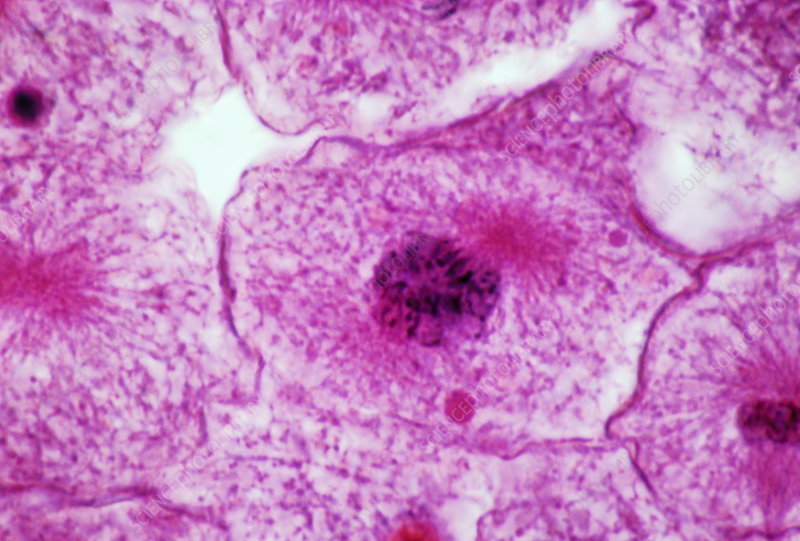
Prometaphase
Nuclear membrane disappears
Metaphase
- Mitotic spindles attach to centromere @ kinetocore
- Chromosomes align on metaphase plate
- Continues to condense
- Most karyotyping taken here
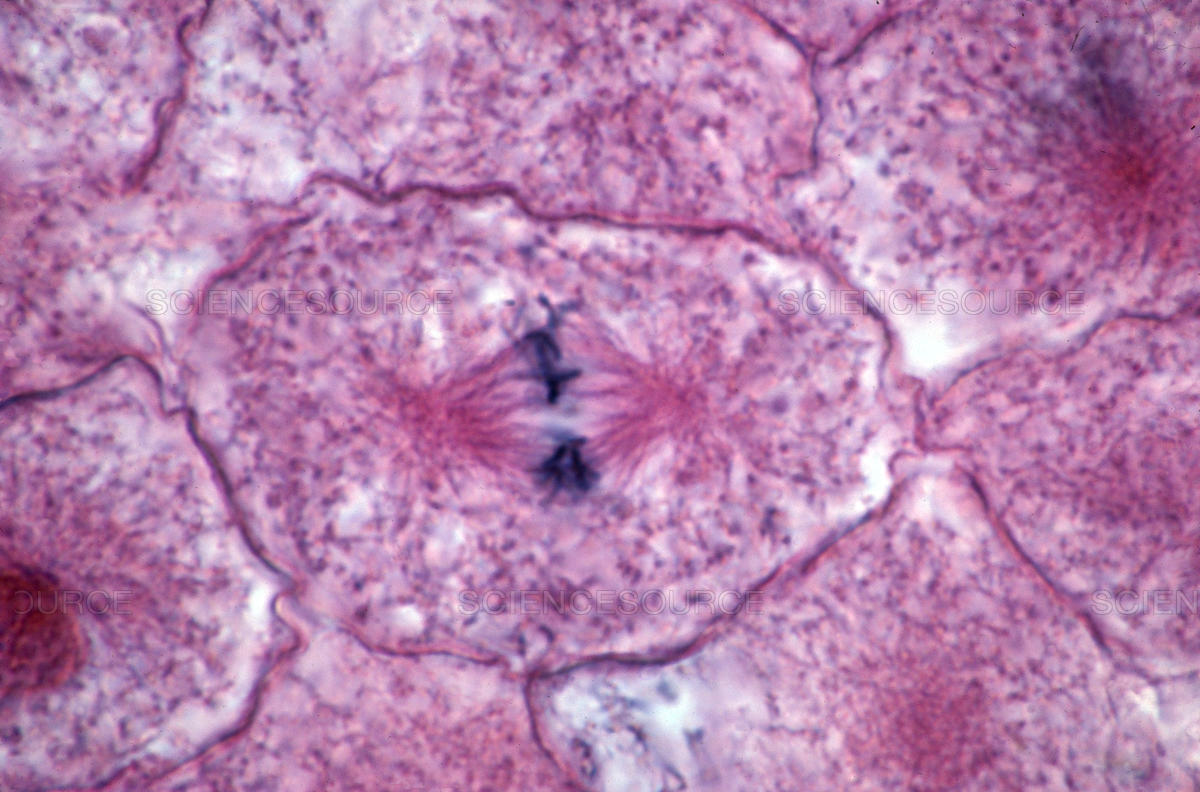
Anaphase
Sister chromatids split at centromere and separate.
Guided by spindle fibers and centrioles.
Telophase
Chromosomes have migrated to opposite ends of the cell.
Nuclear envelops begins to reform.
Cytokinesis forms two daughter cells.
Cell Cycle
Checkpoints
- Exists throughout interphase and M-phase.
- Ensures steps occured correctly.
- Apoptosis can be a normal process here.
Mitotic Spindle
Drugs
Halts cell cycle in metaphase.
- Vincristine (Oncovin)
- Binds tubulin dimer preventing microtubule assembly
- Paclitaxel (Taxol)
- Prevents depolymerization of microtubules
Meiosis
Characteristics
Reductive division
- Produces haploid gametes
- 1 n chromosomes
- 1 N base pairs
- Meiosis I ⇒ seperates homologous chromosomes
- Promotes genetic variation
- Independent assortment
- Recombination
Tetrads
2 homologous chromosomes = 4 sister chromatids
Meiosis I seperates homologous chromosomes
4N ⇒ 2N
Meiosis II seperates sister chromatids
2N ⇒ N
Synapsis
“Crossing-over”
- Occurs during prophase I
- Chiasmata: site where crossing over occurs
- # formed depends on chromosome size
Equatorial Divisions
Cell division where the number of chromosomes remains the same.
i.e. Mitosis and Meiosis II
Anaphase Lag
Delayed chromosome movment during anaphse of mitosis or meiosis.
- Lagging chromosome not incoorporated into new nucleus
- Can occur with chromosomes or chromatid
- Failure to connect to spindle apparatus
- Moves too slow
- Normal cell forms 1 normal karyotype and 1 monosomy
- Trisomy cell forms 1 trisomy karyotype and 1 “normal” karyotype ⇒ trisomy rescue
Uniparental Disomy
When both copies of a chromosome are inherited from one parent.
Usually results from anaphase lag then aneuploidy correction.
Non-disjunction
Failure of one or more chromosomes/chromatids to separate appropriately during mitosis or meiosis.
- Meiosis ⇒ aneuploidy of all cells
- Meiosis I ⇒ 2 cells w/ extra chromosomes, 2 cells w/ no chromosomes
- Meiosis II ⇒ 1 cell w/ extra, 1 cell with none, and 2 normal cells
- Mitosis ⇒ mosaicism
Mosaicism
Definition
Single individual with two or more genetically different cell types.
Euploidy
Normal chromosome number.
46 chromosomes
Trisomy
47 chromosomes
Usually incompatible with life ⇒ spontaneous abortion
Except trisomy 21, 13, 18, XXX, XXY, XYY
Monosomy
45 chromosomes
Usually incompatible with life except for Turner’s syndrome (45,X)
Spermatogenesis
Steps
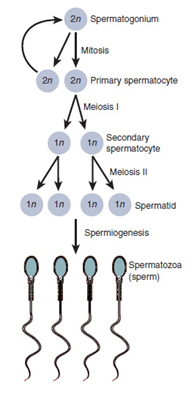
Type A spermatogonia ⇒ mitosis ⇒ some type A spermatogonia & some type B spermatogonia
Type B spermatogonium ⇒ mitosis ⇒ primary spermatocytes (diploid, 2N)
Primary spermatocyte ⇒ meiosis I ⇒ secondary spermatocytes (diploid, 2N)
Secondary spermatocyte ⇒ meiosis II ⇒ spermatids
Spermatids ⇒ spermiogenesis ⇒ spermatozoa


-
Exam 1 Biochemistry Thread137
-
Exam 1 Embryology Thread36
-
Exam 1 Genetics Thread143
-
Exam 1 Microanatomy Thread90
-
Exam 2: Biochemistry286
-
Exam 2: Embryology29
-
Exam 2: Genetics176
-
Exam 2: Microanatomy0
-
Exam 2: Nutrition83
-
Exam 2: Physiology98
-
Need to Know Numbers for Nutrition23
-
Genetic Diseases1



