Adverse Outcome Pathways
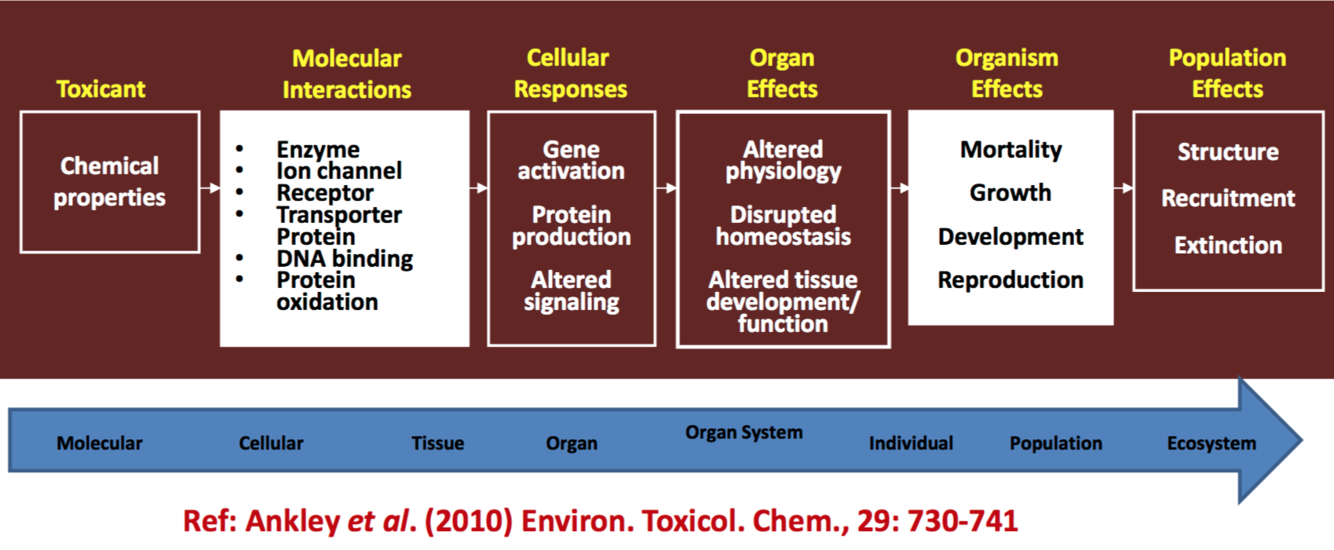
Oxidative stress
compounding factors
Technical:
- Tissue/species specific variation for basic procedures
Biological
- Age, sex
- reproductive phase
- tissue
Seasonal
- Metals
- Temprature
- Food availability
- Oxygen levels
- UV exposure
Lake Apopka
Alligator population
- From 1957-1981: Tower chemical Co. maunfactured both chlorinated and OP insecticides as well as copper based fungicide as a site 1.5 miles from lake Apopka.
Wastewater from the manufacturing process was discharged into an unlined pond.
During heavy rain in 1980 the percolation pond overflowed; discharged into lake
DDT and other chemicals contaminated the lake
DDT and other pesticides also entered lake as a result of extensive agriculture
DDT’s degraded products-DDE and DDD prime suspects for reproductive abnormalties
[Low hatching rates; depressed testosterone levels in males; raised estrogen levels in females; Mulitple egg cells in folicles; indeterminate male genitalia]
Aromatase in female fish
Aromatase inhibition - Reduced E@, Vtg synthesis - Impaired vitellogenesis - reduced fecundity
Fish intersex
Early 1980’s
‘Male roach’ were found to be developing eggs
The ‘pill’ affecting the sex of fish
estrogen
Male fish contained high amount of yolk protein precursor vitellogenin
Consequences of Biliary Excretion
Increased half-life when compound reabsorbed Toxic metabolites in the gut Increased hepatic exposure; enterohepatic recycling Gut bacteria alter absorption or toxicity of metabolites Saturation of the bile: liver necrosis
OECD Test 201
Algae (unicellular) - exposed for 72hrs Recorded density (growth) and growth rate Quality criteria - x16 increase in growth 3 days prior - test substance 80% of initial pH within 1.5 units, temp within 2 degrees
OECD Test 236
Acute toxicity test - Fish Embryo Static semi-static, flow-though Control, 5 concentrations, 7 fish/concentration 96h test; record mortalities at 24h intervals - Invalid test: 10% mortality D.O. falls below 60% uncertainty of test substance concentration (80%) pH change of 1 unit Reference substances Solvent controls
Dose Dose-response
- Amount of substance administered/body weight - the dose (amount) that produces a specified effect (e.g. death) Toxicity is a function of exposure time AND dose
Biotransformation
2 Phases - Depends on, physiochemical propertied of compound - enzyme type & activity in target organs Phase I: adding a functional (reactive) group Phase II: conjugation to increase water solubility
Glyphosate
Herbicide Molecular weight = 161.1
Cyermethrin
Insecticide Molecular weight 416.3
Excretion Mechanisms
Gills: - low MW, non-polar organic; by diffusion - metals; active transport mechanisms - paracellular routes? Kidney - many compounds removed by filtration - MW
TBT and dogwhelks
Observed in 1970
Virilization of femal prosobranchs termed inposex
Formation of a penis and/or vas defence on female gonochoristic prosobranch species.
Absorption of toxins across the gut
Depends on physic-chemical properties of the compound Effected by pH - oesophagus neutral - stomach pH 2 anterior intestine ~pH 6 Lipid soluble: thought gut Weak acids: mostly stomach Weak bases, and some weak acids: small intestine Strong acids/alkali; carrier mediated Phagocytosis: e.g. botulinum toxin (micro-organisms, food type and ration size
Fluoxetine
Pharmaceutical Molecular weight = 309.33
Absorption routes
Gills Gut Skin - Epidermis
Endocrine distrupting Chemicals
Natural and sysnthetic hormones: Oral Contraception
Phyto-oestrogens: Present in food such as soyabeans, cabbage, grains
Alkylphenols and Alkylphenols ethoxylates (APE’s) - Industrial non-ionic, surfactants, detergents, paints, herbicides, pesticides, pulp and paper manufacturing
Phthalates - plasticizers, apints, inks, adhesives
Biphenol A - expoy resins: food cans, bottle tops water pipes
Pesticides - DDT dieldrin, lindane
Polycholrinated Biphenyls (PCBs) - electrical transformers, hrdraulic fuel, flame retardants
Dioxins (product of combustion), Antifouling agents, heavy metals (cadmium, lead and mercury)
Excretion Mechanism: Liver
Especially important for Large polar and amphipathic substances that cannot be filtered by kidney Excreted in the bile, produced by hepatocytes Compound eliminated with faeces Bile production is an active process - transporters for neutral, anionic, cationic compounds
Endocrine disrupting agents: definition
- an exogenous agent that interferes with the, synthesis, secretion, transport, binding, action or elimination of natural hormones in the body that is responsible for the maintenance of homeostatis, reproduction, development and/or behaviour.
- An endocrine disruptor is an exogenous substance that causes adverse effects in an intact orgainism, or it’s offspring, subsequent to changes in endocrine function.
Chemical Distribution
Depends on frequency of exposure site of entry into the animal effect of pollutant on blood flow and distribution Plasma concentration will greatly influence equilibrium between blood and tissues - small molecules : pores in capillaries, dissolve in lipid membranes
Nonylphenol
Detergent Molecular weight = 220.35
Exposure via Gills
large surface area small diffusion distance high blood flow few cell layers mucous cells offer some protection trade of with respiration




