1
Q
Describe this experiment
A
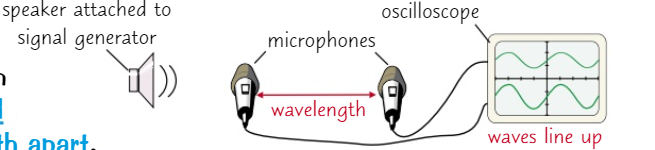
- Attatch a signal generator to a speaker to generate a sound with a specific frequency
- Set up the oscilloscope so the detected waves at each microphone are shown as separate waves.
- Start with both microphones next to the speaker, then slowly move one away until the two waves on the oscilloscope have aligned but are one wavelength apart
- Use v=fλ to find the speed (v) of the sound waves passing through the air
- The speed of sound in air is around 330 m/s so check your results roughly agree
2
Q
Describe this experiment
A
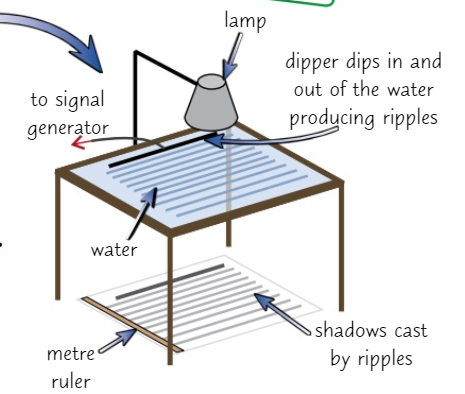
- Create water waves in the tank at a set frequency, using the signal generator attached to the dipper of a ripple tank
- Dim the lights and turn on the lamp to see the wave crests as shadows
- The distance between each shadow lenth is 1 wavelength. Measure the distance between shadow lines that are 10 wavelengths and divide the distance by 10 to find the average wavelength.
- Use v=fλ to calculate the wave speed of the waves
3
Q
Describe this experiment
A
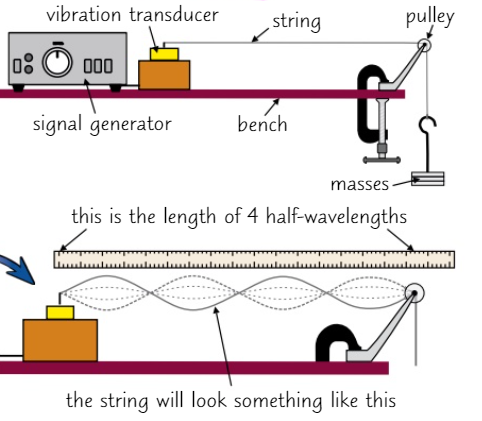
- Set up the experiment as shown and then turn on the signal generator and vibration transducer so the string will start to vibrate.
- Adjust the frequency of the signal generator until there’s a clear wave on the string
- Measure the wavelength of 1 wave
- The frequency is whatever the signal generator is set to
- You can find the speed of the wave using v=fλ




