You should avoid grapefruit if you are taking which drug?
Atorvastatin
What are the symptoms of HDN? (5-6)
- jaundice due to bilirubin build up in the body - the liver cannot filter the excesive amounts from RBC breakdown
- biliruibin may casue kernicterus in the brain - neurological damage
- worse cases cause anaemia
- the liver and spleen increase RBC production and become enlarged (these are the sites of heamatopoesis in babies)
- liver dysfunction
- severe complication - hydrops fetalis - swelling of tissues, usually fatal
what is the Coombs test, roughly how does it work?
the coombs test identifies maternal anti-D antibodies.
- In the direct coombs test, foetal blood is tested for the presence of antibodies already having an effect.
- In the indirect test, the mothers blood is tested to find anti D that might casue a problem in the future.
- The test uses antibodies that bind to Anti-D antibodies (which are already bound to RBCs) and cause agglutination
In statistics, what is an outlier? What can an outlier be caused by (4) and which of these types of outliers should be included in a statistical analysis?
Unexpected results, which may reflect:
- idiosyncrasies in the subject (for example unusual metabolism),
- errors in measurement (faulty equipment),
- errors in interpretation (misreading a meter reading), or
- errors in calculation (misplaced decimal points).
Only the first of these is a “real” result which deserves to be included in the analysis.
In statistics, what is skew? What is positive skew and negative skew?
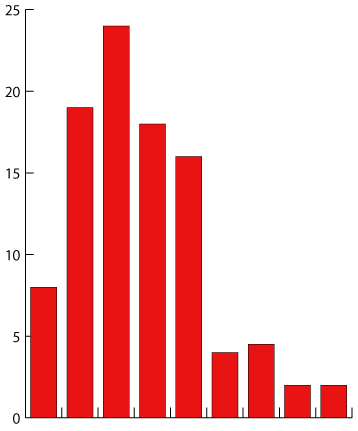
Normally distributed info has no skew. However, when you measure real life variables, they do not always have a symmetrical distribution around the mean like a normal distribution does.
- Positive skew means the ‘tail’ on the RIGHT of the (ab)normal graph is longer than the tail on the left (SEE PICTURE)
- Negative skew has a longer tail on the left.
- Which test might you use to work out whether a distribution is normally distributed or not?
- How do you carry out this test?
- How do you interpret the result of the test? What can it show you, and what can it not show you?
- Shapiro-Wilk test
- Carry out with a computer programme
- Get result coefficient W: if if the distribution is close to normal, this figure will be close to 1
- Get probability p: if p is less than 0.05, the distribution is very unlikely to be normal.
- Shapiro-Wilk will indicate if the data has a non-normal distribution. It can’t definitely say that the data is normally distributed though.
A number of statistical tests can’t be done if the data are not normally distributed (basically because many tests assume normality of the data). But when data are not normally distributed they can sometimes be transformed to become normal. How might this be acheived?
take the log values of the data - variables that are skewed to the right are often transformed by taking the log values.
to do a t test initially what must you assume about the data?
that the data is normally distributed
What do you use the one-sample t test for?
The one sample t-test can be used to determine if a sample mean is representative of the population mean. This can validate that the sample represents the population, or it can be used to determine whether the sample shows differences from the population in the characteristic being measured – for example, you might want to know whether junior doctors had higher blood pressure than the rest of the population of the same age.
what do you use the unpaired t test for?
The unpaired two-sample t-test is used to determine the difference between two independent groups - for example, if you were comparing the forced expiratory volume of asthmatics versus non-asthmatics.
What do you use the paired t test for?
The paired t-test is used to compare dependent samples or groups (for example comparing a subject at two time points, such as before and after treatment).
What two values can give you an understanding of whether two sets of variables have correlation with one another?
Pearson’s correlation coefficient r (or just Pearson’s r) is the usual statistic that describes the linear correlation between two variables.
- Pearson’s r takes a value between -1 and 1, with -1 indicating perfect negative correlation and 1 indicating perfect positive correlation. 0 means there is no correlation.
- When calculating a correlation, statistical packages like StatsDirect and SPSS will give you the value for the correlation (r) along with a p value. If the p value is <0.05 this would be telling us that there is a significant correlation.
What do you use to predict the value of one variable from the value of another variable?
Linear regression.
what are the three types of embryonic haemoglobin? (less than 2 months old)
- Gower 1 (zeta2, epsilon2 or z2e2)
- Gower 2 (alpha2, epsilon2 a2e2)
- Portland (zeta2, gamma2 z2g2)
z and e are unique to embryonic haemoglobin
in the second month of development, which type of haemoglobin becomes predominant?
foetal haemoglobin (alpha2, gamma2 a2g2)
At birth, what is the composition of haemoglobin?
- 50-95% foetal haemoglobin (a2g2)
- the rest adult haemoglobin A (a2b2)
- and a little adult haemoglobin A2 (a2d2) which is synthesised in the third trimester and continues to adulthood at about 2.5%
what compounds other than oxygen can haemoglobin transport?
- carbon dioxide
- nitric oxide - this is carried bound to a globin protein thiol group, and is released at the same time as oxygen.
where is haemoglobin produced?
- the heme part: mitochondria of immature RBCs
- the globin part: ribosomes of immature RBCs
Decribe the cooperatvie oxygen binding to haemoglobin
haemoglobin can bind up to 4 oxygen. As each oxygen is added, there is a confirmationcal change to the shape of the binding sites for the other 4 oxygen, which gives each site more affinity for oxygen: the more oxygen a Hb has, the easier it is to pick up more.
What is haemoglobins oxygen binding capacity decreased by?
- the presence of carbon monoxide becuase this binds to the same site as oxygen, with much greater affinity. (carboxyhaemoglobin - cherry red)
- other compounds bind to the same site as oxygen: cyanide CN-, Sulfur monoxide SO, Nitric oxide NO, Sulfide S2-, Hydrogen Sulfide H2S
- the presence of Carbon Dioxide and protons (acid), which together? bind to a different site on the Hb and lower affinity for Oxygen (the Bohr effect). Shifts the Hb oxygen dissociation curve to the right
When might iron overload take place? How does iron do damage to cells?
- Iron overload sometimes occurs in disorders in which normal regulation of iron absorption is impaired. It is most commonly produced iatrogenically through the parenteral administration of large amounts of iron or blood for therapeutic purposes.
- Iron can be toxic. Its ability to donate and accept electrons means that if iron is free within the cell, it can catalyze the conversion of hydrogen peroxide into free radicals and ultimately kill the cell.
Which chemical processes are iron used for in the body? (3) Which molecules are iron bound into to carry out these processes? (2)
- heme: redox reactions and electron transport processes. These reactions and processes are required for oxidative phosphorylation, the principal source of energy for human cells.
- iron-sulfur proteins: oxidative phosphorylation.
Which molecules containing iron are used for the storage and transport of oxygen? (2)
- Haemoglobin: transport oxygen from the lungs to the tissues and to transport carbon dioxide back to the lungs.
- myoglobin: storage and diffusion of oxygen in muscle cells.
How does the body prevent iron overload?
humans have no physiologic regulatory mechanism for excreting iron. Most humans prevent iron overload solely by regulating iron absorption. Those who cannot regulate absorption well enough get disorders of iron overload. In these diseases, the toxicity of iron starts overwhelming the body’s ability to bind and store it.




