What percentage of children will be diagnosed with eczema at somepoint in childhood?
24%
Is the prevalence of eczema increasing or decreasing?
Increasing, currently at 4%
What is eczema also known as?
Dermatitis
What is eczema?
Eczema is a condition where patches of skin become inflamed, itchy, red, cracked, and rough. Blisters may sometimes occur.
Is an inflammatory skin condition
What parts of the body does eczema often impact?
Flexural areas
What does eczema lead to generally?
It is irritated skin that leads to barrier dysfunction and inflammation
What is atopic eczema?
An itchy skin condition in the last 12 months, plus 3 of the following:
- Onset before age 2
- History of flexural involvement
- History of generally dry skin
- History of other atopic disease
- History in 1st degree relative if under 4 years old
What is the pathogenesis of atopic eczema?
Genetics:
- Many genes implicated
- Role for filaggrin gene
- Atopic family history
- Atopic eczema, asthma hay fever (allergic rhinitis), food allergy
Epidermal barrier dysfunction
Environmental factors
Immune system dysregulation
What gene is involved in the development of atopic eczema?
Filaggrin gene
What is the pathology of atopic eczema?
Spongiosis (intercellular oedema) within the epidermis
Acanthosis (thickening of the epidermis)
Inflammation, superficial perivascular lymphohistiocystic infiltrate
The epidermis is the outermost layer of skin, the dermis contains blood vessels, lymph vessels, hair follicles and sweat glands
What is spongiosis?
Intercellular oedema
What is acanthosis?
Thickening of the epidermis
What is the pathology of acute dermatitis?
- Intercellular oedema within the epidermis
- Can lead to accumulation of intra-epidermal vesicles
- Infiltration of the epidermis with lymphocytes is common
- Dermal changes include varying degrees of oedema and a superficial perivascular infiltrate with lymphocytes, histiocytes and occasional neutrophils and eosinophils
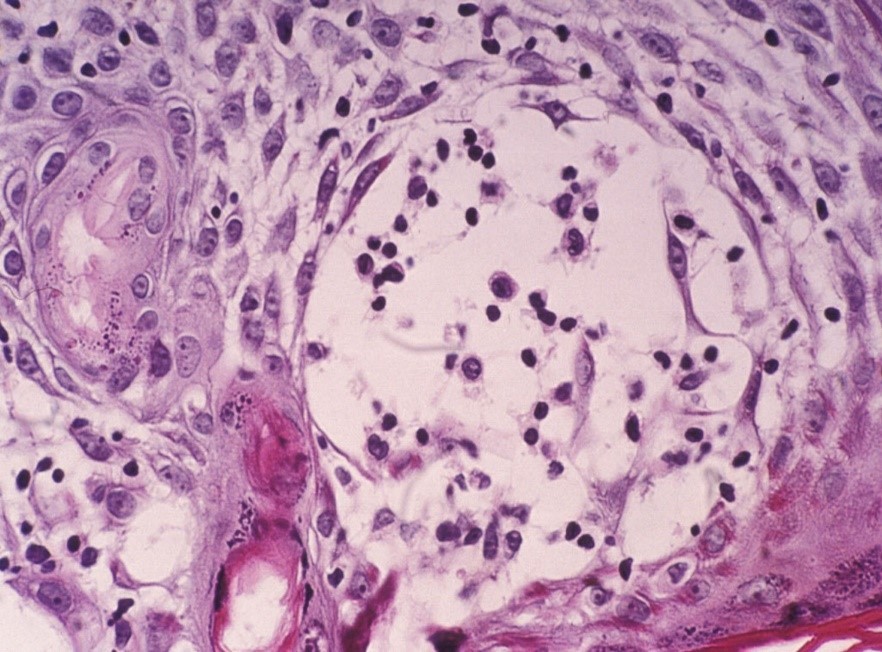
What is the pathology of chronic (spongiotic) dermatitis?
- Degree of spongiosis is often mild
- Significant epidermal acanthosis (thickening of epidermis)
- Fibrosis of papillary dermis may be present
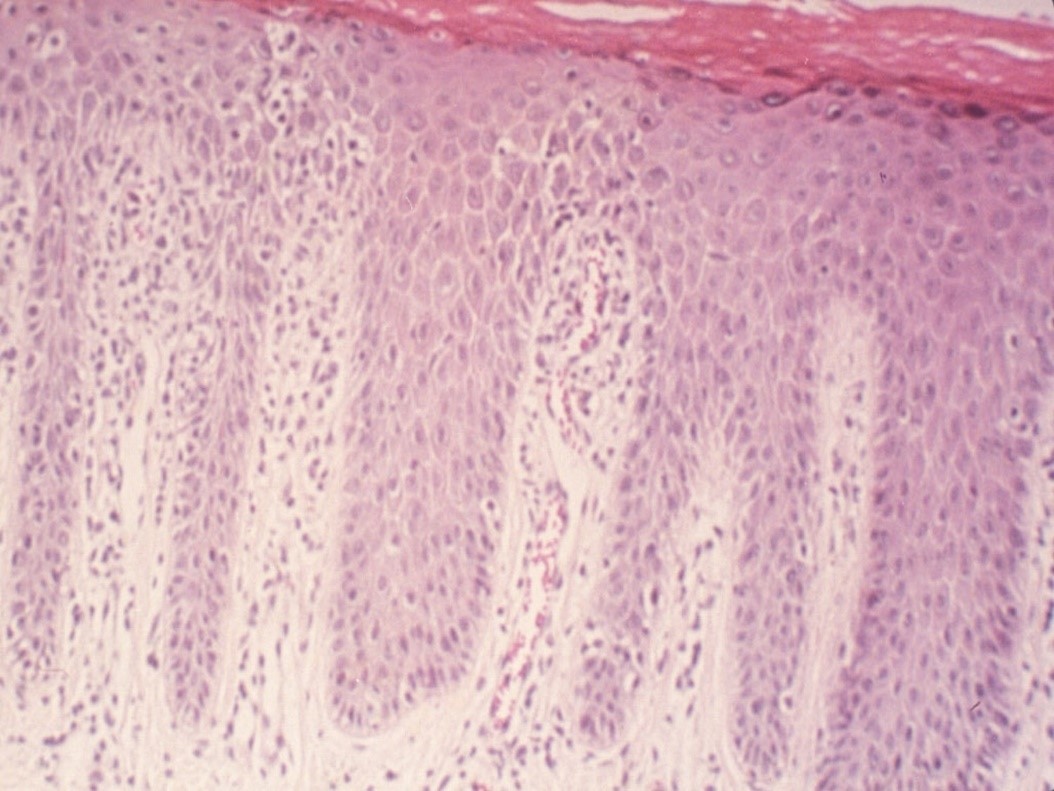
What are the clinical features of atopic eczema?
- Itch
- Distribution
- Flexures, neck, eyelids, face, hands and feet
- Tends to spare nappy area
- Acute changes
- Pruritus, erythema scale, papules, vesicles
- Exudate, crusting, excoriation
- Chronic changes
- Lichenification, plaques, fissuring
What is the distribution of atopic eczema?
- Flexures, neck, eyelids, face, hands and feet
- Tends to spare nappy area
Other than atopic eczema, what are some other types of eczema?
Exogenous (external):
- Contact dermatitis
- Irritant
- Allergic
- Lichen simplex
- Photoallergic or photoaggravated eczema
Endogenous (internal):
- Atopic
- Discoid
- Venous
- Seborrhoeic dermatitis
- Pompholyx
- Juvenile plantar dermatitis
What is allergic contact dermatitis?
Type 4 hypersensitivity:
- Delayed hypersensitivity can take 48-72 hours to develop reaction
- Antigen presenting cells take hapten/allergen to LN and present to naïve T cells
- Clonal expansion of T cells, released into blood stream
- When these T cells next encounter hapten
- Mast cell degranulation, vasodilation and neutrophils
What is hapten?
A small molecule which, when combined with a larger carrier such as a protein, can elicit the production of antibodies which bind specifically to it (in the free or combined state)
What kind of hypersensitivity reaction is allergic contact dermatitis?
Type 4
What is irritant contact dermatitis?
Form of contact dermatitis, in which the skin is injured by friction, environmental factors such as cold, over-exposure to water, or chemicals such as acids, alkalis, detergents and solvents
What can the skin be injured by to cause irritant contact dermatitis?
Skin injured by:
- Friction
- Micro-trauma, cumulative
- Environmental factors
- Cold
- Over-exposure to water
- Chemicals such as acids, alkalis, detergents and solvents
What is a major risk factor for irritant contact dermatitis?
Occupation puts people at risk:
- Hairdressers
- NHS staff
- Cleaners
- Dermatitis
- Nappy rash
What investigation should be done with irritant contact dermatitis?
Patch testing:
- Finds out whether or not skin condition is caused or aggravated by an allergy
- Potential allergen is applied




