Describe the intracranial course of the facial nn?
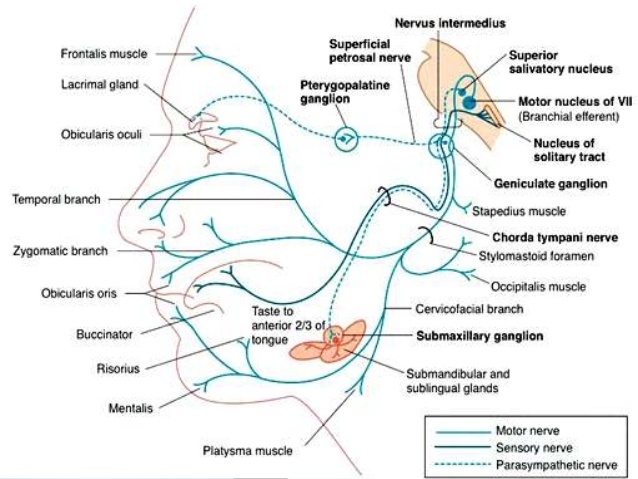
- The facial nn arises in the pons and begins as 2 large roots a motor and a sensory root.
- The 2 roots travel through the internal acoustic meatus a 1cm opening in the temporal bone in very close proximity to the inner ear.
- The roots then enter the facial canal. Within the canal 3 important things happen:
- The 2 roots merge to form the facial nn.
- The nerves form the geniculate ganglion
- The nerve gives rise to the greater petrosal nerve (provides the parasympathetic stimulation to glands) and the innervation to the stapedius muscle
- It also gives rise to the chorda tympani (sensory fibres to the ant 2/3 of the tongue)
- The facial nn then exits the facial canal and cranium via the stylomastoid foramen (This is just posterior to the styloid process)
Describe the extra-cranial course of the facial nn?
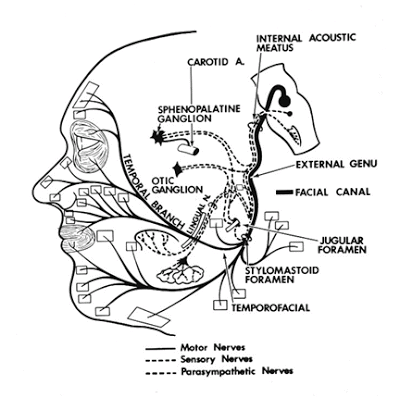
- After exiting the skull, the facial nn turns superiorly to run anterior to the outer ear.
- The 1st branch to come off the facial nn after exiting the skull is the posterior auricular nn (provides motor innervation to the some of the muscles around the ear.)
- Immediately after this motor nerves to the diagastric and stylohyoid arise.
- The main trunk of the nerve, now termed the motor root of the facial nerve, continues anteriorly and inferiorly into the parotid gland
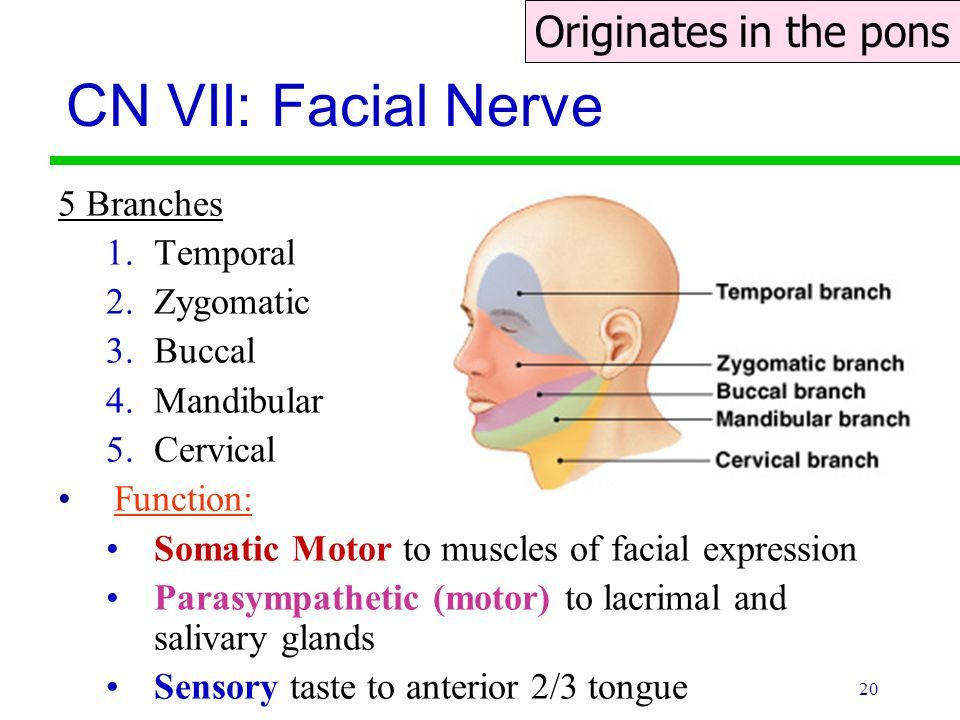
- Within the parotid gland the nerve terminates by splitting into 5 branches:
- -Temporal
- -Zygomatic
- -Buccal
- -Mandibular
- -Cervical
- (Two Zebras Bit My Coccyx)
What are the functions of the facial nn?
Taste to the anterior 2/3 of the tongue & Facial movements
Important to ascertain whether the forehead is affected in a suspected CNVII lesion as forehead sparing suggests a UMN lesion e.g. stroke.
What are the principles of treating a facial nn palsy?
Multidisciplinary approach:
- ENT, Opthalmologists, Physiotherapists, Stroke team (if indicated)
Eye care:
- to avoid corneal exposure damage, lubricating eye drops. Investigate underlying cause.
ENT (cholesteatoma) If idiopathic bells palsy steroid use is indicated in the 1st 72hours in those over the age of 16.
What is bell’s palsy?
Is an idiopathic LMN facial nn lesion. Presents with facial weakness with forehead involvement usually unilateral.
What parotid gland disorders can affect the facial nn?
The most common causes of facial nerve disorders as a result of the parotid gland are benign tumours (pleomorphic adenoma), malignancy (adenoid cystic carcinoma, adenocarcinoma), surgical trauma, and infectious process (s.aureus, mumps). Tumours benign and malignant will both present with a lump on the gland and potentially lympathendopathy. Infections will result in painful swelling as well as systemically feeling unwell.
List the potential causes of a facial nn palsy?
Conditions to Exclude…
…in children = Moebius Syndrome, Hemifacial Microsomia, Forceps delivery, Herpes Zoster, Acute OM
….peripheral = Trauma, Iatrogenic (surgery), Malignant Parotid Tumours, Inflammatory conditions (Sarcoidosis)
…Middle Ear = Iatrogenic, Infection (Otitis Media, Cholesteatoma, AOM, HZV, Tumours (SCC, Glomus jugulare)
…Petrous Temporal Bone = Fractures, Tumours
…Intracranial = Tumours (Neuromas, Meningiomas), Vascular (Stroke), Neurological (MS)




