Tracheophytes
Vascular plants - a monophylectic group among land plants.
Vascular plant apomorphies
- lignified secondary cell walls, w/ pits (some)
- sclerenchyma tissue
- tracheary elements (xylem tissue)
- sieve elements (phloem tissue)
- endodermis
- independent, long-lived sporophyte generation
AND, except for the earliest fossil lineages,
- sporophytic leaves associated with a stem to comprise a shoot system
- roots
Vascular plant period of origin
Silurian Period, some 450 mya
The earliest members of tracheophytes belong to three extinct groups, which are known only from fossils.
- rhyniophytes
- zosterophyllophytes
- trimerophytes
Rhyinophyta characteristics
- seedless
- simple, dichotomously branched stems
- no true roots or leaves
- round or elongate terminal sporangia
- homosporous
Cooksonia
The oldest known vascular plant. Its stem was ca. 6.5 cm tall, and its sporangia were round. It became extinct by the mid- Devonian period, ca. 390 mya.
Rhynia
A marsh plant, came next, during the early Devonian (ca. 410-360 mya) . The upright stem was ca. 18 cm tall, ca. 3 mm thick, and dichotomously branched. It possessed a cuticle, was photosynthetic, and had stomata.
Zosterophyllophyta characteristics
- seedless
- simple, dichotomously branched stems
- no true roots or leaves
- round or kidney-shaped lateral sporangia borne on short stalks
- homosporous
- probable ancestors of lycophytes
Trimerophyta characteristics
- seedless
- complex, dichotomously branched stems
- no true roots or leaves
- elongate lateral sporangia borne on short stalks
- homosporous
- evolved from rhyniophytes
- ancestor of ferns and possibly horsetails
Pteridophytes
- This group comprises the extant, seedless vascular plants. At one time, these plants, such as Lepidodendron, dominated the earth. This was especially true during the Carboniferous Period.
- Today, pteridophytes comprise over 13,000 living species. In North America, north of Mexico, there are about 400 species.
Lycopodiophyta apomorphies
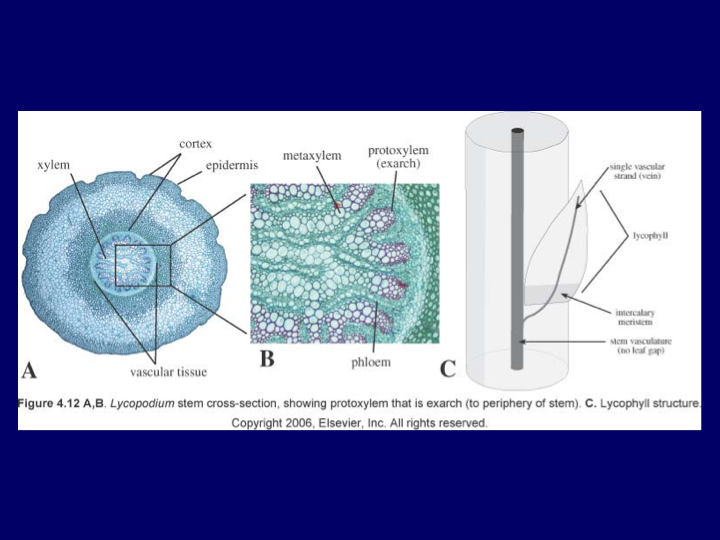
- endarch protoxylem of roots
- exarch protoxylem of stems
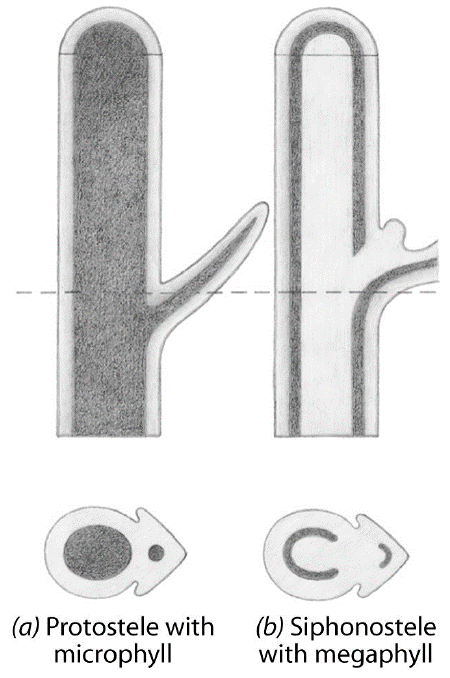
- lycophyll (microphyll) leaf type. This is a relatively small leaf that possesses only a single strand of vascular tissue. It is usually associated with stems that have protosteles. Leaf gaps are not produced by lycophylls.
Family Lycopodiaceae characterics
- common names: club moss, ground pine, running cedar
- aboveground stems are dichotomously branched
• belowground stems (rhizomes) possess adventitious roots
- sporangia are associated with sporophylls
- sporophylls are often aggregated into a strobilus
- homosporous
* Lycopodium - common in North America. Certain species were collected for making Christmas wreaths, and the dry spores were once used as flash powder and condom lubricants.
Family Selaginellaceae characteristics
- common name: spike moss
- aboveground stems are dichotomously branched
- belowground stems (rhizomes) possess adventitious roots
• leaves possess a ligule
- microsporangia are associated with microsporophylls, megasporangia are associated with megasporophylls
- sporophylls are often aggregated into a strobilus
- heterosporous
* most Selaginella sp. live in tropical regions
Family Isoetaceae characteristics
- common name: quillwort
- belowground stems are short, erect, and cormlike; and possess adventitious roots
- leaves are long and quill-like, and each possesses a ligule
• microsporangia and megasporangia are sunken in the bases of the leaves
• heterosporous
* Isoetes - an emergant plant of shallow ponds.
Euphyllophytes
• sister group of lycophytes
• comprises remaining tracheophytes (vascular
plants)
- 30-kilobase inversion in the large single-copy region of chloroplast DNA
- exarch protoxylem of roots
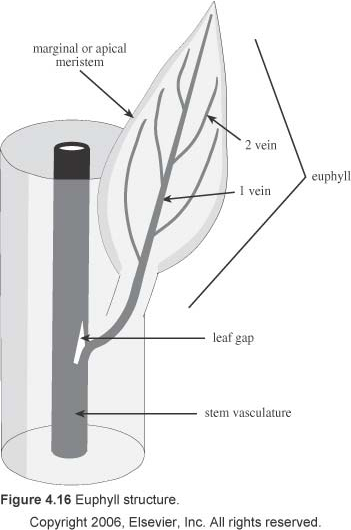
- euphyll (megaphyll) leaf type. This is a relatively large leaf that usually possesses several strands of vascular tissue, as well as a leaf gap.
Monilophytes
• common name: ferns (in a broad sense)
• monophyletic group comprising members of
5 orders
- mesarch protoxylem of stems
- most members possess a stem vasculature known as a siphonolostele
Steles
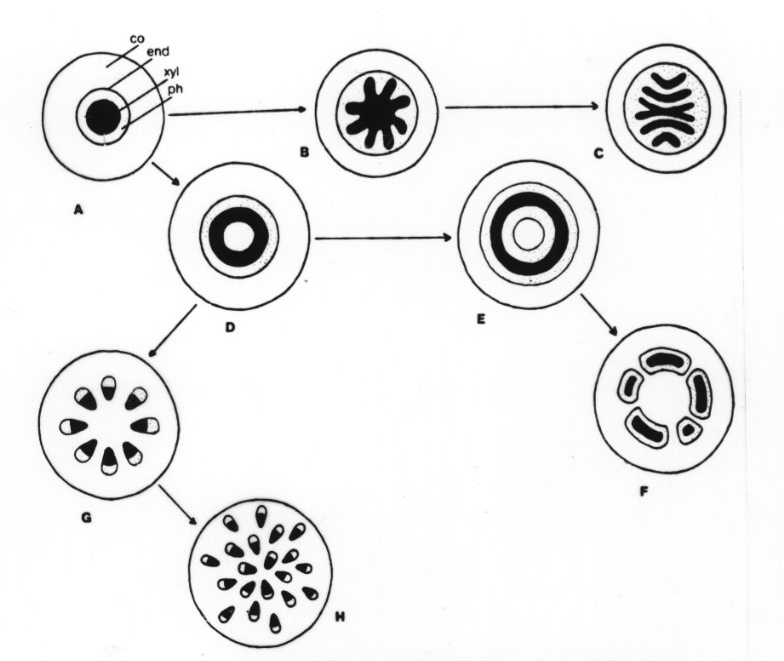
Another name for the vascular cylinder is the stele. There are several types of steles ranging from primitive to advanced.
Protostele
- A protostele is the simplest and most primitive type of stele. It consists of a solid cylinder of vascular tissue in which the phloem either surrounds the xylem (haplostele = A, actinostele = B) or is interspersed within it (plectostele = C).
- Protosteles are found in most roots. In stems, protosteles are usually found in extinct vascular plants, psilophytes, and lyco
Siphonostele
A siphonostele is characterized by having a pith surrounded by vascular tissue. The phloem tissue may be found only on the outside of the xylem (ectophloic = D) or on both sides (amphiphloic = E). A dictyostele (F) is characterized by a system of strands of vascular tissue around a pith.
Eustele
A eustele (G) is also characterized by a system of strands of vascular tissue around a pith. An atactostele (H) is characterized by vascular tissue scattered throughout the pith. These two stele types are found in seed plants.
What are the shared apomorphies of Ophioglossales and Psilotales?
- roots unbranched, root hairs absent
- gametophyte subterranean, mycorrhizal
Order Ophioglossales
• common name: ophioglossoid ferns
• fronds are dimorphic, with a sterile segment
and a fertile segment
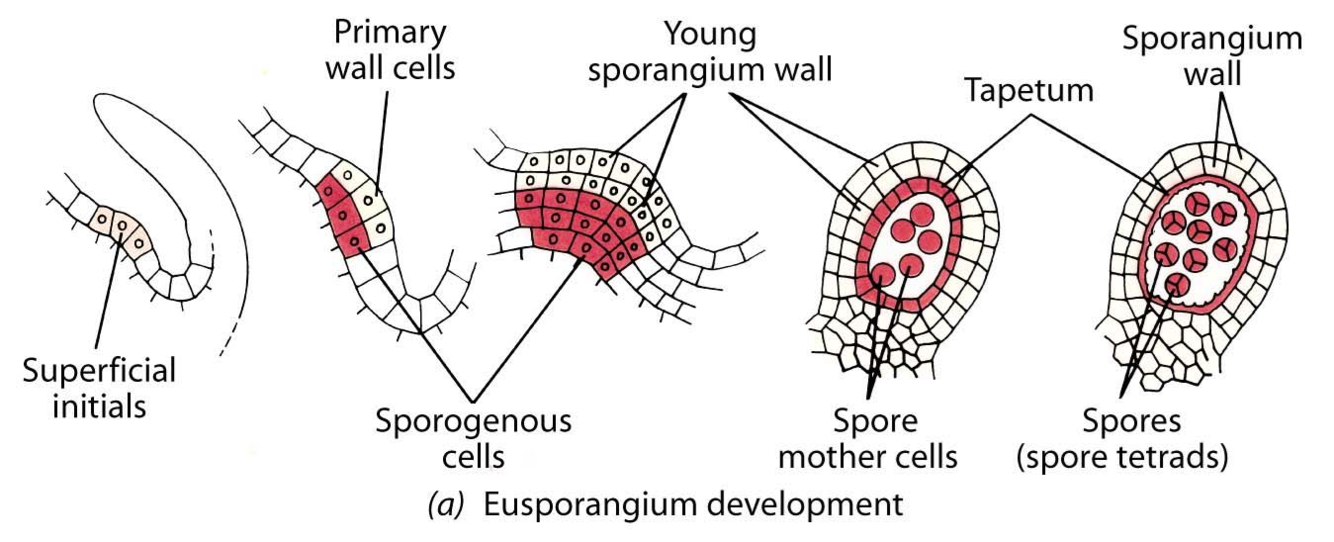
• eusporangium (large sporangium with wall comprising more than one cell layer; formed from more than one epidermal cell; may have 128-several thousand spores; no annulus)
Family Ophioglossaceae
- common names: adder’s tongue, grape fern
- sporangia aggregated into an upright fertile region or spike
- homosporous
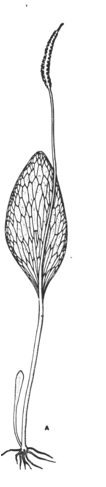
Ophioglossum (adder’s tongue)
- several species in North America
- record for most chromosomes (n=621)!