Key parts of sperm cell
- Head
- mid-piece
- tail
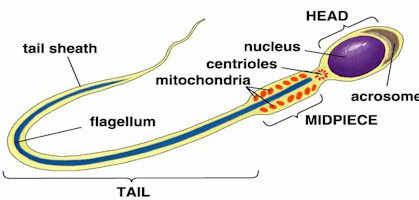
Sperm head: structure and fxn
haploid with highly condensed chromatin present here.Shape of head is speciesdependent.
∙ Acrosome: anterior ½ of sperm head that is a thin, doublelayered
membrane sac full of
hydrolytic enzymes beneath the sperm plasma membrane and above nucleus. SUPER IMPORTANT!
∙ Protamine: keeps the chromatin condensed. This is a specialized basic histone that wraps
DNA w/ disulfide bond cross linking. Makes DNA transcriptionally INERT (can’t do it b/c sperm
gotta travel we
don’t want transcription to occur).
Mid-piece: structure and fxn
covered in sheath, contains the mitochondria that power this slippery little guy (or girl!).
Tail: structure and fxn
- contains axial filament with the 9+2 array of microtubules typical of cilia and flagella.
- Responsible for motility.
- ∙ 9 axoneme doublets arranged circumferentially around microtubule pair.
- ∙ Covered by mitochondrial sheath (like a condom!).
- ∙ Focus on the protein called dynein → Dynein regulation! Some active, some inactive moving in a wheel form to propel the little sperm forward. When dynein is activated it converts ATP energy into
- chemical energy of movement to generate momentum. Left RightLeftRight activation and movement.
Characteristics of sperm capacitation
how spermatozoa can undergo the acrosome reaction that allows them to fertilize eggs.
After capacitation, they display hyperactive motility with increased flagellar beat frequency and amplitude.
Get a decrease in progressive movement (so only the strongest can survive!).
∙ Bind to zona pellucida
∙ can do acrosome reaction
Characteristics of sperm acrosome rxn
acrosomal reaction normally takes place in the ampulla of the fallopian tube (site of fertilization) when the sperm penetrates the secondary oocyte.
The acrosome regions is a double membraned sac. The outer membrane of the acrosome region of the sperm (see table) fuses with theplasma membrane of sperm, exposing the contents of the acrosome →
Hyaluronidase and acrosin are then released. Involves G proteins, voltsensitive Ca++ channels and intracellular Ca++ and pH.
First stage of acrosome rxn
penetration of corona radiata, by releasing hyaluronidase from the acrosome to digest cumulus cells surrounding the oocyte and exposing acrosin attached to the inner membrane of the sperm.
After reaching the Zona Pellucida, the actual acrosome reaction begins.
Acrosin digests the zona pellucida and membrane of the oocyte. Part of the sperm’s cell membrane then fuses with the egg cell’s membrane, and the contents of the head sink into the egg.
Upon penetration, the process of egg activation occurs. The oocyte undergoes its secondary meiotic division, and the two haploid nuclei (paternal and maternal) fuse to form a zygote.
Major factors involved in acrosome rxn
- Hyaluronidase and acrosin: enzymes that are responsible for spermoocyte fusion.
- Involve G proteins, voltagesensitive Calcium channels, and intracellular Calcium and pH.
- Fertilin: protein that allows for the fusion, it’s a heterodymer of alpha and beta N- glycosylated subunits.
- Sperm binding to the zona is mediated by ZP3
- Lack of species specificity: Sperm Penetration Assay zone free hamster oocyte fusing w/ human sperm.
Characteristics of zona rxn
after the acrosome reaction has occured, the egg releases cortical granules and forms the ZP3F glycoprotein so that sperm can no longer bind!
This reaction PREVENTS polyspermy.
Role of zona pellucida and its glycoproteins in fertilizaation
- Zona Pellucida: shelllike structures that surround oocytes, it’s a glycoprotein sheet.
- Made up of protein, hexose, sialic acid, and sulfate.
- Each glycoprotein plays a role in sperm binding and acrosome reaction
- induction.
- Composed of 3 glycoproteins:
- o 1). ZP1: Facilitates structure becoming sheetlike
- o 2). ZP2:
- o 3). ZP3: mediates sperm binding to the zona. Has specific sperm binding site.
Important steps of fertilization to remember
- Ovulation & oviductal collection of the oocytes.
- b. Deposition of sperm with sufficient number and motility
- c. Sperm capacitation
- d. Sperm traversing the cumulus oophorus
- e. Sperm interaction with zona pellucida and acrosome reaction
- f. Sperm penetrate into zona pellucida
- g. Spermoocyte fusion: between sperm’s plasma membrane in the post acrosomal region and the oolemma. Fertilin is a sperm protein responsible for spermoocyte fusion. There is a lack of species specificity.
- h. Oocyte activation
- i. Male pronuclei formation
Process of sperm-oocyte fusion
- The sperm is activated by the female reproductive tract.
- ∙ It enters the cumulus layer of the oocyte and gets lucky enough to make it to the Zona Pellucida.
- ∙ The acrosome reaction is induced and the necessary enzymes to cut through the Zona Pellucida
- extracellular matrix are released.
- o The sperm basically acts like a drill and manages to lyse a hole in the Zona.
- ∙ Finally, the sperm and egg membranes fuse!!! Success.
Process of oocyte activation
Oocyte activation: occurs because the Zona reaction has occurred and the sperm has made it!
∙ Reawakening of the oocyte through 2nd meiotic division.
∙ Can morphologically see through exocytosis of cortical granules.
∙ Can see the extrusion of the 2nd polar body.
Process of male pronuclei formation
disulfide bonds are reduced by the action of oocyte- derived glutathione
sperm nucleus decondensation, formation of male/female pronuclei
Components of semen analysis
based on color, viscosity, volume, volume, pH, concentration, motility, rate of travel, rate of progression, and morphology.
Male accounts 40% of infertility and female is 40% of infertility
Normal values of semen analysis
Concentration and motility are the most important parameters.
∙ Volume > 2 ml
∙ Concentration > 20 x 10^6 / ml
∙ Motility > 50%
∙ Morphology = 14% normal (one tail etc.) Most sperm are weird!
∙ Viscosity = normal
∙ Rate of progression > 50% grade 3 or 4. Rated on scale of 14.
1= worst rating, twitch but don’t really swim. 2 = clueless, swimming in circles. 3 = fast,
but not as fast as 4. 4= swim linear and fast, best sperm. Do IxE treatment to try to
improve sperm motility.

-
Fertilization16
-
Implantation19
-
Physiology of the Placenta25
-
Pathology of Twinning14
-
Breast Development and Physiology30
-
Breast: Normal Histology Benign Disease29
-
Lactation19
-
Breast Cancer Pathology0
-
Placental Pathology0
-
Maternal Physiology0
-
Endocrinology of Pregnancy0
-
Endocrine Disorders in Pregnancy0
-
Breast Cancer Screening0
-
Physiology of Parturition14
-
Drug Use in Pregnancy21



