MBTI:
Eight types of MBTI traits – (8 questions total)
- *Extroverted** – direct their energy and attention outward and receiving energy from interacting with people
- *Introverted** – direct their energy and attention inward and receive energy from reflecting with their thoughts, memories, and feelings
- *Sensing** – taking in information that is real and tangible, what is actually happening. Observant of Specifics. Uses the sense like touch, visual, listening ect.
- *iNtuitive** - taking in information by seeing the big picture, focusing on relationships and connections between facts.
- *Thinking** – in decisions making like to look at the logical consequences of a choice and action
- *Feeling** – decisions making like to consider what is important to them and other involved
- *Judging** – like to live in a planned, orderly way, seeking, to regulate and manage their lives
- *Perceiving** – like to live in a flexible, spontaneous way, seeking to experience and understand life rather than control it.
DISC
- *Dominance** – Shapes their environment by overcoming opposition to accomplish results
- *Influence** – Shapes their environment by influence or persuade others
- *Conscientious** – Shapes their environment by emphasizing working conscientiously with existing circumstances to ensure quality and accuracy.
- *Steadiness** – Shape their environment through an emphasis on cooperating with others within existing circumstances to carry out the task
TLC
The Leadership Challenge (MICEE)
- *Model the Way** – Lead by example/clarify values by finding your voice and shared values
- *Inspire a Shared vision** – envision the future by imagining exciting and ennobling possibilities/enlist others in the common vision by appealing to share aspirations
- *Challenge the Process** – search for opportunities by seizing the initiative and by looking outward ways to improve/take risks or experiment generating smalls wins
- *Enable others to Act** – Foster collaboration by building trust and facilitating relationships/increase self-determination and develop competence
- *Encourage the Heart** – show appreciation for individual excellence/celebrate the values and victories by creating a spirit of community
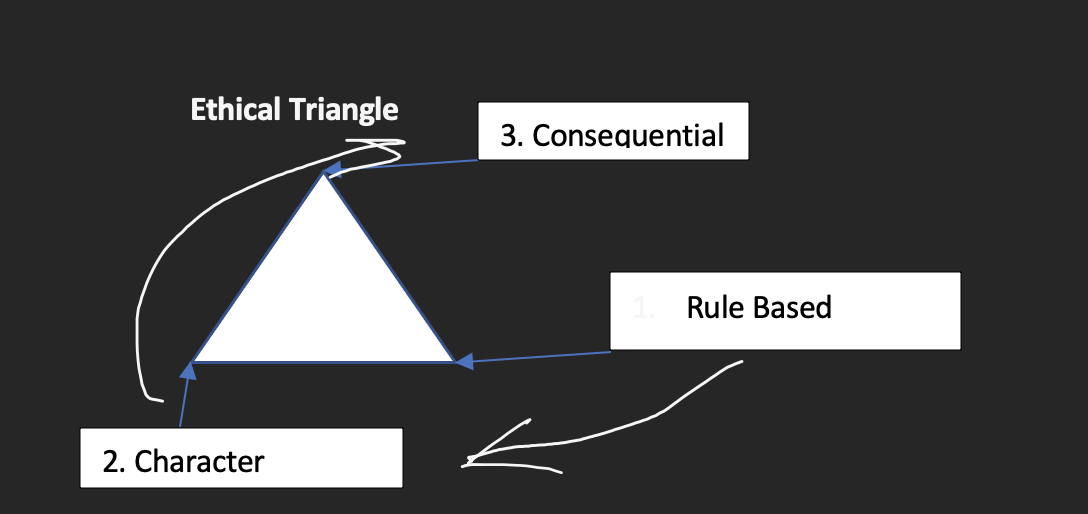
ETHICS TRIANGLE
Character – Who the person is and not what they did?
Rule Based – Did you break a rule, yes or no?
Consequences – Does the punishment meet the crime?
SMART
Method: (Used at the end of Coaching during follow up)
Specific – what do you want to achieve in your focus area?
Measurable – what does success look like?
Action-orientated – what step will you need to take?
Realistic – How do you know you can achieve this goal?
Time-bound – When will you achieve this goal?
GROUP DYNAMIC
Team Building: Group Dynamics (Leader Tasks)
Forming:
Give clear direction
Get members acquainted
Creat positive atmosphere
Assign straight forward simple tasks
Be sensitive to members need for direction
Storming:
Open up conflict
Move toward negotiation and consensus
Get members to assume to take responsibly
Norming:
Let team assign own tasks
Provide direction
Hold celebration
Encourage the team to review their own goals and progress
Listen and facilitate
Performing:
Participate
Consult
Inspire
Be involved in tasks as needed
Keep commutation and information flowing
Provide new vision
TIME MANAGMENT
- Record – tasking items and commitments (write them down on paper/sticky notes)
- Clarify – actions to be taken for each task (questions: what is the output deliverable/stakeholders/important/time/time do we have/ time do you need or ask for help)
- Organize - tasks into categories and prioritize (categorize: actionable items and non-actionable items: trash items can’t be accomplished)/(projects are more then two tasks)
- Review - action lists, daily and weekly (review accomplished consistently)
- Complete tasks (context - does you current situation allow you to complete the task)(Priority – how important is this tasks compared to others)(Time available – Do you have enough time to complete the task)(Energy Available – how much energy do you have to complete the task)
DMAIC
Define – identity problem stakeholder scope
Measurable – collect data about the problem
Analyze – root cause of problem
Improve- developing innovative solution
Control – monitor & maintain process improvement
INTERACT
Is the behavior…
Having an negative impact on the job? Being late f
Preventing others from doing their jobs?
Preventing you from doing your job?
A violation of unit or CG policy? Mask or blousing straps
Behavior vs. standard
Emergency Problems
Role Clarity
Ability
Willingness
PERFORMANCE FEEDBACK
Three types of feedback
Appreciation – given through awards, time off, and memos.
Direction – help guide through a different way of doing things (not against the standard or regulation) Advice or recommendation
Evaluation – given against a certain standard or regulation (Figure out where you stand)
FEEDBACK TRIGGER
Truth trigger – set off by the substance of the feedback itself – its somehow off, unhelpful, or simply untrue
Relationship Trigger - Tripped by the particular person who is giving us this “gift” feedback
Identity triggers – something about feedback causes us to question ourselves. When this happens, we are unable to see the truth in the feedback without also thinking less of ourselves.
MOTIVATION
Motivation Notes:
Pink’s Internal Motivators:
Autonomy – Freedom
Mastery – achieving expert and greatness
Purpose – desire to serve something than oneself
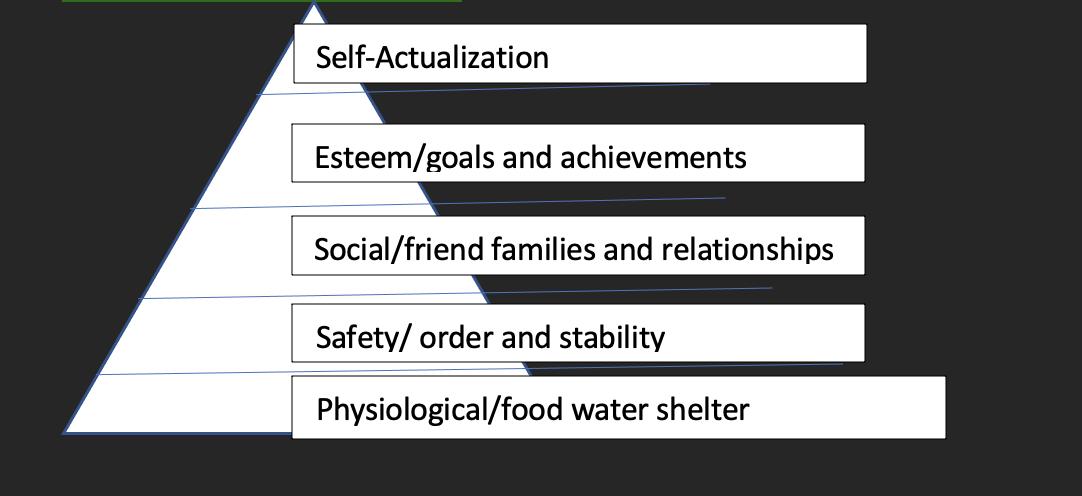
MASLOW’S HIERARCHY OF NEEDS
HYGIENE FACTORS
Policies & Admin
Supervision
Work conditions
Interpersonal/relationships
Money, status, and security
Effort level: 20 -30% compliance level
MOTIVATORS
Achievements
Recognition
Challenge
Responsibility
Growth and Development
Creativity
Effort level: 80 -90% commitment level
Ethical Decision Making
Truth v Loyalty – taking sides based on relationships
Justice v Mercy – being lenient on an individual based on circumstances
Short term v long term – what are the effects
Individual v Community – Looking at the greater good
Character – Who the person is and not what they did?
Rule Based – Did you break a rule, yes or no?
Consequences – Does the punishment meet the crime?
SMART
Method: (Used at the end of Coaching during follow up)
Specific – what do you want to achieve in your focus area?
Measurable – what does success look like?
Action-orientated – what step will you need to take?
Realistic – How do you know you can achieve this goal?
Time-bound – When will you achieve this goal?
ETHICAL DECISION MAKING
4 Common Types
Truth v Loyalty – taking sides based on relationships
Justice v Mercy – being lenient on an individual based on circumstances
Short term v long term – what are the effects
Individual v Community – Looking at the greater good
Types of Listening:
Subjective- Listen with bias
Objective- Listen without bias
Intuitive- Listen between the lines/picking up on the unsaid words
Coaching Model:
Foundation – establish rapport/identify the problem
Dialogue – use objective and global listening/acknowledge and validate thought, feelings, or actions
Action Planning – make achievable goals, concrete plans, and measurable milestone
Follow-through – discuss support follow-through/accountability



