What is a discounted cash flow (DCF)?
• Projects estimated cash flows over an assumed investment holding period, plus an exit value at the end of that period, usually arrived at on a conventional ARY basis • Cash flow is then discounted back to the present day at the discount rate (also known as desired rate of return) that reflects the perceived level of risk • Growth explicit investment method of valuation
In what circumstances are you likely to use a DCF, and what types of valuations (6) / for what particular purpose (1) might a DCF therefore be used for?
Used for valuations where the projected cash flows are explicitly estimated over a finite period, such as: • Short leasehold interests and properties with income voids or complex tenures • Phased development projects • Some ‘Alternative’ investments with limited comparable evidence • Non-standard investments (e.g. with 21-year rent reviews) • Over rented properties • Social housing • When comparing returns from real estate to returns from other asset classes
What guidance did the RICS issue on the use of the DCF method?
RICS Discounted cash flows for commercial property investments, 2010
How would you calculate the value of a property using the DCF method?
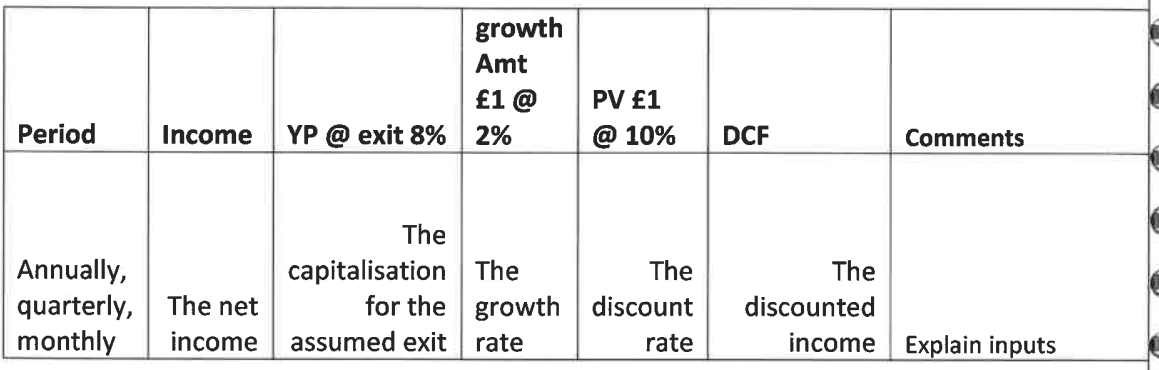
- Estimate the cash flow (income less expenditure) - assess current rental level + determine a rental growth factor to estimate future rents 2. Estimate the exit value at the end of the holding period Once exit value has been established for each income period/stream, the cashflow is discounted back to the present day (reflecting the investors overall target rate of return/hurdle rate, that reflects the perceived level of risk) 3. Select a discount rate - two approaches available - i. Discount the rent individually using the discounting PV table ii. Discount them in blocks using the YP table 4. Discount cash flow at the discount rate Each remaining rental period goes through YP SR (same yield as exit), Amt of £1 (at say 2% (Bank of England 25 year bond used to compare), PV of £1 at equated yield (say add 2% to ARY), resulting in a net present value (NPV) 5. Sum of the discounted cash flows would provided you with the NPV, which is the value of the property
What is the net present value (NPV), and what can it be used to determine?
Sum of all future expected income and capital flows, discounted at the investor’s required rate of return An NPV can be used to determine if an investment gives a positive return against a target rate of return
Where you have a known purchase price, what does it mean if there is a positive NPV?
Investment exceeds the investor’s target rate of return
Where you have a known purchase price, what does it mean if there is a negative NPV?
Investment has not achieved the investor’s target rate of return
What is the internal rate of return (IRR), and what is it used to assess/subject to what 3 common assumptions?
The rate of return which all future cash flows must be discounted at to produce an NPV of zero The IRR is used to assess the total return from an investment opportunity making some assumptions regarding rental growth, re-letting and exit assumptions.
What can a valuer use if they don’t have a software package to calculate the IRR?
• Linear interpolation can be used to estimate the IRR • Find a discount rate which produces a negative and positive NPV, then interpolate between the two
According to Discounted Cash Flow for Commercial Property Investments, 2010), what does Investment Value describe?
Investment Value describes what a property is worth to a specific investor, based on their assumptions about the future expected income from that property (this is the importance of the ‘worth’ Valuation basis)
How does the relationship between Investment Value and Market value influence an investors decision to buy/sell?
• All things being equal, it should hold that, if Market Value is Lower than Investment Value, an investor will take the decision to acquire a property • Likewise, if Market Value is greater than the Investment Value, the investor will take the decision to sell
Why might an investor’s opinion on Investment Value differ from the Market Value?
Because each individual investor has different income requirements, expectations of where the market will move, attitudes to risk, tax positions etc.
What is the discount rate also known as? What does it reflect?
Discount rate is also known as desired rate of return. It reflects the perceived level of risk
What must you take care not to do when selecting a discount rate?
You must take care not to double count, meaning that if the discount rate has made allowances for a factor implicitly, you should not then make cost allowances explicitly for that factor in the cash flow too
How is IRR calculated (even by Excel)?
Interpolative trial and error, excel just does this really fast and behind the formula. You can always sense check the IRR by making sure that at the IRR rate adopted the NPV does equal zero
What matters can be explicitly reflected in a DCF yield/calculation (5), and what do you consider when deciding on the exit yield?
• The approach separates out and explicitly identifies growth assumptions rather than incorporating them with an ARY, for instance: o Anticipated rent variations o Effect of obsolescence (rental growth/required capital outlays) o Voids and associated costs (property outgoings and taxes) o Marketing costs (agents and legal fees) o Refurbishment and upgrades o The exit value at the end of the cashflow period can reflect anticipated conditions at the end of the cashflow holding.
What are is the main potential problem with using a DCF?
Data: accuracy issues of estimating explicitly/ comparable evidence availability for forecasting explicit assumptions
Most broadly, when is a DCF used?
Used when an investor has a target rate.
How does a DCF differ to the conventional methods of valuation, what type of method is it commonly known as and how is income typically discounted (comprising what 2 components)?
• Sometimes referred to as Contemporary methods
o Rental and Capital growth are made explicit o the cash flow is discounted at the investor’s target rate of return which is arrived by a taking Risk-Free Rate plus a Risk Premium
o I.e. whereas with conventional methods valuation growth is implicit (included) in the yield, for DCF it is excluded and is discounted at the investor’s true rate of return and not an ARY.
• The Risk-Free Rate is
o the gross redemption yield on U.K. gilts
• The Risk Premium is the additional return you would want over and above the risk free rate which reflects the risk of property, and comprises:
o Market Risks
o Specific Risks
• Investors want a risk premium because property is riskier than government bonds due to higher management costs, high transfer fees and low liquidity.
- Two objectives potentially - MV, or objective may be to estimate value to a particular investor (‘investment value’ or ‘worth).
- All things being equal, an investor will buy a property investment if its investment value is considered to exceed its Market Value, and will sell if the property’s Market Value exceeds that opinion of its investment value.
- An individuals opinion of the latter will almost invariably differ from the MV because everyone has different income requirements, expectations, attitudes to risk, tax position etc. It is those differences of opinion that create a market in which investments are bought and sold
- DCF method is of greatest application in assessment of investment value to assist in buy/sell decisions or selection between alternative available investments. However, it can also be used to estimate MV by adopting a set of tenable assumptions and then applying those assumptions, with appropriate adjustments, to the valuation of a property.
- Where there are no transactions, the DCF model provides a rational framework for the estimation of MV not present in the ARY (capitalisation rate) approach, which is reliant on comparables.
What are the 6 steps of a DCF?
Draw out the simple DCF layout/what each heading refers to/means.
DCF RICS doc has an example, but seems complex - perhaps check back if I have time.
- Show purchase price in row one - no discount
- Display net income in a table
- Multiply by PV £1 at a discount rate (AKA target rate/desired rate of return) for years until received (future money)
- discount rate will reflect market and property-specific risks (take care to not reflect risk factors in both the case flow and discount rate i.e. if cash flow assumes exercise of all lease breaks and consequent voids, then the discount rate can be lower since the risk (the downside) has already been reflected in the cash flow). valuer should adopt market-based forecasts for rental and yield movements and should advise on appropriate discount rates having regard to sector and property-specific factors.
* -* necessary to reflect investment’s specific leasing pattern (RRs, LRs, re-lettings at expiry, void costs for vacant parts, non-recoverable outgoings (taxation, external financing etc.) and anticipated capital outlays on refurbishment or upgrade)
* - the costs of finance (i.e. interest payments, arrangement fees) can also be factored into cash flow. Further adjustment may be necessary to the discount rate adopted to reflect the additional risk incurred by undertaking a geared position, as opposed to an investment that is 100% equity financed.*
* - the discount rate is usually derived by reference to the return on an alternative form of perceived low-risk or riskless asset (frequently the benchmark is the gross redemption yield on government gilts and cash), plus appropriate additions for risk.*
* - the risk-free return is normally taken to be the gross redemption yield on a medium-dated government gilt, preferably of the same duration as the assumed holding period of the investment.*
* - 1. Risk-free rate of investment*
* - 2. Market risks (systemic) - affect whole market (illiquidity, forecast rental/yield growth, regional structural change, legislative change (planning/privity of contract/changes in fiscal policy)*
* - 3. Specific risks (unsystemic) - covenant risk, void risk, ownership/management costs, differing lease structures (i.e. RR structures, breaks) - given the overlap, and therefore difficulty in eliminating all double counting of risk, typically appropriate to incorporate property-specific risks into cash flow, whilst market risks are just incorporated into the discount rate.*
* - Relatively broad definitions however, which is important to consider in DCFs - the degree of seperation of the various risk factors and their incorporation in a DCF are of key importance in the validity of an appraisal.*
* - in financial literature, the capital asset pricing model (CAPM) draws a distinction between market risk and specific risk - market risk (AKA systemic risk) affects all assets and cannot be eliminated through diversification. Specific risk, however, is unique to each asset and is therefore uncorrelated with the market. Specific risk matters a LOT for CRE, compared to other types of investments (lack of homogeneity etc.).*
* - discount rate - time value of money can be considered to represent interest forgone (+risk premium, representing compensation for the risk inherent in future cash flows that are uncertain). i.e. if £1 could be placed on deposit for a year to earn 5% interest then, broadly, £1 receivable in a year’s time has a present value of £1/1.05 = £0.952. This is because the £0.952 could be deposited to earn 5% (i.e. 0.048 interest) so that it would accumulate to £1 after a year.*
* This presupposes that £1 in a year’s time is certain, but it might not be. If the amount of receipt is uncertain, the investor will not be willing to pay as much, perhaps only £0.90 instead. If so, the potential receipt of (approx) £1 has been ‘discounted’ not by 5%, but by 10%. So the discount rate will always reflect the investor’s perception of risk. In this case, the 10% discount rate reflects 5% for the time value of money, plus a 5% risk premium.*
* This rate can then be used to discount the anticipated cash flows - £100 in 1 years time is worth (100/1.10 = 90.91), £100 in 2 years is worth (100/1.102=82.64), and 3 years (100/1.103=75.13).*
* - although an ARY valuation conventionally treats all rent payments as received annually in arrears, an explicit DCF should always reflect the actual cash flow frequency. To discount (e.g.) a quarterly cash flow, a quarterly discount rate must be applied. The quarterly equivalent of an annual discount rate is derived by the formula (1+i)0.25 - 1, e.g. to discount at 10% p.a., the quarterly cash flow must be discounted at 1.100.25-1 = 2.411% per period.*
* - if cash flows are receivable in advance, e.g. rents received in advance quarterly, the first period’s receipt is not discounted and the second period’s receipt is discounted by one period and so on. The Excel function for NPV assumes cash flows at end of each period, so to reflect rents received in advance the NPV should be multiplied at (1+ i/100) where (i) is the discount rate per period.*
* - In conventional model tax is not usually explicitly factored, as comparables are typically analysed on rentals and expenditures gross of tax. DCFs allow tax to be factored into calculation if required.*
* - anticipated rental growth a key factor that affects both cash flow and exit value - econometric forecasting models used, but obviously a difficult assumption to make, typically outsourced (not valuer) - challenging as forecasting is not well-developed at a local level (usually only prime national stuff, which is why this technique is predominantly used by London prime investors)*
* - because of this, sensitivity analysis is often used to see how rental growth assumptions effect things.* - Assume an exit value at say 10 years with a capitalisation at market yield (i.e. ARY) - the exit valuation will reflect antipated rental growth, the reversionary nature and unexpired terms of the leases at the exit date, and the application of an appropriate ARY. Depending on the holding period this may be forecast or based on equilibrium market conditions. Where allowances made for refurb/upgrade in cash flow, the exit yield should reflect the anticipated state of the property reflecting refurbishment completion, particularly relevant in multi-tenanted buildings, such as shopping centres, where the landlord can control physical and, to some extent, functional obsolescence.
* - cash flows can cover any time horizon but are normally 5/10/15 year periods - however, shorter time horizon, greather the impact of exit value on present (MV/IV) value. transaction costs will also have a greater impact since they will have to written over a shorter period.*
* - if you are comparing different investment opportunities, the horizons should of course be the same, as would lead to inaccurate differences in IRR.*
* - for investment value assessment, time horizon should reflect investor’s anticipated holding period (could be breaks/lease expiries, lending term etc.)* - Add up all the discounted cash flows in end column
* The resultant calculation is the NPV, defined as the present value of all future expected income and capital flows, discounted at the investor’s target rate of return.* - If NPV is more than 0 target rate is met
* - this allows comparison with potential returns from other investments - i.e. 2 opportunities both at 0, one will have a higher IRR for the investor.*
* - IRR is the discount rate which, when applied to all future expected income and capital flows, equates the price with the present value of these discounted income flows. The NPV is therefore 0 . IRR can be used to compare potential returns from alternative investments whose purchase prices are known.*
- IRR can be derived only by an iterative trial and error process, which is the method used by spreadsheet IRR formula. In Excel an educated guess can be provided to speed up the calculation. In some instances, where calculated chas flows move from positive to negative and back again, there may not be a unique IRR, but this is a mathematical abberation. typically answers will be far apart, but it would be prudent to test the ‘most likely’ figure by checking that, at the IRR rate adopted, the NPV does equal to zero.

-
Conduct rules, ethics and professional practice166
-
Health & safety76
-
Inspection95
-
Measurement71
-
Valuation248
-
Financial modelling20
-
Development appraisals57
-
Estate Agency (Purchase and sale; Leasing/letting)71
-
Leasing/letting76
-
Client care19
-
Communication and negotiation / Teamworking / Inclusive Environments38
-
Accounting principles and procedures68
-
Business planning11
-
Conflict avoidance, management and dispute resolution procedures23
-
Data management / Property records/information systems71
-
Sustainability52
-
General/Topical Questions/COVID34
-
Loan Security Valuation165
-
Landlord and Tenant240
-
Conduct rules, ethics and professional practice (submission)71
-
Health and Safety (submission)7
-
Client Care (submission)10
-
Communication and negotiation / Teamworking / Inclusive Environments (submission)10
-
Landlord and Tenant (submission)40
-
Loan Security Valuation (submission)96
-
Business Planning (submission - needs most changes really)8
-
Sustainability (submission)4
-
Random to consider1
-
Conflict avoidance, management and dispute resolution procedures (submission)1
-
Leasing and Letting (submission)44
-
Measurement (submission)22
-
Inspection (submission)25
-
Data Management (submission)22
-
Valuation (submission)74
-
Case Study (submission)144
-
random extra48
-
RICS Docs22



