T/F: Fits are quite common in children.
true
4/1000 children will have epilepsy, and quite a few more than that will have had a single fit at some time.
NB: convulsions, seizures and fits - all the same thing.
Some children are simply prone to fits, and often grow out of them, but sometimes fits are caused by a significant brain problem e.g. ?
encephalitis, head injury, poisoning or child abuse.
commonest cause of fits in children where parents seek emergency help?
high temperature > febrile convulsions.
T/F: most fits are generalised seizures
true
They usually last 2-3 minutes and stop by themselves.
- A fit usually has to last ?? or more before brain damaged occurs due to the fit itself.
- Recommended that treatment is given or an ambulance is called if the fit lasts more than ??
- 1/2 hour
- 5 minutes (because most fits don’t, and it may take >20 ins to get treatment for it or for it to start to work
T/F: Epilepsy is a term we use when fits recur.
true - a bit like wheezing and asthma, the diagnosis isn’t usually made on just one occasion.
Is best that a neurologist makes the diagnosis, as misdiagnosis is fairly common.
Important consideration when taking a Hx of a seizure?
try as hard as possible to get an eyewitness account, even if this is over the phone, and to take the person through exactly what they saw
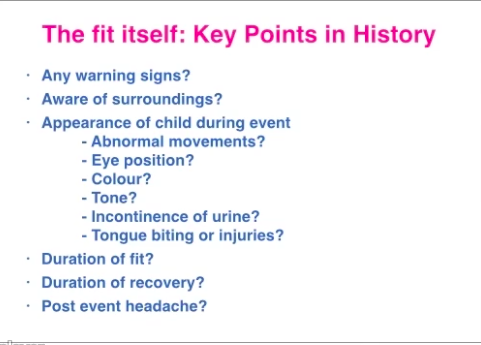
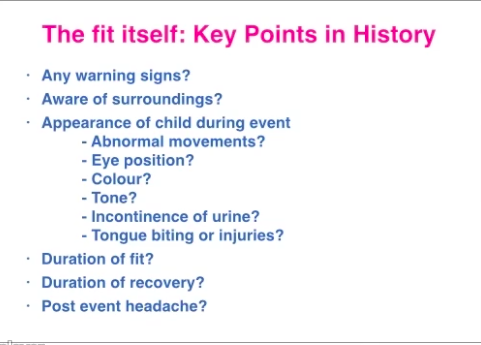
What to cover in the Hx of a patient presesenting with seizure?
- warning and awareness
- appearance
- duration
- HA
Then go back over the past day or 2 to see if you can establish a cause for the fit (recent illness, changes in meds, head injury, drugs & alcohol, metabolic abnormalities, low glucose, birth history, developmental history)
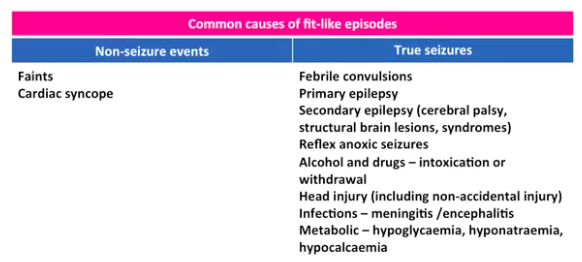
name some non-seizure and true seizure causes of fit-like episodes
what is syncope and what is the commonest cause?
- a drop in blood pressure which causes loss of consciousness
- commonest reason is a simple vasovagal faint.
Hx which might suggest syncope is the cause?
How can it be differentiated from a true seizure?
- child usually describes funny vision such as tunnel vision or going black, sound becoming distant, and weakness of their legs
- As well as a few jerks as they faint, incontinence can also happen. This is more likely if they are not laid flat, to improve the blood pressure.
- The difference is in the recovery phase which is swift. The patient is back to normal in a minute or so.
The blood pressure can also drop if there is a cardiac arrythmia. How to differentiate from a vasovagal faint?
- same appearance as a vasovagal faint, although the patient is often described as pale.
- circumstances also different - instead if the typical things which cause faints (prolonged standing, hot/ emotional environment), a cardiac syncope happens out of the blue or on exercise.
- It is common for the child not to feel any palpitations even when the cause is an arrhythmia.
This event requires cardiac investigations, so if you are not confident there was a good reason for a faint, ensure the child is followed up in a hospital.
T/F: vasovagal faints usually happen from about 7 years onwards, not younger children
true
Some younger children are prone to an exaggerated vasovagal reaction when they suffer pain or emotion.
This leads to breath-holding attacks, where the child stops breathing and goes pale or blue.
In a more severe attack, _____ can occur temporarily and a true seizure can happen, called a __ __ __
T/F: these are sinister and require further investigation by specialist neurologist.
asystole
reflex anoxic seizure
false - in fact totally harmless and kids usually grow out of them (commonest in 1-3 year olds)
Beware after a minor head injury a toddler can have one of these, which can be mistaken for being truly knocked out and lead to an unnecessary CT scan.
If what you have heard described sounds like a true fit then the commonest 2 types are a ? in a small child, or a non-febrile seizure in a known ? child.
febrile convulsion
epileptic
Febrile convulsions
- usually what kind of seizure?
- trigger?
- usual age?
- duration?
- T/F: the term implies an innocent seizure
- are usually generalised, tonic-clonic seizures
- often happen out of the blue in children with a simple viral infection
- usual age is 1-3. Careful diagnosing <1 (although do occur). >3 is unusual for a first-time febrile convulsion
- Most times a febrile convulsion lasts only a few minutes and the child makes a full recovery.
- false - serious infections such as pneumonia or meningitis can also cause febrile convulsions, so the term does not necessarily imply an innocent seizure. (examine the child properly after the fit and consider bloods)
With an ordinary febrile convulsion what is the chance that the child will have another febrile convulsion before they grow out of them?
roughly 50%
- so if it was the first fit, it is important that the parents are given time to calm down, and get some basic medical advice.
- Hospitals often admit a child after their first febrile convulsion.
Children with ordinary epilepsy may have a fit triggered by a fever, but we wouldn’t use the term febrile convulsion for these.
ok
However when you see an epileptic child with a fit, you should ask the same questions about infection, so that you don’t miss a treatable cause for the fit.
What might suggest hypoglycaemia as the cause of the fit?
is most likely in an infant who has been underfeeding for a couple of days, a child with diabetes, or secondary to severe alcohol poisoning.
Describe the typical post-ictal phase in children
- sleepy for about 10 mins- 1 hr
- may have memory loss in this time
- come around > HA, often irritable
NB: if the child became alert and orientated within a minute or two of the so-called fit, it is much more likely to be a non-seizure event.
2 broad types of fit?
generalised or focal
generalised vs focal seizure? most common?
- Generalised:child is unaware of their surroundings
- Focal: they are awake and the fit is affecting a part of the body
The most typical kind of seizure is called a generalised tonic-clonic seizure.
how does a generalised tonic clonic seizure usually present?
(aka a “grand mal seizure”)
- The child becomes unconscious and stiffens (tonic), usually followed by full body jerking (clonic)
- eyes are usually rolled upwards, the jaw and fists clenched, some grunting noises may be heard, and the child may be red or a bit blue in the face. There may be salivation and sweating.
what is a petit mal seizure?
an absence seizure - child stops what they’re doing an freezes for a few seconds
Often happens in children with other kinds of fits as well






