What are non-operative managements of foot problems?
–Analgesia
–Shoe wear modification
–Activity modification
–Weight loss
–Physiotherapy
–Orthotics including insoles and bracing
When are operations indicated on the foot?
The only indication for operative managment is failure of non-operative managment
What are the forefoot problems?
What is the aetiology of bunions (hallux valgus)?
–Genetic
–Foot wear
–Significant female preponderance)
What are the symptoms of hallux valgus?
–Pressure symptoms from shoe wear
–Pain from crossing over of toes
–Metatarsalgia
What is the pathogenesis of hallux valgus?
–Lateral angulation of great toe.
–Tendons pull realigned to lateral of centre of rotation of toe worsening deformity
–Vicious cycle of increased pull creating increased deformity
–Sesamoid bones sublux – less weight goes through great toe
–As deformity progresses abnormalities of lesser toes occur
(there is lateral angulation of the great toe, and from here there is now a lateral pull from the tendon which causes progressive worsening of the condition). Lesser toes are eventually involved)
How is diagnosis of hallux valgus achieved?
–Clinical
–Xrays
- Determine severity of underlying bony deformity
- Exclude associated degenerate change
What is the management of hallux valgus?
- Shoe wear modification (wide +/- high toe box)
- Orthotics to offload pressure/correct deformity
- Activity modification
- Analgesia
–Operative (if non-operative failed or unacceptable to patient)
- Release lateral soft tissues
- Osteotomy 1st metatarsal +/- proximal phalanx
- Generally good outcome but recurrence inevitable
(so wear different shoes, change the shoes, change what you do, painkillers, operate)
Operating involves removing some bone and release of lateral soft tissues. The osteotomy is called a scarf osteotomy)
Which joint does OA affect in hallux rigidus?
Osteoarthritis of 1st MTP joint
What is the aetiology of hallux rigidus?
–Not known
–Possibly genetic – typical shape of metatarsal head is slightly pointed rather than rounded
–Possibly multiple microtrauma
What are the symptoms of hallux rigidus?
–Many asymptomatic
–Pain – often at extreme of dorsiflexion
–Limitation of range of movement
How is diagnosis of hallux rigidus made?
Clinical
Radiographs
What is the management of hallux rigidus?
–Non-operative
- Activity modification
- Shoe wear with rigid sole
- Analgesia
Operative
- Cheilectomy (removing bone spurs from the base of the big toe)
- Arthrodesis (fusion of the joint) (gold standard - fusion of the 1st MTPJ. Arthrodesis is a good operation if the other operations have failed
- Arthroplasty (replacing the joint) (hemiarthroplasty is a good option to maintain ROM, high failure rate, probably better for low demand patients, if the operation fails it tends to fail early.)
What are examples of lesser toe deformities?
- Claw toes
- Hammer toes
- Mallet toes
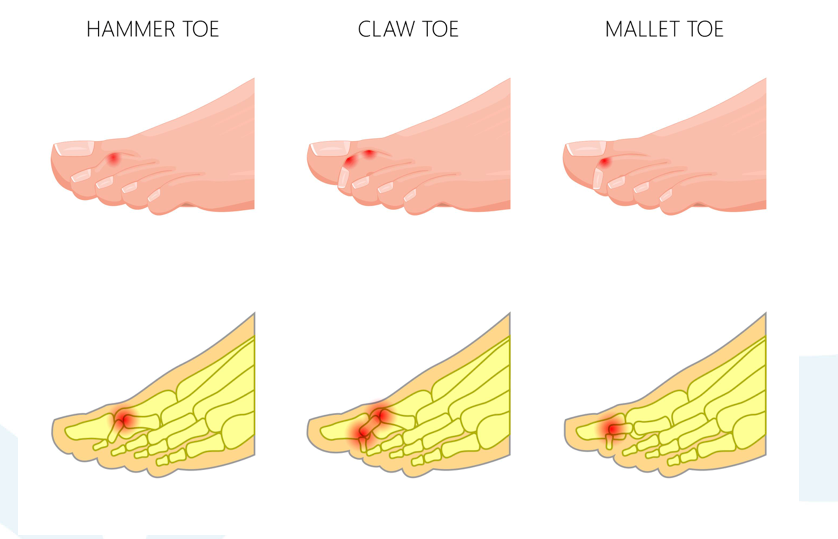
What is the aetiology of lesser toe deformities?
–Imbalance between flexors/extensors
–Shoe wear
–Neurological
–Rheumatoid arthritis
–Idiopathic
What are the symptoms of lesser toe deformities?
–Deformity
–Pain from dorsum
–Pain from plantar side (metatarsalgia)
What is the treatment of lesser toe deformities?
–Non-operative
- Activity modification
- Shoe wear – flat shoes with high toe box to accommodate deformity
- Orthotic insoles – metatarsal bar/dome support
–Operative
- Flexor to extensor transfer
- Fusion of interphalangeal joint
- Release metatarsophalangeal joint
- Shortening osteotomy of metatarsal
What is the aetiology of mortons neuroma?
–Mechanically induced degenerative neuropathy
–Tends to affect females aged 40-60
–Frequently associated with wearing high healed shoes
–Common digital nerve relatively tethered to one metatarsal and movement in adjacent metatarsal causing mechanical shear
What are the symptoms of mortons neuroma?
–Typically affects 3rd followed by 2nd webspace/toes
–Neuralgic burning pain into toes
–Intermittent
–Altered sensation in webspace
What is the diagnosis of mortons neuroma?
–Clinical
–Mulder’s Click
–Ultrasound best / MRI good
What is the management of interdigital neuroma?
–Injection for small lesions (steroidal medication or alcohol solutions)
–Surgery – excision of lesion including a section of normal nerve
- Numbness
- Recurrence
- Up to 30% have pain 1 year post surgery
Define metatarsalgia
Metatarsalgia is a general term used to denote a painful foot condition in the metatarsal region of the foot (the area just before the toes, more commonly referred to as the ball-of-the-foot). This is a common foot disorder that can affect the bones and joints at the ball-of-the-foot. It is a symptom and not a diagnosis.
What are the causes of metatarsalgia?
Synovitis, bursitis, arthritis, neuralgia, neuromata, Freiberg’s disease - a neuroma is a tumour formed on the nerve cell sheath
What is the treatment for rheumatoid forefoot?
–Non-operative – shoewear/orthotics/activity etc
–Operative
- Many described techniques
- Current gold standard
–1st MTPJ arthrodesis
–2-5th toe excision arthroplasty



-
Bone and Soft Tissue Tumours50
-
Joints, synovial fluid and cartilage32
-
Osteoarthritis and Principles of Management23
-
Bone and Soft Tissue Infection51
-
Knee Problems27
-
Anatomy of the Lower Leg Ankle and Foot24
-
Foot & Ankle Anatomy - Clinical Correlation19
-
Growth Injury and Repair - Ligament Injuries12
-
Growth Injury and Repair - Bone Growth and Fracture Healing28
-
Growth Injury and Repair - Tendon Injuries30
-
Growth Injury and Repair - Peripheral Nerve Injuries34
-
Anatomy of the Hand and Wrist30
-
Foot Problems70
-
Anatomy of the Shoulder and Elbow30
-
Mini Symposium - Fractures and Discloations42
-
Mini Symposium - Dislocations6
-
Mini Symposium - Open Fractures16
-
Orthopaedic Problems of The Hand31
-
Anatomy of Hip and Knee (Including Clinical relevance)46
-
Introduction to Paediatric Orthopaedics and Normal Variation25
-
The Acute Limping Child33
-
Shoulder and Elbow Problems23
-
Nerve Palsies in the Limb55
-
Mini Symposium: Spine (Degeneration, Low Back Pain, Disc Prolapse)38
-
Mini Symposium - Spinal injuries49
-
Forensic Aspects of Trauma7
-
Forensic Aspects of Trauma 210
-
Introduction to rheumatology0



