what are osme examples of non-operative management?
Analgesia
Shoe wear modification
Activity modification
Weight loss (all foot and ankle condition orse if patient carrying to much weight)
Physiotherapy
Orthotics including insoles and bracing
when do you operate?
The only indication for operative management is failure of non-operative management
Pathological Grouping of Disease can be put in what categories?
(Look at aetiology – any of these underlying problems can be responsible for foot or ankle pain)
- Vascular (ischaemic)
- Infective
- Traumatic
- Autoimmune (rheumatic arthritis and other rheumatoid problems etc
- Metabolic (endocrine /drugs)
- Inflammatory
- Inherited (congenital)
- Neurological
- Neoplastic
- Degenerative
- Idiopathic
Anatomical Grouping of Disease can be put into what groups?
- Forefoot problems – metatarsals and toes
- Midfoot problems - tarsal
- Hindfoot problems – heel, calcaneus and talus
- Other
what are examples of forefoot problems?
- Hallux valgus
- Hallux rigidus
- Lesser toe deformities
- Morton’s neuroma (painful condition on sole of foot)
- Metatarsalgia
- Rheumatoid Forefoot
what is Hallux Valgus?
“Bunions”
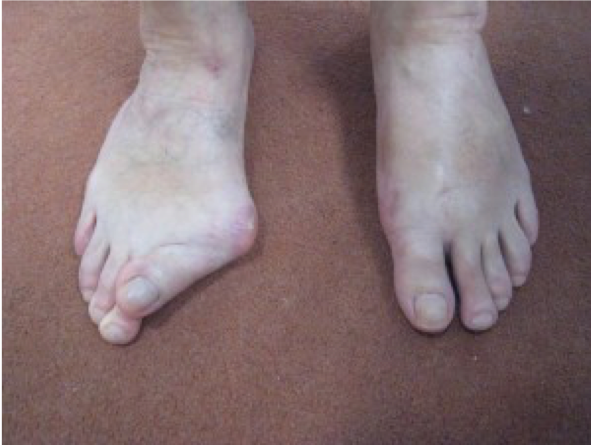
a deformity of the big toe. The toe tilts over towards the smaller toes and a bony lump appears on the inside of the foot
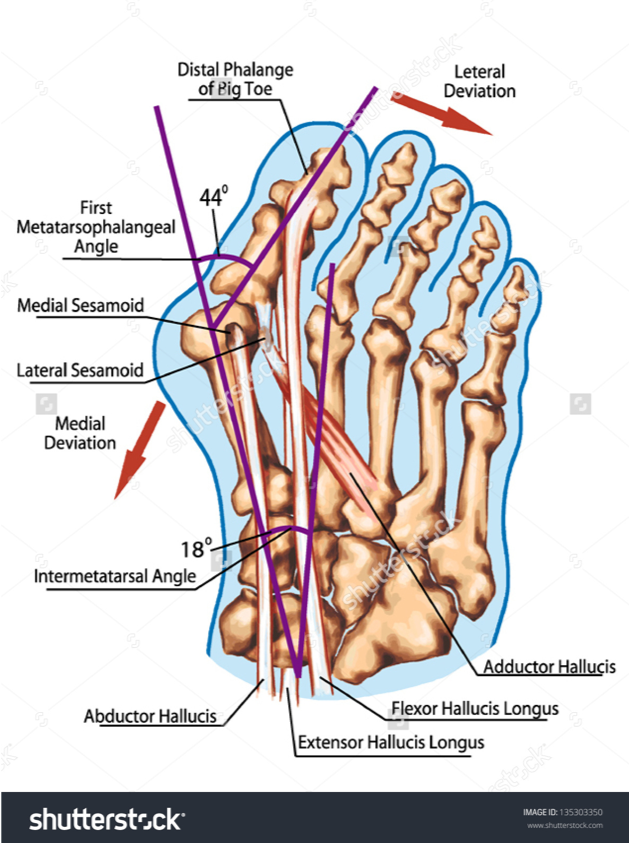
Hallux valgus is a progressive foot deformity in which the first metatarsophalangeal (MTP) joint is affected and is often accompanied by significant functional disability and foot pain. This joint is gradually subluxed (lateral deviation of the MTP joint) resulting in an resulting in an abduction of the first metatarsal while the phalanges adduct. This often leads to development of soft tissue and bony prominence on the medial side of what is called a bunion
what is the aetiology of hallux valgus?
Genetic
Foot wear
Significant female preponderance
what are the symptoms of hallux valgus?
Pressure symptoms from shoe wear
Pain from crossing over of toes
Metatarsalgia (condition in which the ball of your foot becomes painful and inflamed)
what is the pathogenesis of hallux valgus?
Lateral angulation of great toe
Tendons pull realigned to lateral of centre of rotation of toe worsening deformity
Vicious cycle of increased pull creating increased deformity
Sesamoid bones sublux (medially) – less weight goes through great toe
As deformity progresses abnormalities of lesser toes occur
how is the diagnosis of hallux valgus made?
Clinical (probably best way, just looking at the foot)
Xrays:
- Determine severity of underlying bony deformity
- Exclude associated degenerate change
what is the non-operative management of hallux valgus?
- Shoe wear modification (wide +/- high toe box)
- Orthotics to offload pressure/correct deformity
- Activity modification (less time standing)
- Analgesia
what is the operative management (if non-operative failed or unacceptable to patient) of hallux valgus?
- Release lateral soft tissues
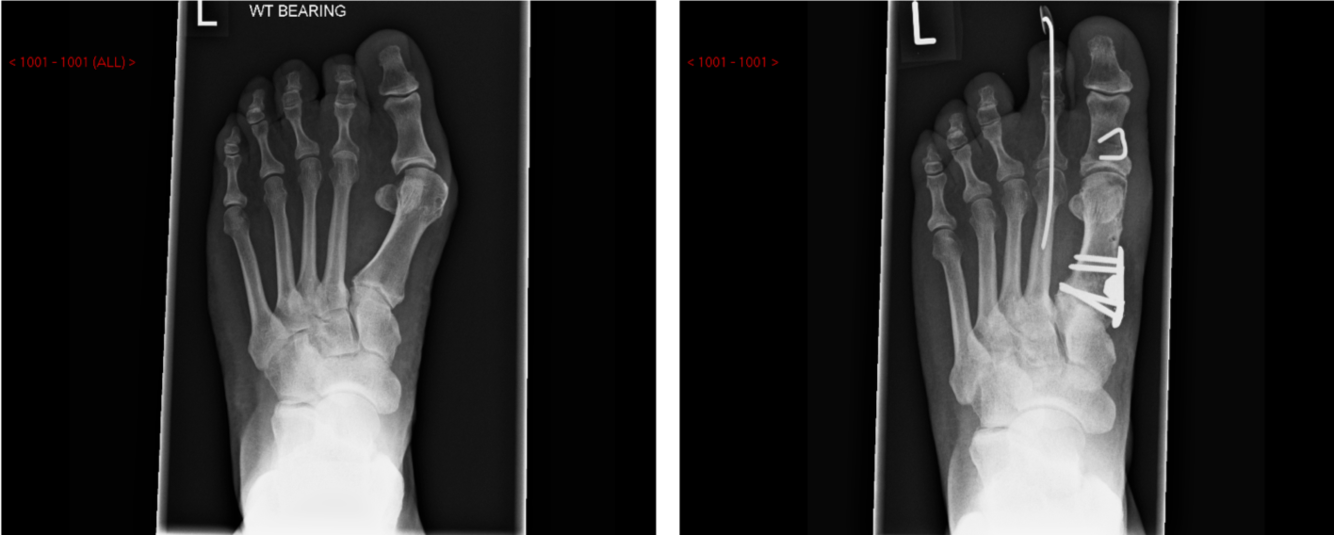
- Osteotomy 1st metatarsal +/- proximal phalanx
- Generally good outcome but recurrence inevitable
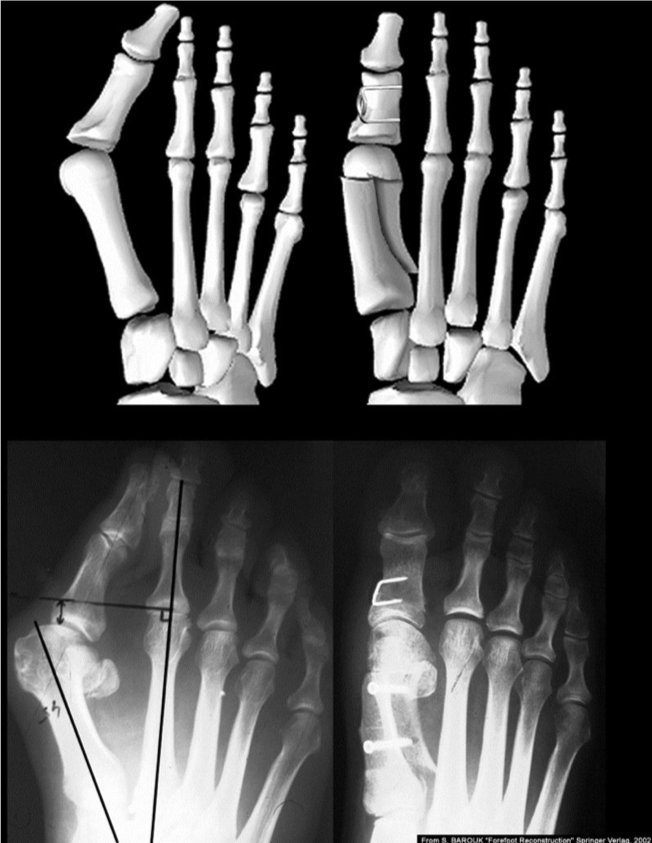
Hallux Valgus – Scarf osteotomy
Bone broken and shifted in the coronal plane
Hallux Valgus – basal osteotomy
what is Hallux Rigidus?
- Latin – Stiff big toe!
- Hallux limitus
- Hallux non-extensus
- Osteoarthritis of 1st MTP joint (causes of these symptoms)
- Bimodal distribution of age
It causes pain and stiffness in the joint, and with time, it gets increasingly harder to bend the toe. Hallux refers to the big toe, while rigidus indicates that the toe is rigid and cannot move
what is the aetiology of Hallux Rigidus?
Not known
Possibly genetic – typical shape of metatarsal head is slightly pointed rather than rounded
Possibly multiple microtrauma
what are the symptoms of hallux rigidus?
Many asymptomatic (incidental finding on x-ray)
Pain – often at extreme of dorsiflexion
Limitation of range of movement
what is the diagnosis of hallux rigidus?
Clinical (history and examinations)
Radiographs
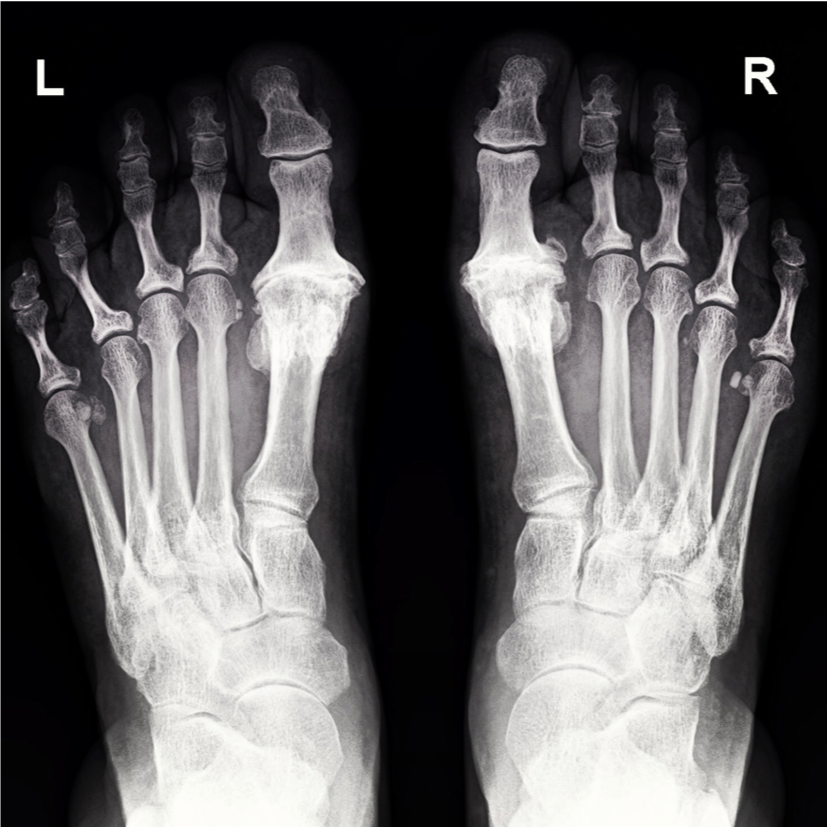
radiography:
Older patient, osteoarthritis, narrowing and irregularity of the MTP joint, joint space narrowed, osteophyte, sclerosis in margins
Normal angle between 1st and 2nd metatarsals
Big dorsal osteophytes so that’s why extension is sore as rub on the soft tissues and pain impinge on dorsiflexion
what is the management of hllux rigidus?
Non-operative:
- Activity modification (running and up hill as more dorsiflexion causes pain)
- Shoe wear with rigid sole
- Analgesia
Surgery (main ones):
- Cheilectomy
- Arthrodesis
- Arthroplasty
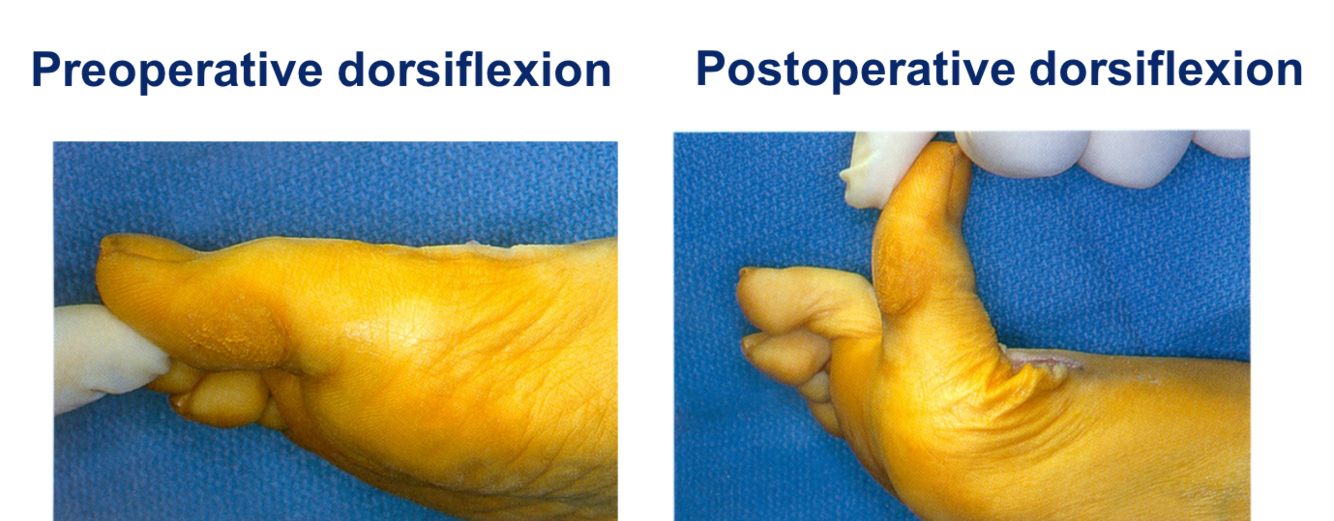
what is Cheilectomy?
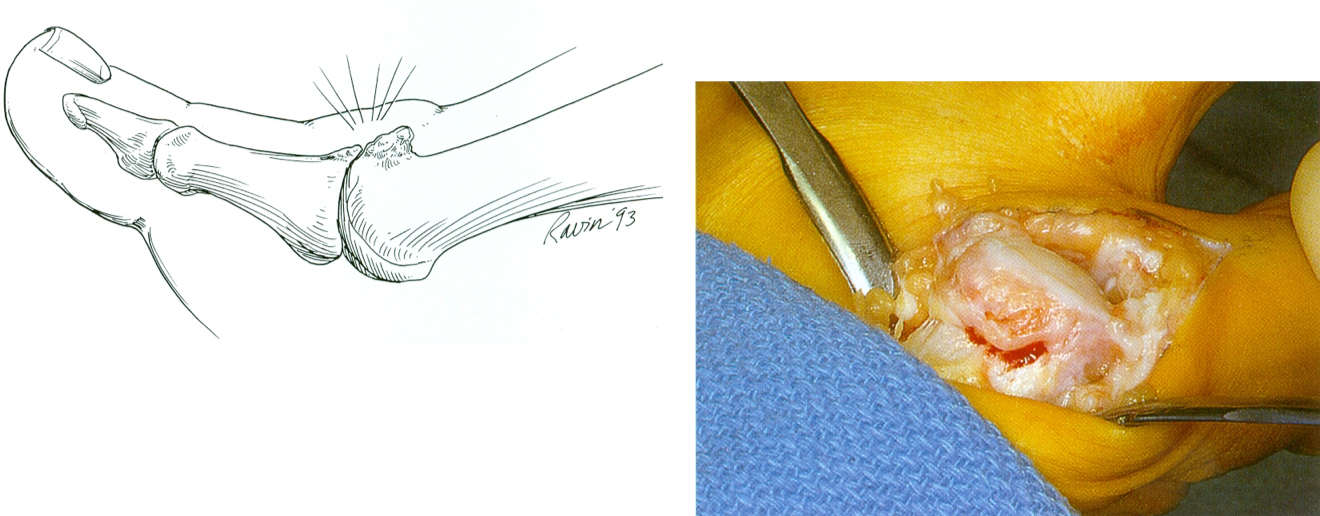
remove dorsal impingement
Particular pain when dorsiflexed, remove dorsal osteophytes
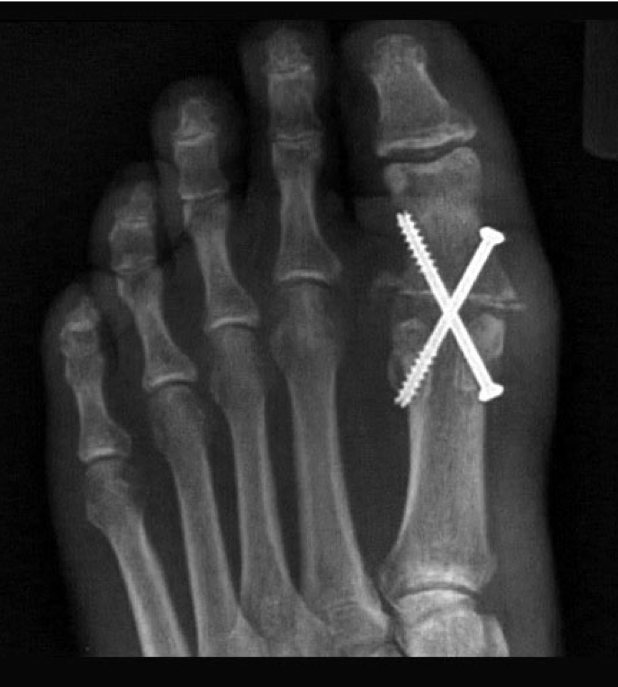
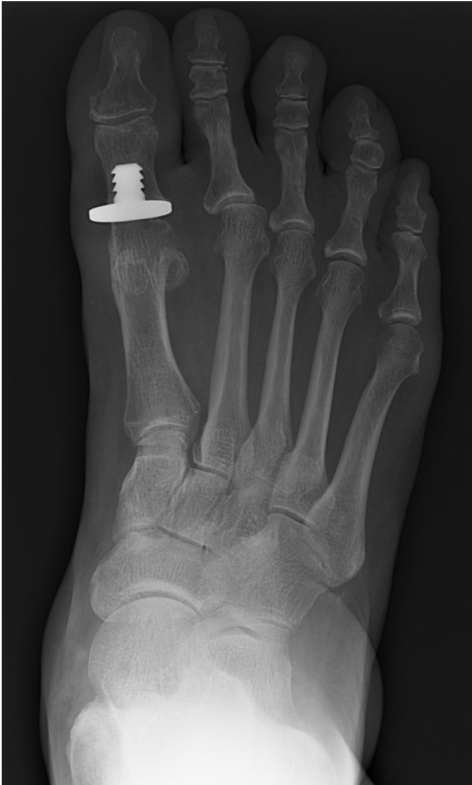
what is 1st MTPJ fusion?
- Gold standard treatment
- Permanent
- “Bail out operation”
Most reliable consistent treatment
Surface of the joint is debrided, fixation so bone crosses of the joint
what is 1st MTPJ hemiarthroplasty?
- Good option to maintain ROM
- High failure rate
- Probably better for low demand patients
whata re some lesser toe deformities?
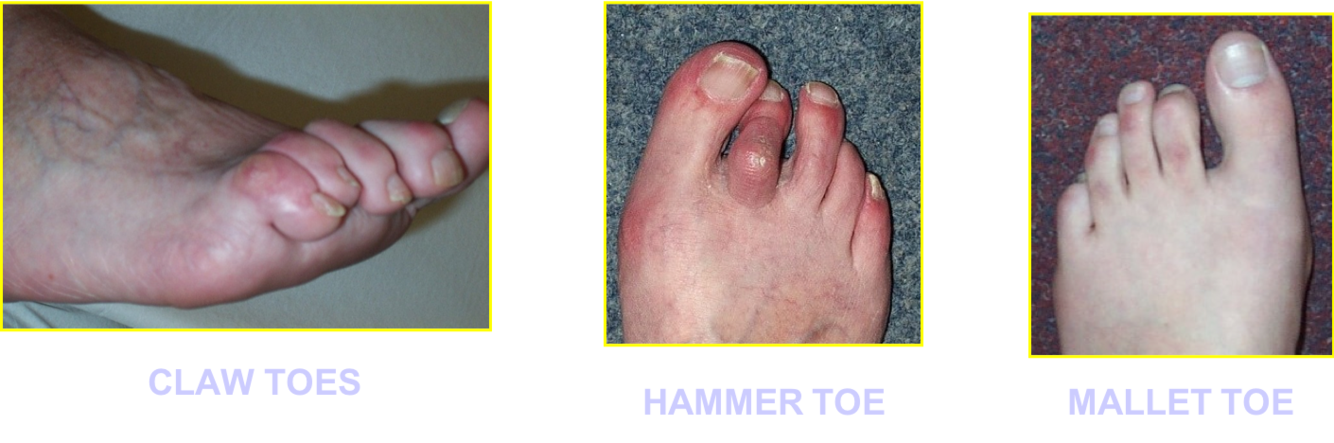
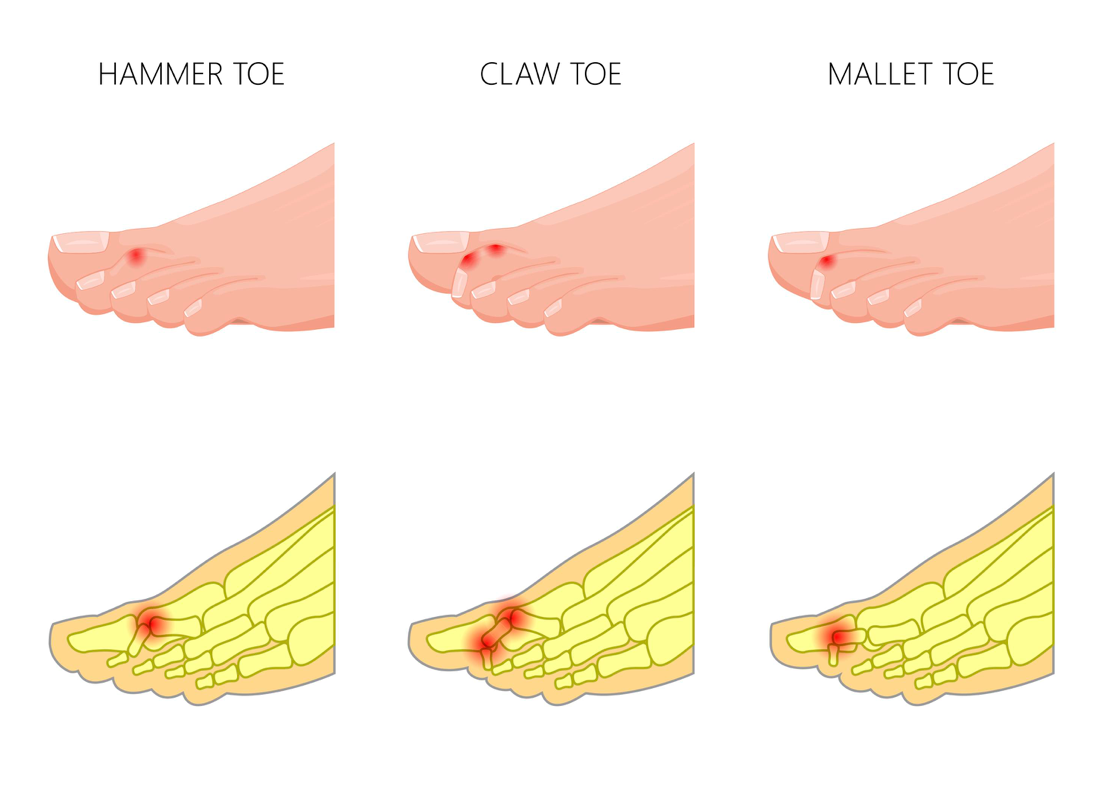
- Claw toes - Flexion at the proximal and distal interphalangeal joint, may have underlying neurological problem
- Hammer toes - Flexion of the proximal interphalangeal joint and dorsiflexion at MTP joint, distal interphalangeal joint extended
- Mallet toes - Not as common, flexion at distal interphalangeal joint, get pain form nail impinging on the sole of their shoe
Lesser Toe deformities - how bone is effected
what is the aetiology of lesser toe deformities?
Imbalance between flexors/extensors
Shoe wear
Neurological
Rheumatoid arthritis
Idiopathic




-
Joints and Synovial Fluid and Cartilage33
-
Pre-Practical Lecture – Upper Limb41
-
Embryology23
-
Bone and Soft Tissue Infection60
-
Bone and Soft Tissue Tumours59
-
Anatomy of the Shoulder and Elbow24
-
Anatomy of the Hand and Wrist6
-
Orthopaedic problems of the Hand31
-
Musculoskeletal Growth/Injury and Repair - Nerve31
-
Musculoskeletal Growth/Injury and Repair - ligament injuries6
-
Musculoskeletal Growth/Injury and Repair - tendon injuries18
-
Musculoskeletal Growth/Injury and Repair - bone growth and fracture healing25
-
Nerve Palsies in the Limbs44
-
Introduction the Rheumatology and Rheumatoid Arthritis28
-
The Science of Rheumatoid Arthritis25
-
Clinical Aspects of RA and Approach to Therapeutics12
-
Rheumatoid Arthritis: A patient’s journey7
-
Metabolic Bone Disease48
-
Commonly encountered rheumatic diseases: crystal arthropathies & polymyalgia rheumatica39
-
Seronegative Arthritis35
-
Mini Symposium: Multi-system Autoimmune Disease52
-
Shoulder and Elbow Problems26
-
Osteoarthritis and Principles of Management22
-
Juvenile Idiopathic Arthritis45
-
Anatomy of the Hip and Knee - Clinical47
-
Anatomy of the Hip and Knee47
-
Anatomy of Lower Leg, Ankle and Foot26
-
Orthopaedic Hip Conditions51
-
Principles of Paediatric Orthopaedics20
-
Children’s Orthopaedics – ‘The Big 3’ - DDH, Perthes’ Disease, SUFE33
-
Children’s Orthopaedics – The Limping Child40
-
Children’s Orthopaedics - Complex needs - CP, Talipes,Scoliosis48
-
Foot Problems83
-
Orthopaedic Knee Conditions39
-
Mini Symposium: Spine (Degeneration, Low Back Pain, Disc Prolapse)40
-
Mini Symposium: Introduction, Spinal Injuries and Cases50
-
Forensic Aspects of Trauma 124
-
Forensic Aspects of Trauma 218
-
How to Describe a Fracture31
-
Basics of Fracture Management38
-
Paediatric Trauma (including NAI)38
-
Upper Limb Injuries34
-
Mini Symposium: The Multiply Injured Patient28
-
Mini Symposium: Fractures 1 (Basics, healing and complications) - Open fractures21
-
Mini Symposium - Fractures 1 (Basics, healing and complications) - Dislocations15



