Type of Forecast by Time Horizon
- Short range: up to 1 year, usually less than 3months
- job scheduling, worker assignment
- Medium range: 3months to 3 years
- sales & production planning, budgeting
- Long range: 3+ years
- new production planning, facility location
Steps in Forecasting Process
- Determine purpose of forecast
- Establish time horizon
- Select technique
- Obtain, clean & analyze data
- Make the forecast
- Monitor the forecast
Objective Forecasting Approaches
- Time Series: past predicts the future
- Naive approach
- Moving averages
- Exponential smoothing
- Trend projection
- Causal / Relational: econometric models
- A/F ratios
- [linear regression]
Time Series Goal and Basic Components
- Goal: generate the large number of short-term, SKU level, demand forecasts required for production, logistics and sales
- Components:
- Level: value where demand hovers around
- Trend: persistent movement in one direction
- Seasonal variations: periodic to calender movements
- Cyclical movements: periodic movements not tied to calendar
- Random fluctuations: irregular & unpredictable
Time Series: Naive method
Demand in the next period is the same as in the last period
-> sometimes can be effective and cost efficient
Time series: Moving average
- A series of arithmetic means
- Effective if there is little or no trend
- used for smoothing since it provides overall impression of data over time
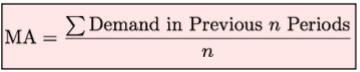
Time Series: Weighted moving average
- Like MA, but with weights for different periods (add up to 1)
- Weights are based on intuition!

Disadvantages of moving average methods
- Require vast amount of historical data (all n periods)
- When the demand has a trend, they lag and
- overestimate demand for a downward trend
- underestimate demand for an upward trend
Time series: Exponential smoothing
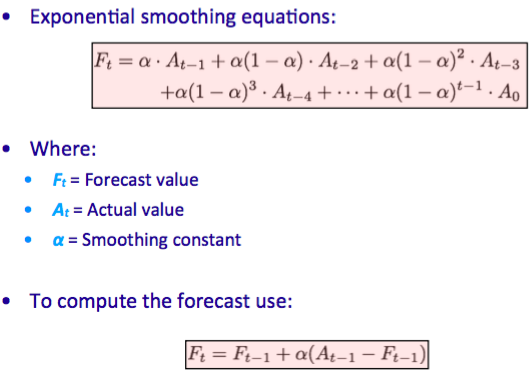
- Form of weighted moving average
- Weights decline exponentially
- most recent data is weighed the most
- Requires choice of smoothing constant alpha
- from 1 to 0
- subjectively chosen
- Involves little record keeping of past data!
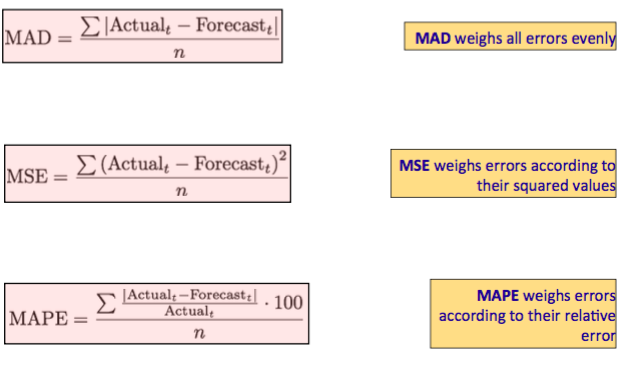
Metrics of Forecast Accuracy
Time series: Exponential smoothing with Trend Adjustment
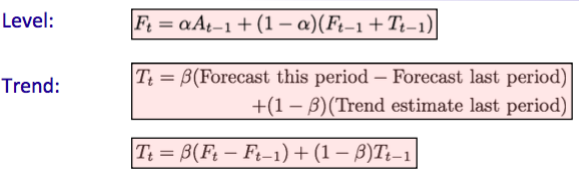
- Applies and exponential smoothing to the forecasts and the trend in period t
- beta as smoothing constant for trend is introduced
=> reduces the lag and moves forecast closer to actual demand
A/F Ratios
- Gather dataset related to products whose demand forecasts are obtained using similar forecasting techniques
- Calculate the ratio between:
- actual demand A
- forecast demand F
- Calculate mean µ and std. dev. σ of the ratios
- Use the usual forecasting technique to obtain the new forecasted demand F
- This expected demand will have
- µD = µ * F and
- σD = σ * F
- Example: If µ = 1,09, std. dev. 0,25 and the obtained point forecast is 200, the expected demand will be 218 with std. dev. 50
Aggregate Planning: time horizon, goal, inputs & outputs
- Medium term: typically 12 months
- production plan
- staffing plan
- Objective: match supply and demand over the next few months on an aggregate level
- Inputs
- reasonably accurate forecast
- definition of the aggregate unit to be considered (e.g. one model is defined as base model for product family)
- production costs data
- Output:
- Production levels and resource requirements for one or few product families using similar resources
Two generic production strategies
Pros & cons
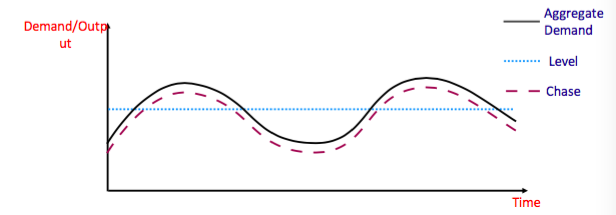
Chase strategy: production quantity equals the aggregate demand for each period
- Lower inventory buildup
- low holding costs
- low obsolescence costs
- Less backorders/stockouts
- More flexible to demand changens
- Applicable for service industries
Level strategy: production quantity equals the average demand for the whole planning horizon
- No need for subcontracting
- Predictable budgets
- Stable workfore level
- Constant production rate
- higher resource utilization
- lower capacity needed
Production
MRP: Material Requirement Planning
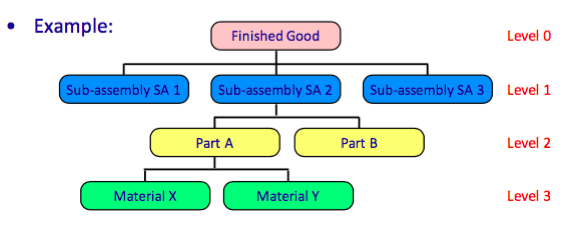
- Takes a Master Production Schedule (MPS) and “explodes” it into detailes production/procurement schedules (timing+quantities) of all components and raw materials
- Gross requirements: using end-items (level 0, e.g. mountain bikes), it generates the required quantities of immediate components (level 1, e.g. wheels), by using the bill of materials (BOM)
- Net requirements: taking into account projected inventories (“we will have 8 wheels already at hand…”)
- Time phasing: production and procurement lead times are taken into account to position requirements in time
- Assumes necessary capacity is available
- Inputs:
- MPS
- Inventory Records
- BOM
- Output:
- Recommended production schedule
- Recommended purchasing schedule
Distribution
Criteria to chose the right transportation mode
- Quantities moved
- nature / physical characteristics of goods
- Frequency of transportation
- Transportation time
- Lead time variance / Reliability
- Lead time customer requirements
- Customer location (distance, concentration)
- Economies of scale, scope and density
Direct operations:
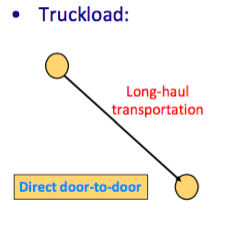
Truckload
- Pros:
- door to door service
- speed
- costs (if truck is full)
- Cons
- costs (if truck is not full)
- lower frequency
- high inventory
- Carriers
- Own fleet
- Truck rental
Consolidated Operations:
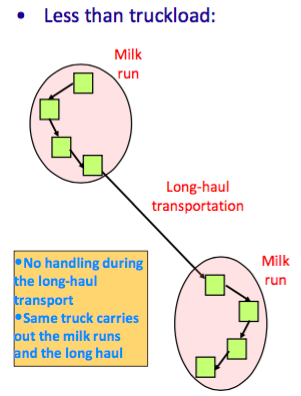
Less than Truckload (LTL)
- Pros
- transport in small quantities
- high frequency
- low inventory
- Cons:
- longer lead time due to milk runs
- high costs
- Carriers:
- Mory, Exel, Danzas…
Consolidated Operations:
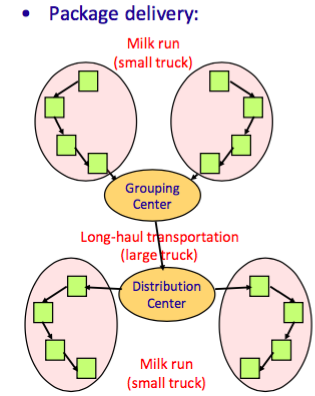
Package delivery
- Pros
- Flexibility
- Speed
- Cons
- High costs
- limited to small parcels
- Carriers
- Postal service
- FedEx, UPS
Distribution related costs
- Transportation
- Facility
- Processing
- Inventory
- Service Level
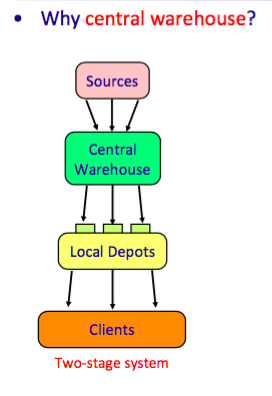
Why local depots?
- Faster customer service, shorter delivery lead times
- Lower transportation costs; freight consolidation from central warehouse to local market
- Lower capital burden on clients: short lead times require clients to have less safety stock
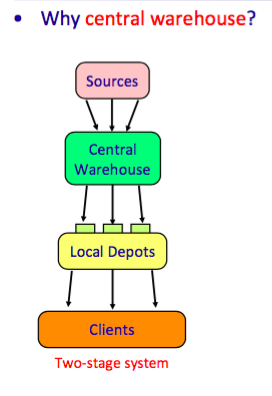
Why central warehouse?
- Faster service for local depots
- Lower transportation costs: freight consolidation from factory/supplier to central warehouse
- Risk pooling: lower overall safety stock
- Single point of contact for factory/suppliers: one office for supplier management, economies of scale: producing & ordering large lots, quantity discounts
Distribution strategies:
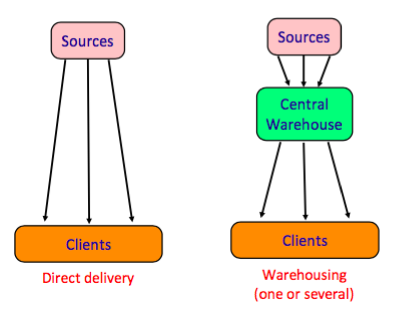
Direct Shipment vs. Warehousing
- Advantages
- less handling = less damage
- less inventory = less holding costs
- transportation lead time decreases
- Disadvantages
- higher transport costs (LTL)
- smaller production runs
- lead time for end customer increses
Distribution strategies:
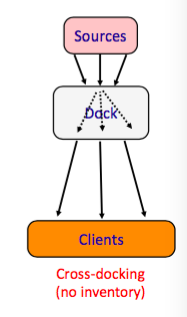
Cross Docking
- Moving products from inbound to outbound vehicle without storage inbetween
- Benefits
- reduced labor costs
- reduced inventory holding costs
- reduced transportation costs (TL in- and outbound)
- Requirements:
- High demand
- Low variance
- Easy to handle items
- Periodic coordinated orders from suppliers