what are the five possible manners of death?
- natural
- accidental
- suicide
- homicide
- undetermined
what proportion of people who die are investigated by the ME’s office? how many recieve an autopsy?
- about 12,000 people die in NH in a calendar year
- 1500 to 1800 of these deaths will be reported to the ME’s office
- only 500 will require an autopsy - the others will have enough information in their patient records and external examination to deterimine cause and manner of death
what are the 25 things that are reportable to the ME’s office in NH? (i don’t think we have to memorize this - i’m bolding the ones he talked about)
- Death resulting from a criminal act, regardless of time interval between incident and death
- Suicide, regardless of time interval between incident and death
- Death resulting from accidental injury, regardless of time interval between incident and death
- Deaths associated with fire or explosion
- Deaths associated with firearms or other mortal weapons
- Death in associated with any public or private conveyance
- Illegal abortion or complications thereof
- Death due to poison, illicit drug use or overdose
- Exposure to toxic agent during course of employment
- Deaths resulting from agents which constitute a public health or environmental hazard
- Sudden, unexpected death of a person under 60 in apparent good health
- Death unattended by a practicing physician
- Death in legal custody – dying while incarcerated, in police car, under arrest, handcuffs, when police were on the scene
- Deaths associated (not caused by!) with diagnostic or therapeutic procedures, including intra- and perioperative deaths – even if died during some benign appearing imaging study, must be reported to ME
- Death in which a body is to be cremated – about 5000 people per year – more or less a clerical check than anything else
- Deaths occurring less than 24 hours after admission to health care facility, save for those known to be terminally ill from natural disease and death is imminent and expected – unless clinician comfortable with certifying death (ie in a case where, even though he’s come into the ER and only been there for a bit, it’s clear why he died)
- Death of a child under 18 save for criteria above
- Death of a child from any cause when death occurs in day care, foster care or child is in custody of or being investigated by DCYF
- Fetal death resulting from trauma after 20 weeks or 350 gm - not every spontaneous fetal loss presumably due to natural causes is reportable – only if its traumatic such as a traffic accident, drug use, assault
- Death known to have been improperly certified
- Death of any unidentified person regardless of cause or manner
- Discovered buried remains, known or thought to be human
- Decomposed and skeletonized remains
- Suspicious or unusual circumstances surrounding a presumed natural death
- Death of a prominent or controversial person
what is rigor mortis? why does it occur (mechanism)? how can it be used to establish time of death?
- stiffening of muscles
- because ATP spontaneously breaks down to ADP and the actin and myosin filaments lock together
- involves the smallest muscles first, so within 45 minutes of death will be detectable in the neck and jaw
- body is completely stiff by 18-24 hours after death
- body will remain stiff for another 24-36 hours depending on environmental conditions
- as body decomposes and muscles break down, body will become flaccid again
what is livor? how can it be used to establish time of death?
- color
- blood will settle to the most dependent (bottom/closest to gravity) region of body
- solid elements will settle out and coagulate, fluid will become less and less fluid
- the early stages will blanche
- after 8-10 hours, no longer blanches
- can also tell you whether the body was moved
what is algor mortis? what can it tell you about time of death?
- temperature change in the body
- declines at steady rate (depending on environment) so can calculate how long the body’s been dead
what ocular changes occur after death? how can they help you establish time of death?
- filming, drying, clouding
- he said the only one he finds helpful is clouding:
- if the cornea is completely opacified and that wasn’t known to be due to some sort of disease process, than the body’s been dead for at least 72 hours
what is the difference between putrefaction and mummification?
- putrefaction requires bacteria and a high humidity environment, will smell
- mummification occurs in a low humidity environment and doesn’t involve bacteria, won’t smell as much, like tanning leather
what late post-mortem changes can be used to establish time of death? (6)
- putrefaction
- mummification
- infestation (different insects have developmental rates and these are consistent)
- skeletonization
- adipocere (development of wax-like substance by bacterial hydrolysis of fat)
- anthropophagy (eating of the body by animals)
what happens during the initial decay stage? what bugs would you expect to see and what is the timing of their development
- enzymatic release and autolysis
- blowflies and house flies will lay eggs around wounds and mucosal surfaces
- eggs hatch and move into the body within 24 hours
- takes 2-3 weeks for the egg to develop into a maggot and then into a fly - considerably longer at low temperatures (rate depends on species - consult entymologist)
what is the process of putrefaction (what’s happening during this process?) where will this process first be observable?
- bacteria break down the tissues, releasing fluids into body cavities
- anaerobic species produce gases including hydrogen sulfide, methane, cadaverine, and putrescine (he said he didn’t care about the specific gases, so i’m assuming we don’t need to know them…)
- gas “infiltrates” teh body and forces fluids into body cavities and out of the orifices
- since there’s lots of bacteria in the GI tract, particuarly the cecum, will see greening of the belly over the cecum first - apparently the skin is thinner here at least
what occurs during infestation of the body?
- maggots move throughout the body, spreading bacteria, secreting digestive enzymes adn tearing tissues with their mouth hooks
- move as a mass benefiting from communal heat and shared digestive secretions
what does skeletonization depend on? how long can it take in summer?
- time taken for a body to decompose depends on temperature and moisture and accessibility to insects
- in summer, in an exposed location, human body can be reduced to bones in just 9 days
what is the chain of custody? why is it important?
- chain of people through which evidence is transfered
- must be proper paperwork and such filled out at every step of the chain
- evidence won’t be admissible in court if the chain is not properly followed
- properly packaged and labled evidence is securely maintained
what are the three layers of the external autopsy?
- inspected first as it arrives at the morgue - should be exactly as it was found at the scene
- body is disrobed and examined again
- if there’s any external findings, these are cleaned and detailed images and sketches are taken of them
- only after these three external autopsy steps are taken is the body cut open
what is the normal distribution of manner of death (NASHU) in urban settings? how is it different in rural settings
- 55% natural
- 23% accident
- 17% homicide
- 10% suicide
- rest undetermined (about 1 %)
- (these numbers are all approximations from the graph given)
- in rural settings, the homicide and suicide amounts are switched (so about 17% suicide and 9% homicide
how many suicides and homicides are usually seen in a year?
- 150 suicides
- 15-20 homicides
what must you do to a knife wound in order to determine the true shape of the blade?
- must cut the skin out of the body
- at least in young people, skin has a lot of elastic properties, and so unless you remove all of the tension on the skin, you can’t see the natural shape it would assume
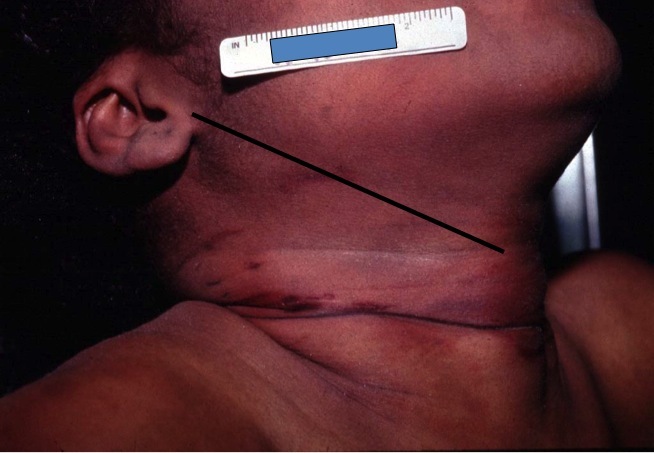
how would you determine if someone was hanged or strangled?
- someone strangled will likely have a ligature mark directly across the throat (where it is on this patient)
- someone hanged or how hanged themselves would have a more diagonal ligature mark from mandibular bone to mandibular bone (more along the black line)
what do human bite marks look like?
- area of central clearing and then a circular bruise around it
- often tears in the skin (lower central incisors in this image)
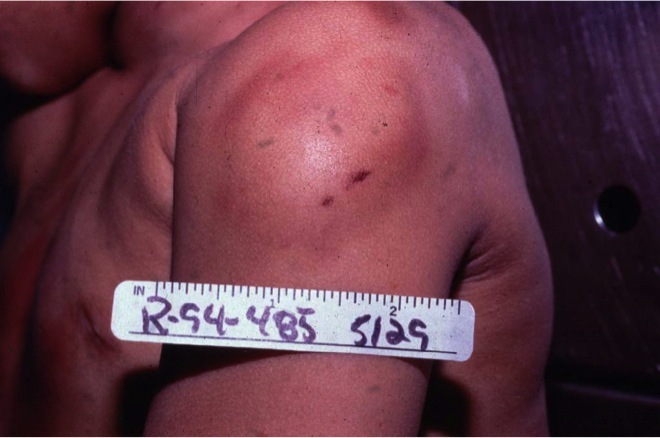
what can the location of bruising from being hit by a bumper tell you?
- patterns can help you identify the bumper
- height of the bruising can help you identify the type of car, since bumper height varies
- when you apply the breaks, your bumper goes down, so can hypothetically tell if someone was trying to stop themselves from hitting the person (cool!)
what kinds of damage would you expect to see in accidents where pedestrians were hit by cars? at what speeds?
- at speeds less than 25 mph, fractures
- at speeds greater than 25 mph and avulsive lower extremity damage
what natural deaths are most commonly seen in infants?
- SIDS is most common cause
- undiagnosed congenital defect (should have been diagnosed)
*
what will naturally kill young adults/adolescents?
- very few things
- a few cases of viral endocarditis
- asthma
- very rarely, substnace abuse related deaths (people don’t really use IVs as much anymore becasue the purity of the drug is so high now it doesn’t really add anything…)

-
molecular biology of neoplasia I - lecture notes - julia32
-
molecular biology of neoplasia II - lecture notes - julia24
-
molecular testing in the diagnosis of cancer - lecture notes - julia10
-
CPC - neoplasia - lecture notes - julia13
-
familial colon cancer - model of carcinogenesis - lecture notes - julia21
-
introduction to epigenetics - lecture notes - julia32
-
review of neoplasia and immunology of cancer - lecture notes - julia28
-
forensic pathology - lecture notes - julia27



