SOLE OWNERSHIP
Ownership by one person
CONCURRENT OWNERSHIP
Ownership by more than 1 person
ESTATE IN SEVERALTY
Sole ownership, or ownership by one person, is called an ESTATE IN SEVERALTY:
- The word “severalty” sounds like it should mean ownership by several people, but it does not.
- The way to remember its meaning is to think of “severed” ownership.
- Any freehold estate can be held in severalty.
CONCURRENT ESTATE
Ownership by more than one person is called a CONCURRENT ESTATE.
There are four types of concurrent estates:
- Joint tenancy
- Tenancy in common
- Tenancy by the entirety
- Community property
In all cases, each co-owner holds an “undivided interest” in the property as a whole, not separate parts of the property.
JOINT TENANCY
The first form of concurrent ownership is called JOINT TENANCY:
- Any two or more persons may hold title to property as joint tenants.
- The primary distinguishing characteristic of joint tenancy is the fact that it carries “survivorship”.
- Because of survivorship, a joint tenancy is NOT inheritable.
JOINT TENANCY also requires the presence of four “unties”:
- Unity of Possession- All tenants must hold an undivided interest in the whole property.
- Unity of Interest- All tenants must hold equal degrees (shares) of interest.
- Unity of Time- All tenants must acquire their interest at the same time.
- Unity of Title- All tenants must acquire title in the same way in the form of one single title to the whole property.
There are two remaining points to remember about JOINT TENANCY.
- A joint tenant may sell his/her interest without the consent of the remaining co-owners.
- However, the new owner becomes a tenant in common with the remaining co-owners who remain joint tenants among themselves.
- Corporations may not hold property as joint tenants.
TENANCY IN COMMON
A category of concurrent ownership wherein:
- Unity of possession is required, but unlike joint tenancy, each tenant holds a separate title to his/her undivided interest.
- A co-owner may sell his/her shares without the consent of the others
- The right of survivorship may NOT exists among tenants in common, so a tenancy in common IS inheritable.
- Because the unity of interest is NOT required, the co-owners may hold unequal or equal shares.
NOTE: In most states, if there are two or more owners of a property and no specific form of concurrent ownership is indicated, the owners are presumed by law to be TENANTS IN COMMON.
- However, in Pennsylvania, if the converyece is made to a husband and wife an no further explanation is given, a TENANCY BY THE ENTIRETY is created.
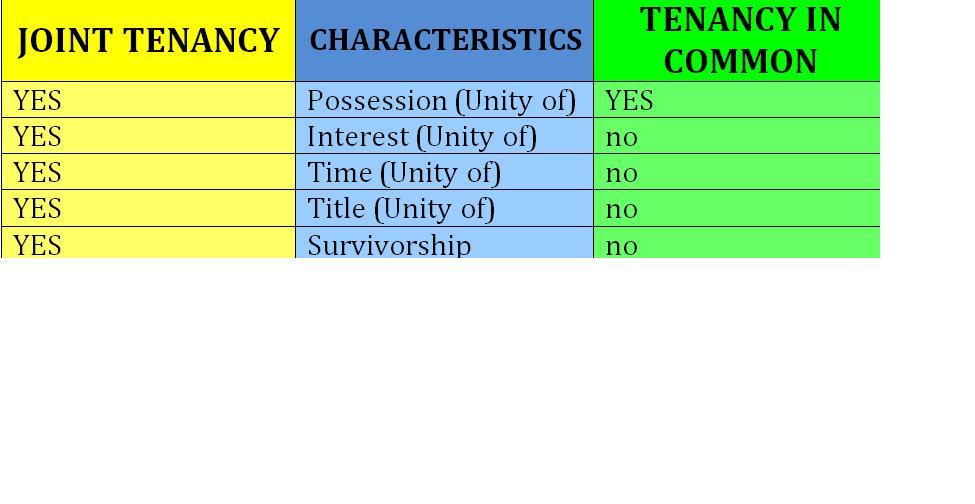
JOINT TENANCY vs. TENANCY IN COMMON
The easiest way to remember the differences between JOINT TENANCY and TENANCY IN COMMON is to remember:
- JOINT TENANCY requires all four unities and survivorship.
- TENANCY IN COMMON only requires the unity of possession, which requires that all owners hold an undivided interest in the property.
COMMUNITY PROPERTY
The third form of CONCURRENT OWNERSHIP is called COMMUNITY PROPERTY.
- It is based on the concept that each spouse has an equal interest in any property ACQUIRED during the marriage.
- Property acquired before the marriage or received after the marriage through will or gift is considered separate property.
- Only a few states recognize COMMUNITY PROPERTY. Pennsylvania does not.
TENANCY BY THE ENTIRETY
The fourth, and last, form of concurrent ownership, TENANCY BY THE ENTIRETY, is a special form of joint tenancy.
- It requires the four unities of JOINT TENANCY (possession, interest, time, and title).
- It also requires a fifth unity, unity of person. It is limited to ownership jointly by husband and wife, who are considered to be one person.
- It usually carries the RIGHT OF SURVIVORSHIP. It is recognized in only about half of the states in the US, including Pennsylcania.
- Neither spouse may encumber the title or dispose of the property without the consent of the other
- It can be terminated only by joint action of husband and wife, or by the death of either spouse.
WHICH FORMS OF CONCURRENT OWNERSHIP CAN BE PARTITIONED?
JOINT TENANCY and TENANCY IN COMMON can be partitioned.
TENANCY BY THE ENTIRETY cannot
PARTITION IN KIND
Method of partitioning the interest of holders of CONCURRENT ESTATES wherein the property itself can be SUBDIVIDED and SPLIT among the owners
PARTITION AT LAW
A method of dividing the interest held in CONCURRENT ESTATES wherein the property is SOLD and the PROCEEDS DIVIDED among the owners
SEPARATE PROPERTY
Under Community Property Law:
- Property owned solely by either spouse before the marriage,
- acquired by gift or inheritance after the marriage, or
- purchased with separate funds after the marriage.
TRUST
A fiduciary arrangement whereby property is conveyed to a person or an institution, called a trustee, to be held and administered on behalf of another person, called a beneficiary.
- The one who conveys (creates) the trust is called the trustor.
- Person who benefits from the trust is called the Beneficiary
- Trustee - 3rd party who holds legal titale and is entrusted with the responsibility of carrying out the trustor’s instructions regarding the purpose of the trust
*
COMMUNITY PROPERTY
A system of property ownership based on the theory that each spouse has an equal interest in the property acquired by the efforts of either spouse during marriage.
- Any conveyence or encumbrance of community property require signatures of both spouses
- When one spouse dies, the survivor automatically owns one-half of the community property
PARTNERSHIP
An association of two or more individuals who carry on a continuing business for profit as co-owners. Under the law, a partnership is regarded as a group of individuals rather than as a single entity.
GENERAL PARTNERSHIP
A general partnership is a typical form of joint venture in which each general partner shares in the administration, profits, and losses of the operation.
LIMITED PARTNERSHIP
A limited partnership is a business arrangement whereby the operation is administered by one or more general partners and funded, by and large, by limited or silent partners.
- General partners run the business
- Limited partners are not legally permitted to participate in the business
- while their liability for losses is limited to only the amount of his investment
LIMITED PARTNERSHIPS ENABLE INVESTORS WITH SMALL AMOUNTS OF CAPITAL TO SHARE IN LARGE REAL ESTATE PROJECTS AT MIMIMUM PERSONAL RISK
CORPORATION
An entity or organization, created by operation of law, whose rights of doing business are essentially the same as those of an individual. The entity has continuous existence until it is dissolved according to legal procedures.
- A corporation is managed and operated by its board of directors
- The charter sets forth the powers of the corporation, including its right to buy and sell real estate
One disadvantage of corporations, especially when income-producing property is involved, is double taxation.
- As a legal entity, a corporation must pay tax on its profits.
- Dividends from the remaining corporate profits are then distributed to the shareholders and are taxed again as part of the shareholders’ individual incomes.
LIMITED LIABILITY CORPORATION
An alternative, hybrid business entity with the combined characteristics and benefits of a limited partnership and an S corporation that is established according to the laws of the state in which the LLC is chartered.
- Limited liability offered by Corporate form of ownership, and
- Tax advantages of a partnership
LLC offers flexible management structures without the complicated requirements of corporations or the restrictions of limited partnerships.
CONDOMINIUM
The absolute ownership of a unit in a multiunit building based on a legal description of the airspace the unit actually occupies, plus an undivided interest in the ownership of the common elements, which are owned jointly with the other condominium unit owners.
- Individual unit owners own common elements as Tenants in Common
COMMON ELEMENTS
Parts of a property that are necessary or convenient to the existence, maintenance, and safety of a condominium or are normally in common use by all the condominium residents. Each condominium owner has an undivided ownership interest in the common elements.
PENNSYLVANIA UNIFORM CONDOMINIUM ACT
The state law adopted from the national model act that governs the development and operation of condominiums. The law also provides for certain disclosures to purchasers of condominium units.
- Legal description of condo units & common elements
- Condominium owners’ assoication by-laws
- Survey of the property
- architect’s drawings and surveyor’s legal descriptions, illustrating both the vertical and horizontal boundaries of each unit; and
- Any restrictive covenants controlling the rights of ownership
**COOPERATIVE **
A residential multiunit building whose title is held by a trust or corporation that is owned by and operated for the benefit of persons living within the building, who are the beneficial owners of the trust or stockholders of the corporation, each possessing a proprietary lease.

-
Property Ownership 154
-
FORMS OF OWNERSHIP25
-
UNIT 2: Land-Use Controls21
-
Property Ownership: LIENS13
-
UNIT 4: Legal Description14
-
UNIT 5: Interests in Real Estate31
-
Transfer of Title25
-
Unit 11: Principles of Real Estate Contracts30
-
UNIT 3: Environmental Issues19
-
UNIT 6: Landlord & Tenant Interests27
-
UNIT 1: Real Property & the Law24
-
UNIT 8: RE Taxes & Leins23



