The GAD experience
- persistent worrying about a number of areas, out of proportion to the impact of events
- overthinking plans and solutions to all possible worst-case outcomes
- perceiving situations and events as threatening, even when they aren’t
- difficulty handling uncertainty
- indecisiveness, fear of making the wrong decision
- inability to set aside worries
- inability to relax, feeling restless, keyed up or on edge
- difficulty concentrating, or feeling that your mind “goes blank”
Epidemiology and background factors
Adult stresses
- low SES
- ethnic minorities
- urban populations
- people living in countries with war, political oppression
- chronic work stress
Childhood stresses
- association between childhood separation anxiety and adult GAD
- bullying
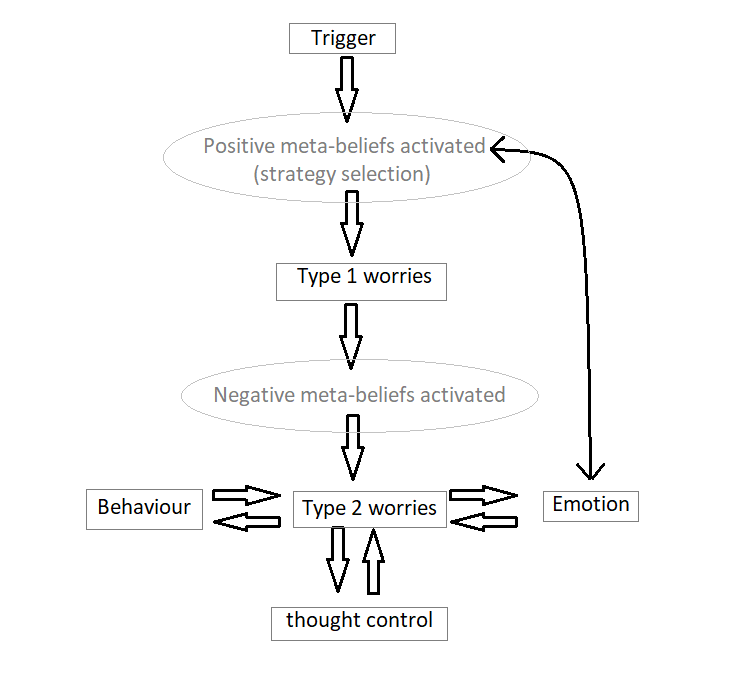
Wells’ S-REF model
Ineffective coping
Type 1 worries
- positive beliefs about worry - “if I worry I will have some kind of control. Worrying will help.”
- ‘what if’ questions are generated and solutions for dealing with that situation are formed
Type 2 worries
- negative beliefs about worry - “if I don’t worry it will get worse.”
- feel your worry is uncontrollable and may be harmful to yourself or others - inappropriate coping strategy
Problem-focused and emotion-focused coping
Problem-focused
- change the nature of the stressor
- e.g. worried about failing an exam –> study, prepare for the exam
Emotion-focused
- address the emotional response to the stressor
- e.g. worried about failing an exam –> distract yourself from the worry
Different coping strategies work better in different situations
Barkovec’s model of GAD
Need to worry is driven by perceived benefits of worrying
Insecure attachment styles are a dispositional characteristic
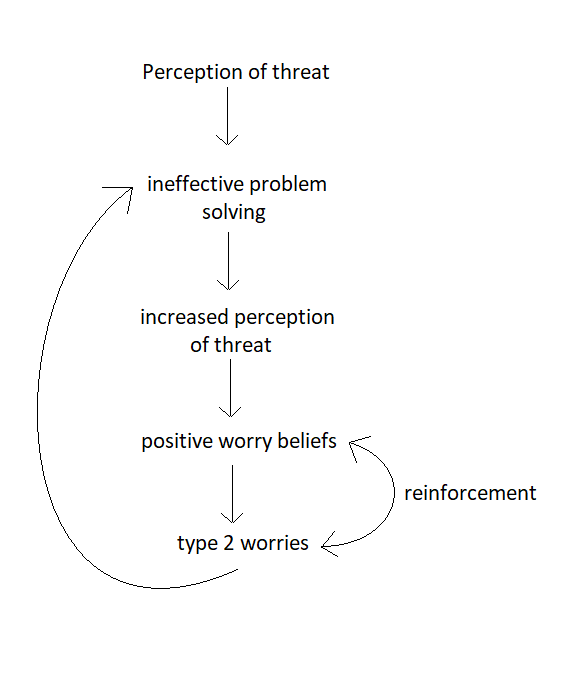
Dugas’ model :
Intolderance of uncertainty
- Some find uncertainty very difficult to deal with
- leads to anxiety - caused by positive beliefs about worry (“if I worry I’ll keep some form of control”)
- 4 central features
- intolerance of uncertainty
- cognitive avoidance
- negative problem orientation
- positive beliefs about worry
Intolerance of uncertainty
key intervention components
Key intervention components
- self-monitoring (diaries - but people bad at following thorough with these)
- intolerance of uncertainty education
- evaluating worry beliefs
- improving problem-orientation
- processing core fears (identify fears driving anxiety - negative automatic thoughts driven by negative schemas {Beck})
Multipath model of GAD
Multiple things influence and are influenced by GAD:
- biology
- psychology
- lower threshold for uncertainty
- anxiety-evoking schemas
- worry as a coping strategy
- worry about worrying
- social
- lack of social network
- separation/loss
- anxious/nonresponsive parents
- peer conflict/victimisation
- sociocultural
- stressful/poor living conditions
- prejudice & discrimination
- low SES
Psych, social & sociocultural can be changed - focus formulation on these
Mennin’s model:
emotional dysregulation
Proplematic relationship with internal experiences of perceived threats –> experiential avoidance (worry) –> short term distress reduced but long term increased
Students with GAD report:
- more intense emotions
- poorer understanding of emotions
- greater negative reactivity to emotional experience
- less ability to self-soothe after negative emotions
Emotional dysregulation model
key intervention components
- relaxation
- belief reframing
- emotion education
- emotional skills training
- experiential exposure exercises
Panic and GAD
High anxiety situation
High sympathetic nervous system activity - fight/flight
- heart racing, shaking, sweating, hyperventilation/breathlessness
Catastrophic beliefs - “I’ll faint and make a fool of myself,” “I’m going to die”
Avoidance of this situation/location as it subsequently produces the same response after first time
Panic response gradually generalises to multiple situations/locations –> GAD
Treat GAD that arose from panic situation
Graded exposure to feared stimuli
Relaxation/breathing exercises
Cognitive restructuring or self-instruction training
Brown paper bag (immediate relief - recycle CO2)




