Questions from Lisa: Colorectal:
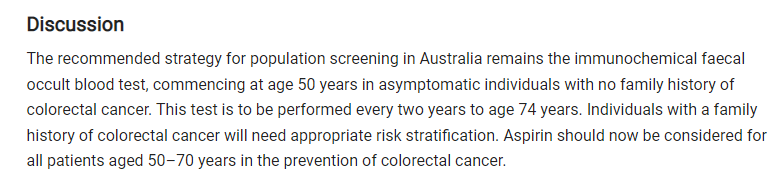
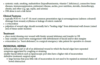
CRC RACGP guidelines: Screening: Who and when and what?
- FOBT- every two years for patients of low risk- from ages 50-74 years
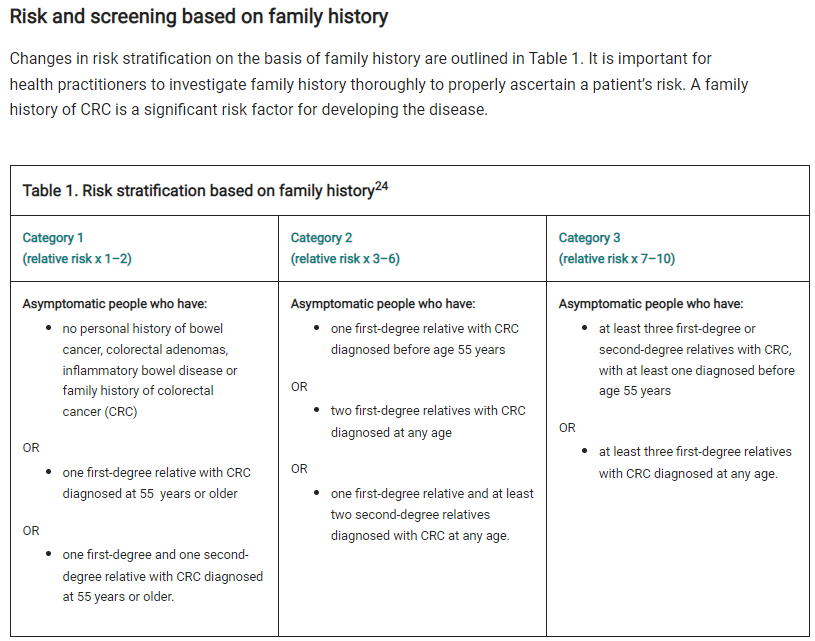
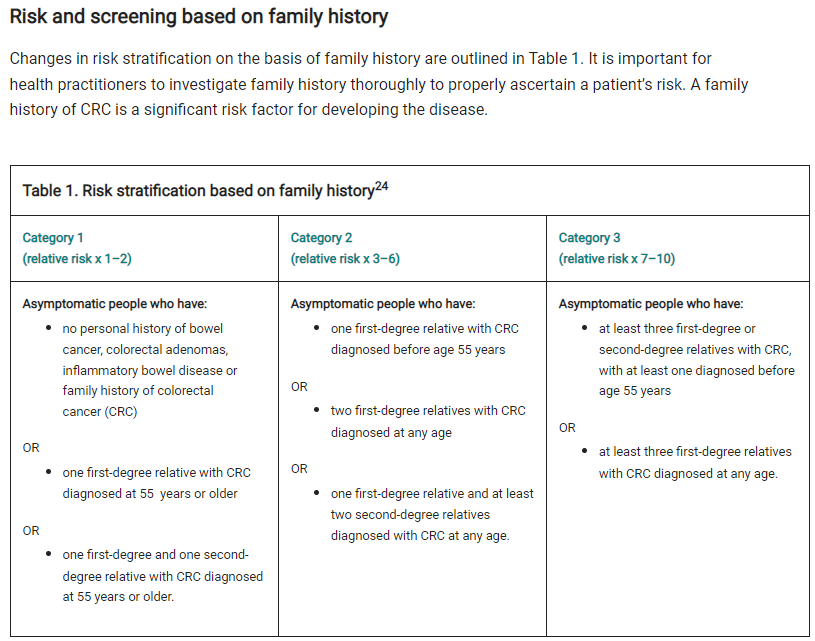
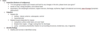
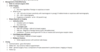
Risk stratification: CRC: Risk stratification based on family history:
What are important changes to managing and recommendations to CRC screening:
- Actively consider commencing patients on low dose aspirin (level 1 evidence can reduce incidence and mortality in CRC
Screening flowchart based on Family history: read
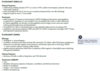
What should be done for Low risk patients? Moderate risk patients? High risk patients?
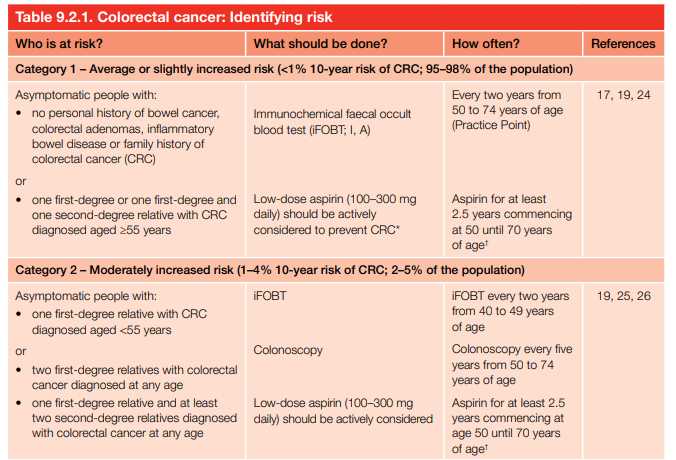
Colorectal cancer identifying risk:
Who is at risk?
What should be done? How often?
(Low and medium risk)
CRC screening:
Who is at risk? What should be done? How often?
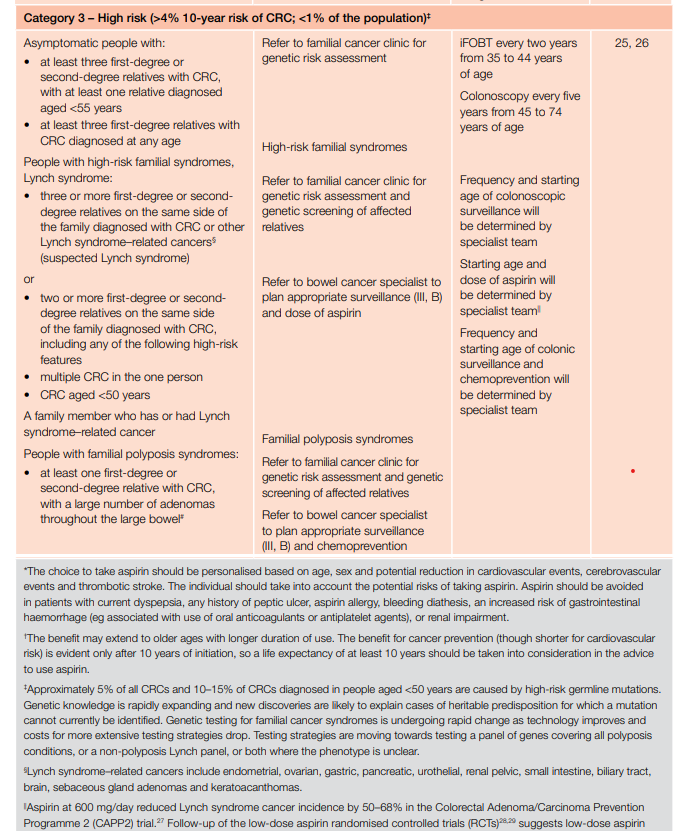
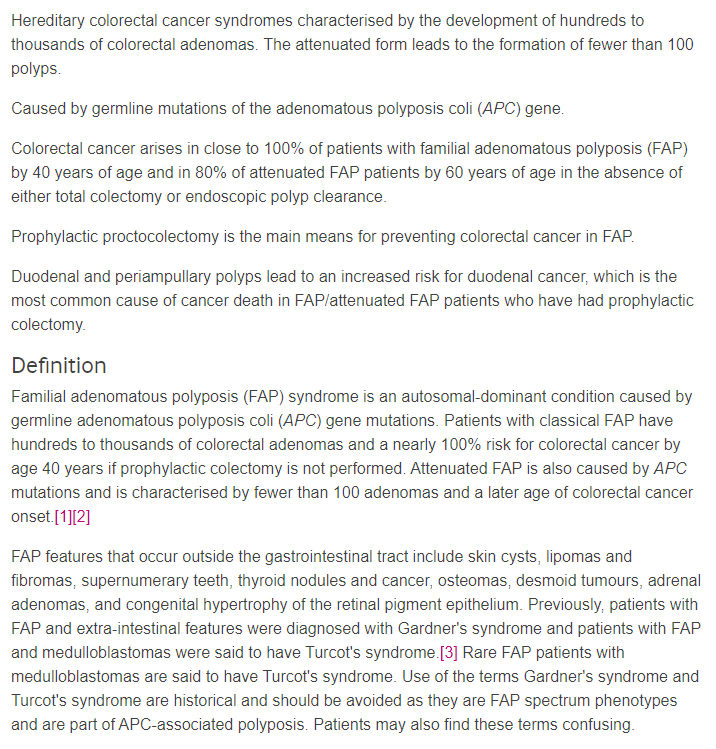
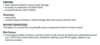
What is Familial adenomatous polyposis?
Define? What genes are associated with this condition
What is Peutz Jeghers syndrome?
What are the mutations that cause this?
What this conditions significance to CRC?
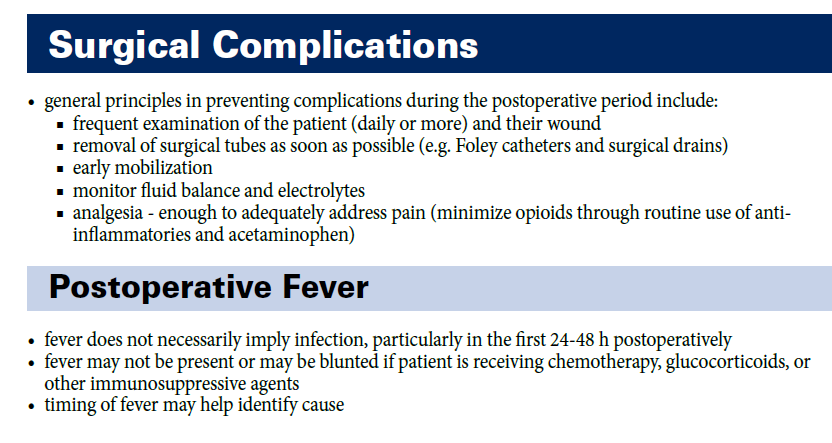
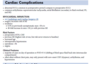
What are general principles in preventing complications udring the post-operative period? List 5
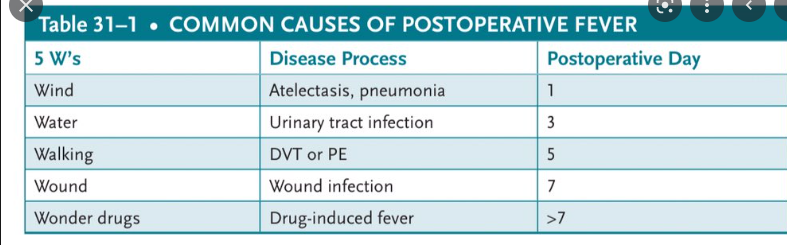
When is a post-operative fever most likely to occur?
Outline sequence of events for post-op complications:
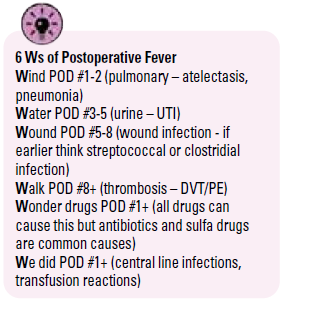
Wind, Water, wound, walk, wonder drugs
Management of any of these causes of fever?
- Frequent examinations of the patient, and their wound
- Removal of surgical tubes as soon as possible (e.g urinary catheter) + surgiucal drains
- Early mobilization
- Monitoring fluid and electrolyte status
- Analgesia, enough to adequate- enough to mobilize early -without too much pain
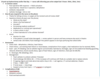
Post-op fever:
- fever does not necessarily mean imply infection particularly in first 48 hours
- Feveer may not be present of blunted if receiving chemo, glucocorticoids + other immunosuppressive drugs
- Timing of fever may help identify cause:
Hours after surgery- POD# - Inflammatory reaction in response to physiological stress
- Unlikely to be infectious unless necrotizing fascitis or other severe infection
- reaction to blood products given in surgery
- malignant hyperthermia
POD #1-2 days post op: (Wind) atelectasis- Most common cause day 1
- atelectasis
- early wound infection (especially clostridium, group A strep) - Feel for crepitus + look for dishwater drainagae
- aspiration pneumonitis
- Others: Acute adrenal insufficiency, thyroid storm, transfusion reactions
POD # Days 3-7: Likly infectious:
- UTI
- SSI
- IV site infection (commonly staph aureus)
- Septic thrombophelbitis
- Leakage at bowel anastomosis (Presents with- tachycardia, hypotension, oligouria and abdominal pain)
POD # Days 8 plus:
- INtra-abdominal abcesses
- DVT/PE - (can occur anytime post op but most common in days 8-10)
- Drug fever
- Others: URTI, infected seroma/biloma/haemotoma/ C.difficle + endocarditis
Treatment: Resusitation then treat primary cause
Outline important aspects of wound care management:
Outline important aspects of management of surgical drains:
Wound Care post-op
- Can shower days 2-3 after epithelization
- most dressing can be removed and left dry if dry
- Steri strips/glue should be leaved for 2 weeks
- examine wound if wet dressings, signs of infections (tachycardia, fever and pain)
- Skin sutures and staples can be removed POD - 7-14 (exceptions- incisions across skin creases, closed under tension, or pt factors (elderly, immunosuppression, corticosteroid use)
- negative pressure dressings consist of foam, and suction and promote granulation tissue (ideal for large grafted areas, or large non healing ulcers)
Drain management:
- Placed at time of surgery to prevent acculumation and build up of fluid (blood, pus, serum, bile and urine)
- Can be used to assess third spacing fluid accumulation post operatively
- Should be inserted through its own wound, not surgical wound- to decrease risk of infection
- Monitor output daily
- drains should be removed once drainage is minimal (30ml < day/24hours)
- Drains do not guarantee that the patient will not form a colleciton
- Ridged drains can erode through structures and cause necrosis
What is A SSI?
What are common eitologies?
How are they classified? What are the infections risks associated with each? Give an example for each:
What are patient characteristics that effect SSIs: (list 6)
What are other external factors that effect SSIs?
- S. Aureus, E.coli, Enterococcus spp, steptococcus spp, clostridium spp.
Patient characteristics:
- age
- DM
- Steroids
- immunosuppression
- Smoking
- obesity
- Burns
- Malnutrition
- patient with other infections
- traumatic wound
- radiation to area
- Chemotherapy
Other factors
- Prolonged preoperative hospitilization
- reduced blood flow through
- Break in sterile fields
- multiple antibiotics
- hematoma/seroma
- Foreign bodies (drains, sutures, grafts)
- Skin preparation
- hypoxemia
- hypothermia
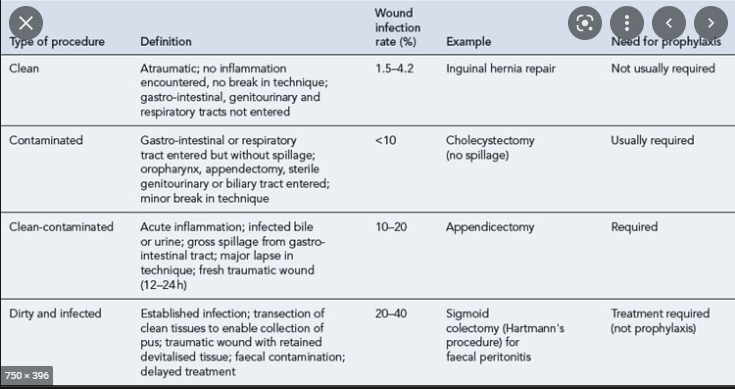
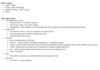
Prophylaxis for SSIs:
- Preoperative antibiotics for most surgeries (cefazolin+/-)
Post-operative management- Immediate management post-op outline assessments:
What are common post operative care needs? And how are they managed: Read
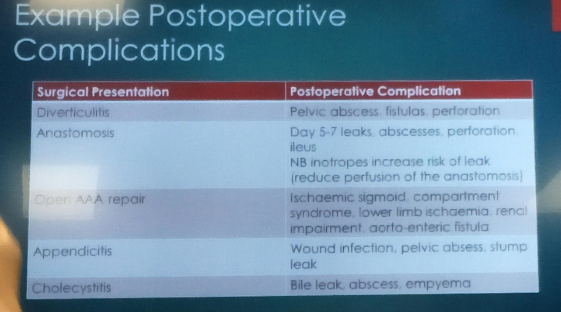
List surgical complications associated with:
Diverticulitis:
Anastomosis?
Open AAA repair?
Appendicitis?
Choleycstitis?
Immediate management
Patients go to recovery area
Monitoring (depending on procedure)
- Vitals - arterial line or not
- Urine output & fluid balance - monitored after most significant procedures
- Bloods - FBC, UECs (often re-checked)
- Drains - monitored for volumes and content
- Central line - CVP is monitored in those with poor cardiorespiratory reserve
Common post-operative care
Analgesia
- Patient relief - usually opioids
- Facilitates deep respiration to prevent atelectasis
Respiratory
- Chest physiotherapy - deep breathing exercises & promoting removal of secretions
- Benefit - prevent atelectasis & pneumonia
VTE prophylaxis
- Started ~6 hours after operation once bleeding is excluded
- Enoxaparin 40mg
Encourage early moving and feeds
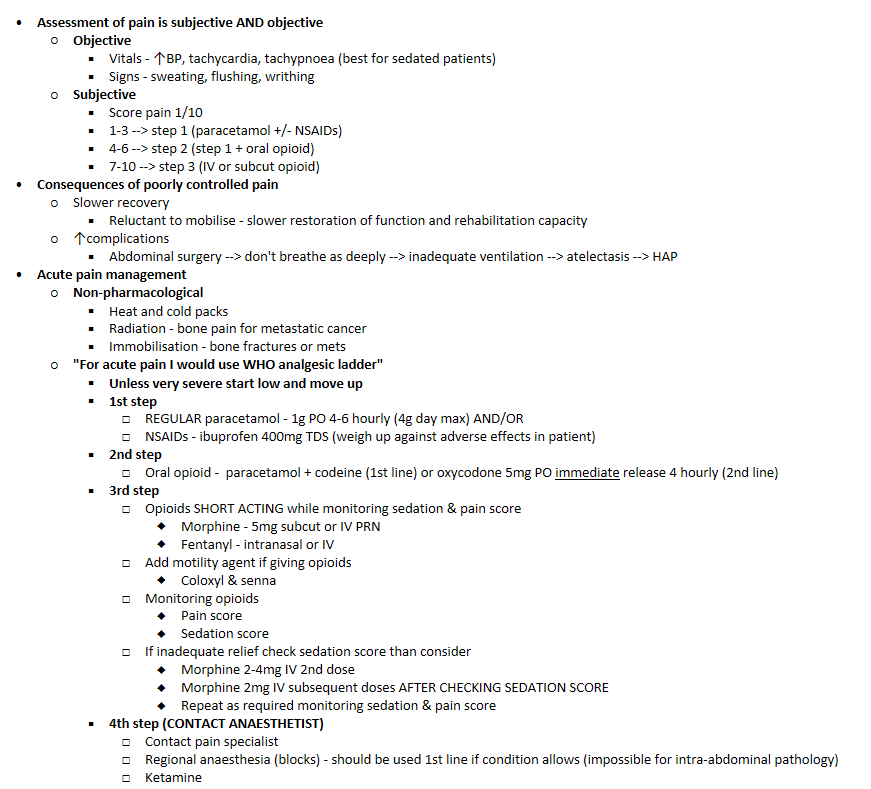
Outline a pain assessment: Objective signs? Subjective scores?
What are consequences of poorly controlled pain?
Outline a stepwise approach to pain 1st non-pharm: list 4
For acute pain what universal system do you use?
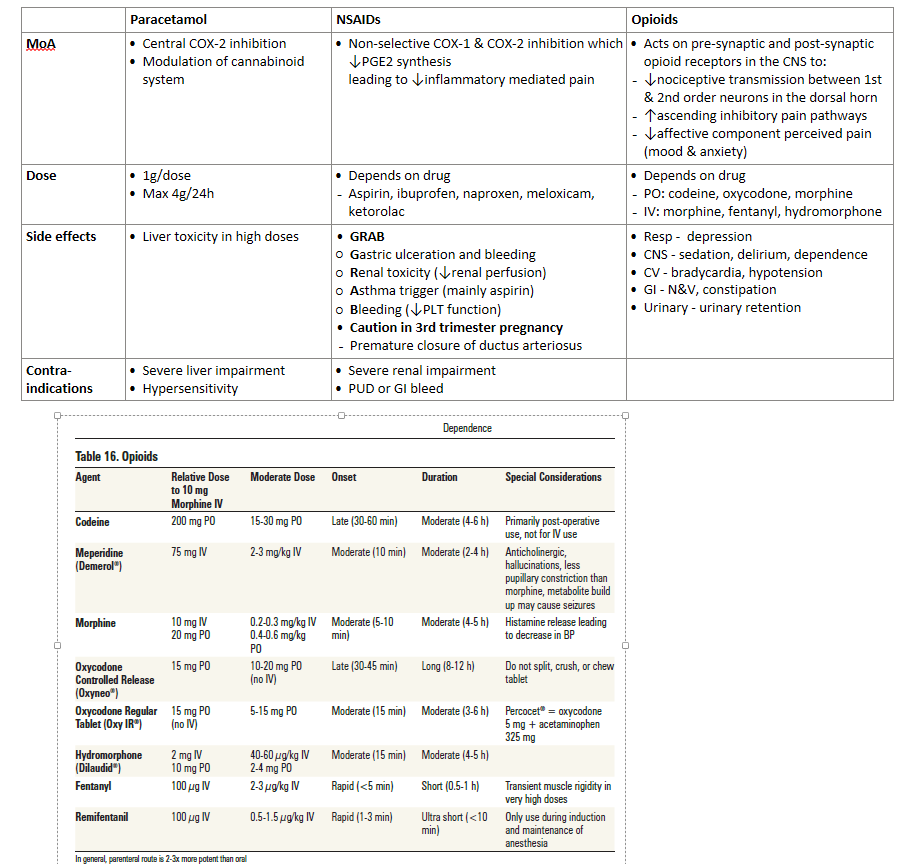
MOA of paracetomol? Side effects?
NSAIDS MOA? Side effects list 4 (GRAB)
Opioids MOA? side effects? CNS? resp? CV? GI? Urinary?
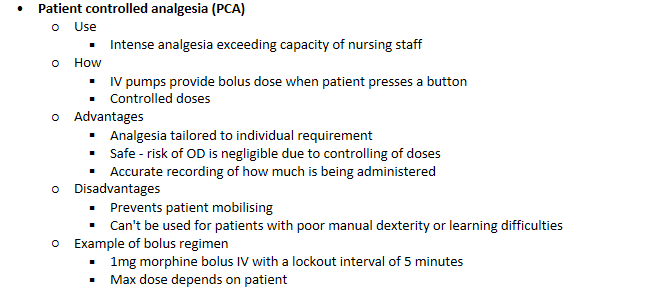
What is PCA? (patient controlled analgesia)?
Use? How? Advantages? Disadvantages? Examples of doses?
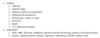
List 5 common causes (sites) of causes of post-operative sepsis? 5cs?
Post-operative sepsis
Septic sources on surgical wards (5 Cs)
- Chest infection
- Cut - wound infection
- Catheter - UTI
- Collections - abscesses
- Cannula & central line
Outline general principles in preventing complications in the post-operative period: List 6 - 3 marks
Continued next card:
Outline causes of post-op fever according to POD? (post operative date)
WHats is likely POD 1? 1-2? 3-7? and POD 8+?
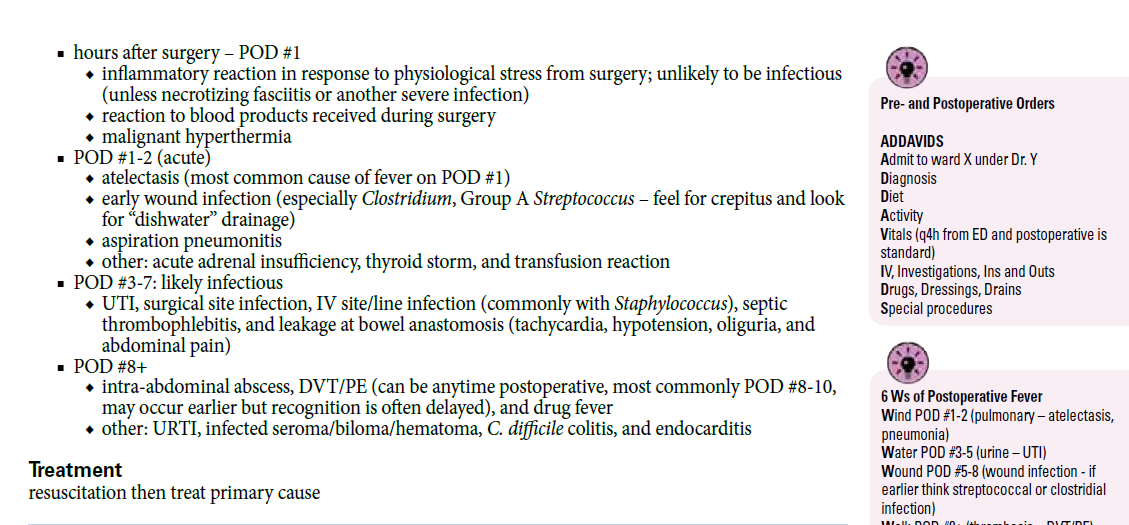
List the 6 Ws of post-operative fever?
What are the different types of post-op bleeds?
Primary? Reactive? Secondary?
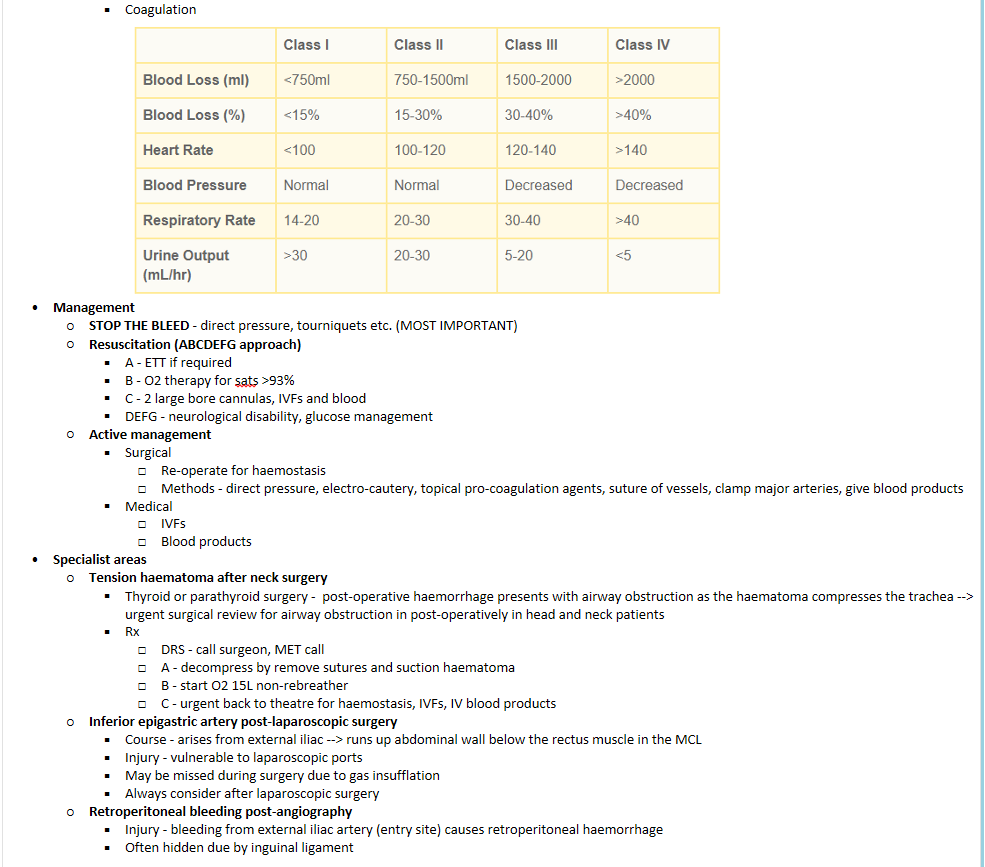
Outline an asssessment of haemorrhage (assessment)
DRSABCDE - Ix? Management?
Types of post-op bleeding
Primary
- Intra-operative bleeding
Reactive
- Within 24h of the operation
- Cause - ligature that slips, missed vessel (intraoperative hypotension and vasoconstriction hides bleed)
Secondary
- Erosion of a vessel due to spreading infection
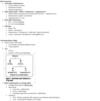
Assessment of haemorrhagePrimary survey (DRSABCDE)
D - don PPE, check safe to approach
R - COWS
S - call MET call, notify surgeon
Haemorrhage control
A
- Assess - check obstruction & patency, listen for stridor
- Rx - suction, manoeuvres, LMA
B
- Assess - SpO2, RR, cyanosis, trachea, chest expansion, percussion, auscultation
- Ix - blood gas, CXR
- Rx - 15L O2 non-rebreather
C
- Assess - P, BP, CRT, temperature, JVP
- Ix - bloods
- Rx - IVCs, start fluids, blood products, IDC & UO
D
- Assess - pupils, brief neurological
E
- Assess - T, abdominal, top to toe
Ix
- FBC - post-operative anemia is common and usually benign due to blood loss + IVF dilution; significant drop only suggests bleeding
- G&H and cross-match
- Coagulation
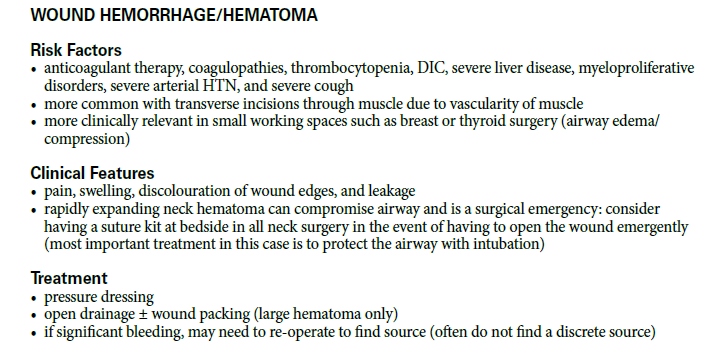
Wound Haemorrhage/haemotoma:
What are risk factors for this? (list 4)
Clinical features? (list 4)
Treatment?
Post-operative nausea and vommitting:
Incidence? Consequnces?
Causes of PONV? (list 6 important reversible causes)
What are risk factors influencing post-op Nausea and vommitting?
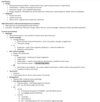
Post-operative nausea & vomiting (PONV)
Incidence
- 20-30% within first 24-48 hours after surgery
Consequences
- Aspiration pneumonia
- Electrolytes - hypokalemia, hyponatremia
- Metabolic alkalosis
- Suture dehiscence - rupture of wound along suture line
- Bleeding
- Incisional hernia
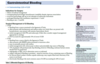
Cause of PONV
- PONV - most common cause is related to the operation & above RFs & is benign
2 brainstem areas key in controlling vomiting
- Vomiting centre - in medulla oblongata; controls and coordinates movements of vomiting; inputs from CTZ, GI tract & higher cortical structures (pain, sight, smell)
- Chemoreceptor trigger zone (CTZ) - located outside of BBB, responds to stimuli in blood to trigger vomiting
Important reversible causes to rule out
- Pain
- Infection
- Metabolic - uraemia, electrolyte disturbance, DKA
- Post-op ileus or bowel obstruction
- ↑ICP
- Medications
Risk factors influencing PONV
- Patient factors - female, non-smoker, past PONV
- Surgical factors - type (abdominal or pelvic, middle ear and eye, gynaecological), long duration
- Anaesthetic - poor pain control, certain agents (opioids, volatile anaesthetic, NO), dehydration
Outline an assessment of Post-operative nausea and vommitting:
Consider all causes:
Hx, Assosicated symptoms? Pmhx, social, fh?
Examination?
Ix?
Management? Goals? DRSABCDE, non pharm? hydration? pharmacological?
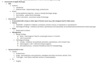
Assessment of PONV
Consider above causes when assessing
HxHPC
- Vomiting - onset, duration, appearance, haematemesis or coffee ground vomitus, volume, relation to eating & drinking, projectile
Surgery - indicaiton, details, complications, anaesthetic used
Associated symptoms (ROS)
- Constitutional - pain, fever/chills
- GI - bowel motions (passing stools and flatus), distention, anorexia
- Urological - FUND
- CNS - headache, drowsy, weakness
- CV - chest pain, palpitations, syncope, SOB
- Resp - cough, SOB, leg pain
PMHx
Medical history
Medication review - anaesthetic, analgesia, anti-emetics, regular medications)
Surgery - operation details and complications,
A&I
Social
Family Hx
Exam
Inspection - surroundings (vomit bag, IVC sites), airway protected, colour (pallor, jaundice), LOC (aspiration), expose fully, lying still or colicky pain
Vitals - P, RR, T, BP, O2, fluid balance (U/O, drain outputs, others), BSL
Peripheral - CRT, temp, skin turgor
Face - mucous membranes, sunken eyes
Chest & abdomen
Ix
Blood gas - severe vomiting for metabolic alkalosis
Bloods - FBC, UECs + CMP
Management
Goals - ↓patient discomfort, prevent aspiration, wound dehiscence & metabolic abnormalities
DRSABCDE
DRS
A&B - airway protected/aspiration
C - P, BP, assess hydration, IVC if severe
D - LOC (airway protection)
E - T, septic foci
Non-pharmacological
- Reassurance - PONV common & usually doesn’t indicate a serious process; treatable with meds
- Small meals
- Shower
- Hydrate and correct electrolytes
- PO (small sips) or IV if dehydrated and can’t keep down
- Correct electrolytes - abnormalities prolong ileus
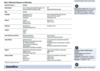
Pharmacological
If PONV is severe or ileus is present give IV
Anti-emetics
Ondansetron*
- Dose - 8mg subling PRN (standard post-op dose)
- MoA - 5-HT3 antagonist in the chemoreceptor trigger zone (CTZ)
- SEs - headache (common), diarrhoea, dizziness, QT prolongation
Prochlorperazine
- MoA - D2 antagonist; potent anti-psychotic (mesolimbic) and anti-emetic effects (CTZ)
- SEs - extrapyramidal, neuroleptic malignant syndrome
Metoclopramide
- Use - weak anti-emetic not effective for post-operative PONV
- MoA - D2 antagonist in the CTZ
- SEs - extrapyramidal (akathisia, dystonia), hyperprolactinemia & galactorrhoea, headache
- CI - Parkinson’s
Analgesia
- Control of pain important to reduce PONV
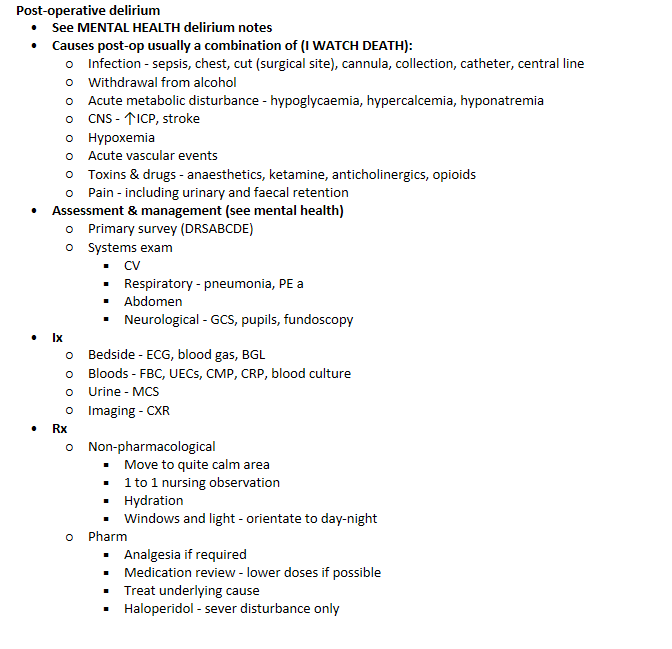
Post-op delirum (or delirum in general)
List 6 causes: Think (IWATCHDEATH)
Outline assessment of pt with suspected delirium:
Primary survey, systems exam?
Ix?
Management?


-
AH2 ‐ Common Periop Complications - General Complications After surgery - Dr Aramovic30
-
AH2 ‐ Hepatopancreaticobiliary - Don Cameron20
-
Trauma - Advance Life support - SHOCK31
-
Introduction to Surgery: Dr Sally Meade important12
-
Introduction to FLUIDS8
-
Peri-operative Pain and PONV19
-
Infection/sepsis/SSI/Hand hygiene19
-
Perioperative Care - ERAS and nutrition in surgical patient38
-
Perianal conditions -BW 2 Dr Alex Croese27
-
Acute Chronic Ischemia3
-
Learning objective: Surgery: Principles of surgery and peri-operative care:14
-
Thyroid Nodule12
-
Vascular Cases13
-
Water And Electrolyte Management11
-
Gen surgery Learning objectives:84
-
Pancreatic Cancer- Bilary Obstruction14
-
Upper GI surgery learning objectives:4
-
Upper GI Surgery: Base Week 3 material47
-
Urology: Haematuria/Dr Lun: Ingunoscrotal lumps, prostate cancer43



