What is the structure of an amino acid?
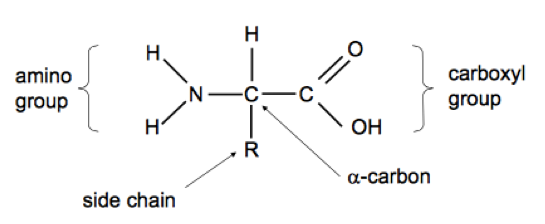
Define Chirality
Chirality means “handed”
The central carbon of an amino acid is the chiral centre, it has four substitutents bound to it giving rise to different isomers.
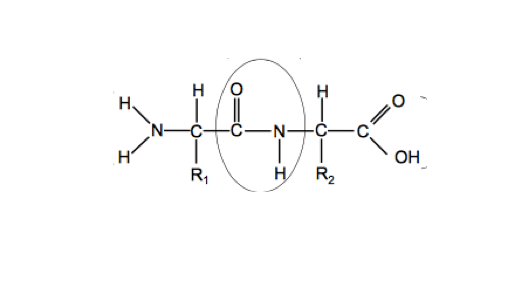
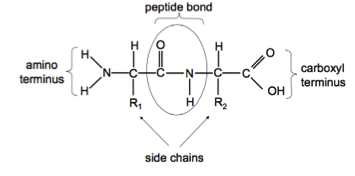
Describe the key features of this peptide (amino terminus, carboxyl terminus, peptide bond & side chain)
List the different bonds that hold protein together in their conformations
- Covalent Bonds
- Hydrgen Bonds
- Van der Waals Forces
- Ionic Interactions
- Hydrophobic Interactions
What is a covalent bond?
Bond where two atoms share electrons - it is the strongest type of bond
What is a hydrogen bond?
When two atoms bearing partial negative charges share a partially positively charged hydrogen, the atoms are engaged in a hydrogen bond
What is an ionic interaction?
These arise from the electrostatic attraction between charged side chains
What are Van der Waals forces?
These are transient, weak electrostatic attractions between two atoms, due to the fluctuating electron cloud surrounding each atom which has a temporary electric dipole
What are hydrophoic interactions
The major force driving the folding of proteins into their correct conformation.
They create a hydrophobic core and a hydrophilic surface to the majority of proteins
Describe the four folding structures of a protein
- Primary - linear sequence of amino acids
- Secondary - local structural motifs
- Tertiary - secondary structural motifs - protein folds into compact domains
- Quaternary - 3D shape of a multimeric protein
What are the two major secondary structures of a protein?
- Alpha helices
- Beta-pleated sheets
Define a nucleic acid
DNA and RNA are examples of nucleic acids
Nucleic acids are macromolecules made up of nucleotides
Define a nucleotide
A nucleotide is composed of a base, a sugar, and a phosphate group.
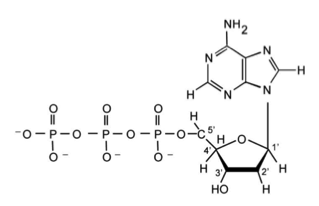
Give some examples of a nucleotide
- Deoxyadenosine 5’-triphosphate (dATP)
- Adenosine monophosphate (AMP)
Define a nucleoside
Composed of a base + sugar
(i.e. no phosphates)
Give some examples of a nucleoside
- (deoxy)cytidine
- (deoxy)thymidine
- (deoxy)uridine
- (deoxy)adenosine
- (deoxy)guanosine
What are the Bases? (inc. DNA and RNA)
- Cytosine (C)
- Thymine (T) (DNA only)
- Uracil (U) (RNA only)
- Adenine (A)
- Guanine (G)
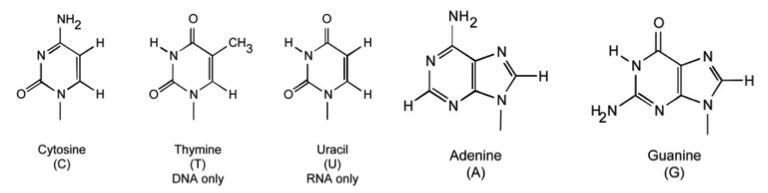
What is the difference between a purine and a pyrimidine base?
Purines = one carbon ring nitrogen base
Pyrimidines = two carbon ring nitrogen base
Which bases are purines?
Which bases are pyrimidines?
- C - pyrimidine
- T - pyrimidine
- U - pyrimidine
- A - purine
- G - purine
Describe the primary structure of DNA
- linear sequence of bases
- long chain of deoxyribose units linked by phosphodiester links
- Phosphate groups are attached to the 5’- and 3’-carbon atoms of each sugar to form the backbone chain of DNA.
- 5’ and 3’ ends (which face opposing directions)
- 5’ end carries a free phosphate
- 3’ end carries a free hydroxyl (-OH) group a
Describe the secondary structure of DNA
- Right-sided double helix
- Two chains in the helix run in opposite directions
- The two chains are held together by hydrogen bonds between the bases (this creates a major and minor groove)
- The two strands are complementary in their sequence due to the specificity of base pairing
Explain Watson-Crick base pairing
The bases of DNA always pair specifically -
A – T
C – G
How main hydrogen bonds are in each base pair (A/T and C/G)
- A/T = 2 therefore it is less stable
- C/G = 3 therefore it is more stable
What are the key differences between the E. coli (bacterial) and human (eukaryotic) genome?
- Size - human genome is larger
- Human genome divided into chromosmes
- E coli genome single circular DNA molecule