What are some causes of metabolic acidosis?
1) Increased acid production
a) Lactic acidosis
- hypoxia
- poort tissue perfusion
- CO or cynaide poisoning
b) Diabetic ketoacidosis (DKA)
- beta-hydroxybutyric and acetoacetic acids
- failure of oxygen delivery to the tissues
2) Decreased acid excretion
a) Renal failure
b) Renal tubular acidosis
- Failure of tubular acid secretion
3) Bicarbonate loss
a) Severe biarrhoea, ileostommy
What would you see in
Acute respiratory alkalosis?
Acute metabolic alkalosis
Acute respiratory acidosis
Acute metabolic acidosis
1) pH
2) bicarbonate
3) pCO2
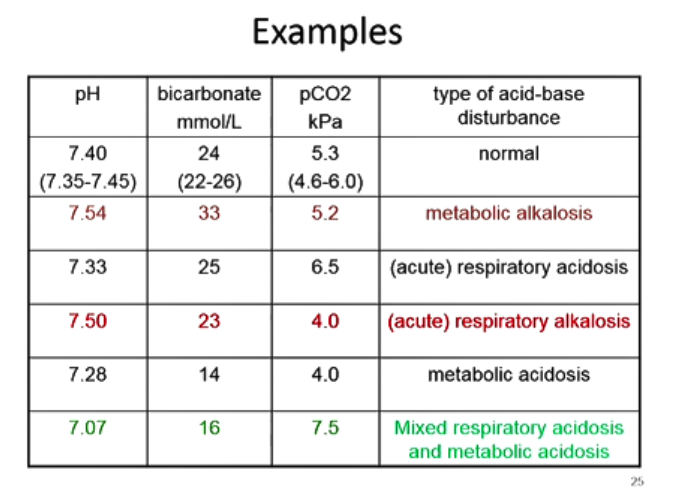
Normal pH of the body is…
~7.4
Describe the detailed 4-step approach to interpreting acid-base data
- 1) What is the primary diagnosis?
- -Acidaemia/alkalaemia first, then is it primary or acidosis or primary alkalosis? (look at pH)
- -Is the primary disturbance respiratory or metabolic? (look at the pCo2, bicarbonate and Base excess)
- 2) Is the compensation appropriate?
- -Use an acid-base map or use a ‘rule of thumb’ (inappropriate compensation implies a mixed disorder)
- 3) Calculate the anion gap
- -A high anion gap implies metabolic acidosis is present and can determine the diagnosis (+ urine serum anion gap if serum anion gap is normal)
- AG = cations - anions
- AG = (Na+K) - (Cl+ bicarbonate)
- (Normal AG reflects mainly protein anions)
- Increased AG indicates the presence of unmeasured anions
- 4) Calculate the delta anion gap/delta HCO3 ratio
- This helps to identify the presence of a co-existing metabolic acidosis or alkalosis
- Delta ratio = increased anion gap / decrease [HCO3-]
- Meausred AG - Normal AG
- Normal [HCO3] - measured [HCO3]
- If the delta ratio is lesser than 1 = concurrent with normal AG acidosis
- (e.g. DKA and diarrhoea) (two conditions which result in acidosis)
- If the delta ratio is between 1-2 = pure AG acidosis
- If the delta ratio is greater than 2, it indicates concurrent metabolic alkalosis (e.g. lactic acidosis and vomitting). (one condition which result in acidosis and the other resulting in alkalosis)
Case report:
-42 year old man who is semi-comatosed with seizures
- pH is low
- PO2 is normal
- pCo2 is low
- Bicarbonate is very very low
- Base Excess = -19
Na, K and Cl are normal.
What can we determine from this?
Metabolic acidosis
AG = (140+4) - (102+8)
AG = 34 (high)
Ethylene glycol poisoning (dry-freeze) is suspected. Treatment was commenced with an ethanol infusion
What are some causes of normal Anion Gap acidoses (Metabolic acidosis)
Non-renal causes (most common)
-Normal renal acidification by the kidneys but loss of bicarbonate from non-renal causes
1) Diarrhoea
2) GI ureteral connections, ileostomy
3) External loss of pancreatic or biliary secretions
Renal causes
-failure of renal acidification
1) Proximal renal tubular acidosis (type 2 RTA)
2) Hypokalaemic distal renal tubular acidosis (type 1 RTA)
3) Hyperkalaemic distal renal tubular acidosis (type 4 RTA)
4) RTA of chronic kidney disease (failing kidney, but not quite failed)
What is Renal Tubular acidosis (RTA)?
-Defects in acid excretion: urine pH > 5.5 and urine ammonium not increased (inappropriate for metabolic acidosis)
- Proximal (Type 2) or distal (Type 1) types
- Usually hypokalaemia
Why does chronic vomitting cause muscle weakness?
Pathogenesis:
1) Loss of HCl due to vomitting causes alkalosis
2) Hypokalemia is due to
a) alkalosis
b) K+ loss to due to excessive laxative use (in chronic diarrhoea, K+ loss predominates due to the NaK exchange in the colon. In acute diarrhoea, Na+ loss predominates)
3) Hypokalemia causes muscle weakness (hyperpolarises exciatble cells)
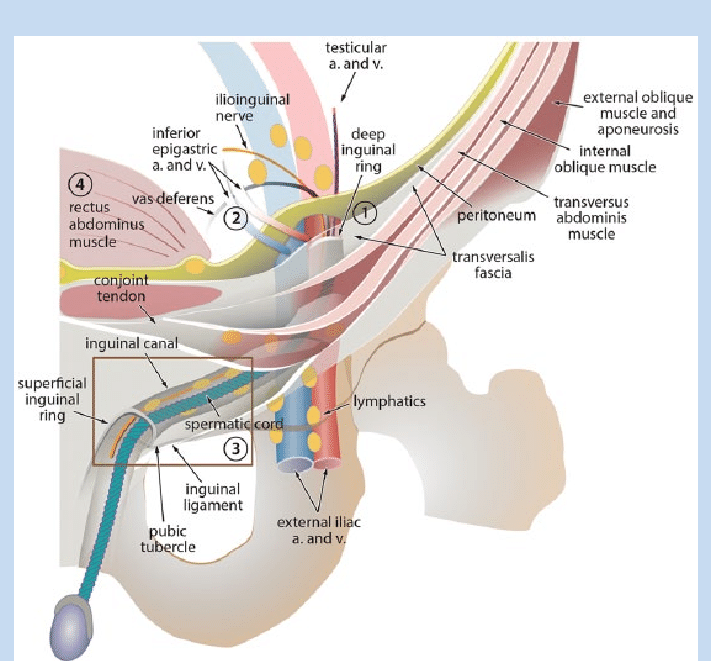
What are the boarders of the Inguinal Canal?
- *Anterior Wall =**
1) Aponeurosis of External Oblique
2) Internal Oblique (in Lateral 1/3) - *Floor =**
1) Inferior rolled edge of External Oblique aponeurosis (Inguinal Lig.)
2) Lacunar Lig. (Medial) - *Roof =**
1) Fibres of Internal Oblique
2) Transversus Abdominis - *Posterior Wall =**
1) Transversalis Fascia
2) Conjoint Tendon (Medial 1/3)
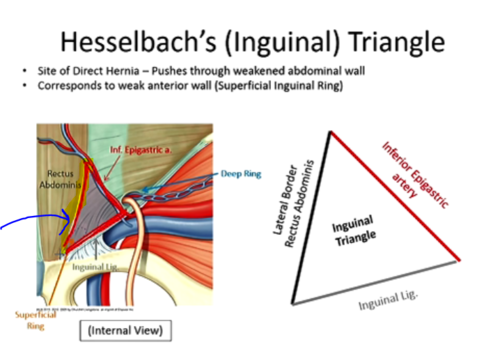
What is the Hesselbach’s (Inguinal) Triangle?
Site of Direct Heria- pushes through weakened abdominal wall
Corresponds to weak anterior wall (superficial inguinal ring)
Lateral Boarder: Rectus abdominis
Inferior Epigastric artery
Inguinal Ligament
Name the arteries found in the spermatic cord
3 Arteries -
1) Testicular a. (from L2 level Abdominal Aorta)
2) Artery of Vas Deferens (Deferential a.)
3) Cremasteric a.
Name the nerves found in the spermatic cord
1) Genital branch of Genitofemoral n. - (L1-2)
2) Sympathetic nerves (from Testicular plexus)
3) (Ilioinguinal n. - L1) - (DOESN’T actually travel in cord)
A 16 year old NZ European boy presents with severe pain in his left testis associated with some swelling. It started an hour ago and is excruciating. He has otherwise been well in the past.
What is wrong with this patient?
testicular torsion
Spermatic cord twists round, cutting of blood supply (causing Ischaemia)
Surgical EMERGENCY!
Describe the cremasteric reflex
Reflex that indicates whether torsion has occured in the testis
Normal Reflex
- Stroke superior medial thigh
- Stimulates sensory fibres of Femoral branch of Genitofemoral n. & Ilioinguinal n. (L1-2 origins)
- This in turn stimulates motor fibres of Genital Branch of Genitofemoral n.
- Cremaster muscle contracts on Ipsilateral side, raising the testis
If Torsion has occured:
-Reflex not present
-NB: Method is not infallible!
-Ultrasound confirmation = very reliable (Distinguishes torsion from epididymitis by showing lack of blood flow to testis)
-6 hour window of opportunity - chance of saving testis drops significantly after this time
What are Inguinal Hernias?
Inguinal hernias = protrusion of abdominal contents through inguinal canal
2 types: Indirect & Direct
DIRECT: Abdominal contents herniate through weak spot in fascia of posterior wall of Inguinal canal - Hesselbach’s Triangle (don’t travel into the groin)
Direct: **MEDIAL to Inf. Epigastric a.
More older in elderly patients
INDIRECT: Herniation goes through D.I.R. and through ENTIRETY (this is the difference between direct and indirect) of inguinal canal into scrotum Within Spermatic Cord
Indirect: LATERAL to Inf. Epigastric a.
More common in younger patients
How do you differentiate between inguinal or femoral hernia?
1) Inguinal Ligament
- Inguinal: Superior to the inguinal lig (also more common in males)
-Femoral: Inferior to the inguinal lig (more common in females)
2) Pubic tubercle **
- Inguinal: Above and medial
- Femoral: Below and Lateral
How do you differentiate between the 3 hernias?
Q: Is there a Hernia?
Test: Cough impulse & reducibility
A: Positive cough impulse / lump is reducible = Hernia
Q: Is it Femoral or Inguinal?
Test: Find _Pubic Tuberc_le and reference hernia to this point
A: Above & Medial = Inguinal, Below & Lateral = Femoral
Q: If Inguinal, is it direct or indirect? (Without Imaging)
Test: Using your knowledge of the surface anatomy place fingers over D.I.R and have patient cough
A: No Bulge = Indirect
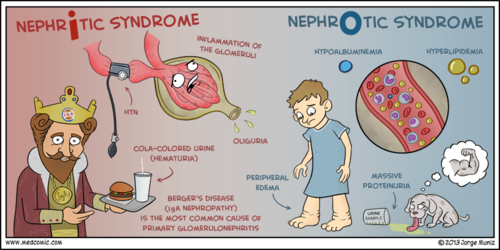
What is Nephrotic Syndrome?
Nephrotic syndrome is often caused by damage to small blood vessels in the kidneys that filter waste and excess water from the blood.
1) >3.5g/day urinary protein
2) Low serum albumin
3) Oedema (due to the loss of albumin which reduces oncotic pressure and results in aggregation of fluid in the interstitial space)
4) Frothy urine
5) Hypercholesterolaemia
6) Blood clots
7) Renal function may be normal or impaired (GFR)
What is the difference between Nephritic and Nephrotic syndrome?
Nephrotic ( o = odemia)
Nephritic = acute kidney injury
What are the root values of Sciatic Nerve?
L4-S3
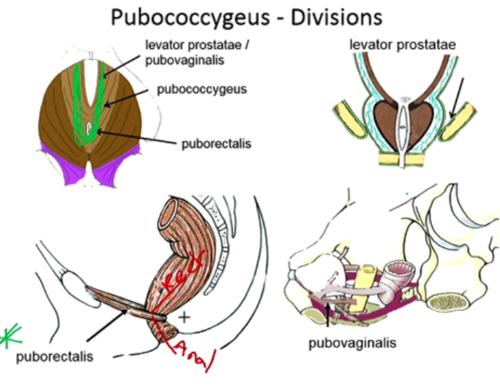
What causes the rectum to be bent?
What is the significance of this?
Puborectalis from the Pubococcygeus part of the Levator Ani
Levator Ani is innervated by:
- pundendal nerve (S2-4)
- nerve to levator ani (S3-4)
If this is damaged, you lose the ability to control your bowel movements
What is Guevedoces? (DHT syndrome)
Condition characterised by lack of Androgen DHT (5α-Dihydrogen Testosterone) during development
- 5α-Reductase deficiency (5a-reductase converts testosterone to DHT)
- DHT = 2-3x more potent androgen than testosterone
Males born with female primary sexual characteristics (i.e. no/underdeveloped penis - genitally ambiguous)
Sex = Male but Gender = Female due to lack of conspicuous male genitalia
Puberty: Raised androgen sex hormones may result in radical virilisation and development of Male genitalia
- Choice about whether they want to adopt the male gender identity or remain female
If the right renal artery becomes abnormally constricted, what will happen to renin secretion by the right kidney and the left kidney?
Also state what would happen to the BP
Right: Decrease flow, so Renin secretion will increase (constrict)
Left: May see increased flow because BP goes up (because of the increase in renin secretion by the right side). Renin secretion will decrease
Overall: Acute increase in renin. Will hit the rest of the body. B_P will go up._






