What are the 3 types of digestion?
Digestion: chemical degradation of nutrient macromolecules by digestive enzymes
• Luminal digestion: enzymes secreted into the lumen of GI tract from salivary glands, stomach and pancreas
• Membrane or contact digestion: digestive enzymes synthesized by enterocytes and inserted into the brush border membranes. Integral part of the microvillar membrane in close vicinity of specific carrier proteins (= digestion-absorption coupling). Applies to carbohydrate and protein digestion/absorption
• Cytosol : peptidases break down absorbed di- and tripeptides to single amino acids
What is absorption?
What are the mechanisms by which absorption can occur?
Where do enterocytes release absorbed nutrients?
Absorption:
- Permeation of molecules from the lumen of the GI tract, through the epithelial cell (enterocyte) layer, into the blood and lymph vascular compartment.
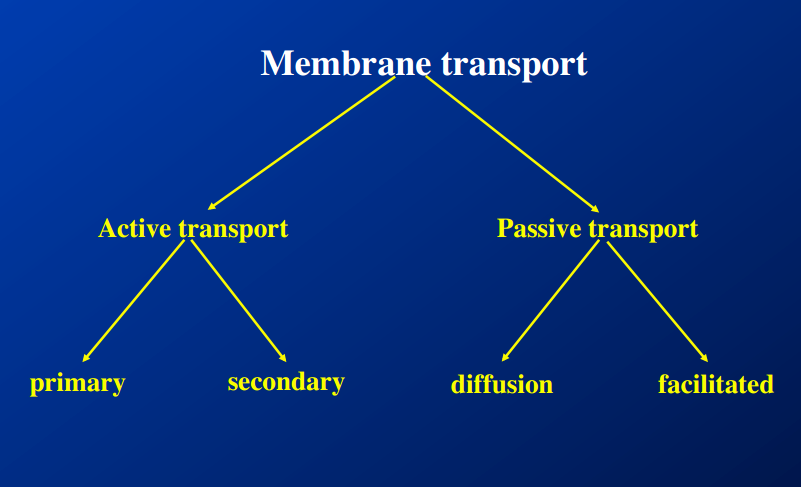
- Occurs via diffusion, facilitated or active transport mechanisms across apical membrane.
- Enterocytes release absorbed nutrients into blood (e.g. amino acids, sugar) or lymphatic circulation (e.g. lipids) for delivery to sites of metabolism/utilization.
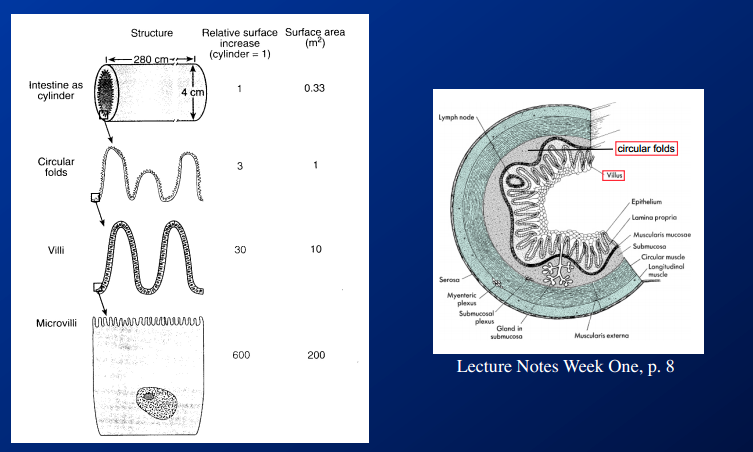
What special anatomical features increase the absorptive surface by about 600x?
Special anatomical features (circular folds, villi and microvilli) increase absorptive surface about 600 times.
What are the general differences btwn the small and large intestine as it pertains to fluid, electrolyte and nutrient absorption and secretion?
Both small intestine and large intestine absorb and secrete fluid and electrolytes, however there are regional differences in amounts, direction and mechanisms of fluid and electrolyte transport. Only the small intestine absorbs nutrients. There is substantial regional or segmental heterogeneity in nutrient absorption.
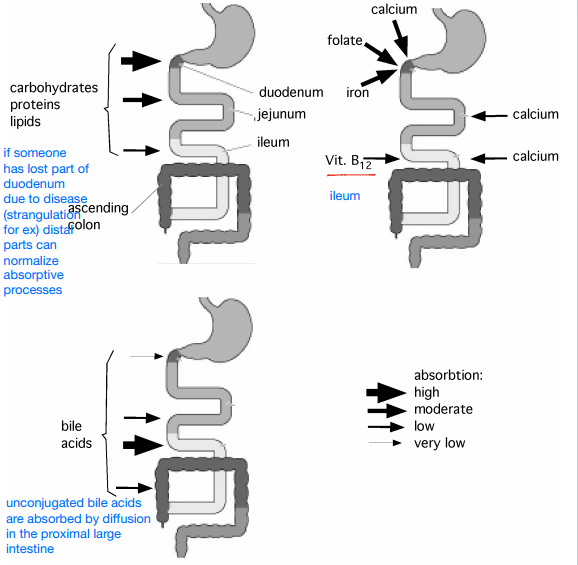
State where in the GI tract the following nutrients are absorbed. Indicate (if applicable) where the most absorption occurs.
carbohydrates
lipids
proteins
folate
calcium
iron
Vit B12
bile acids
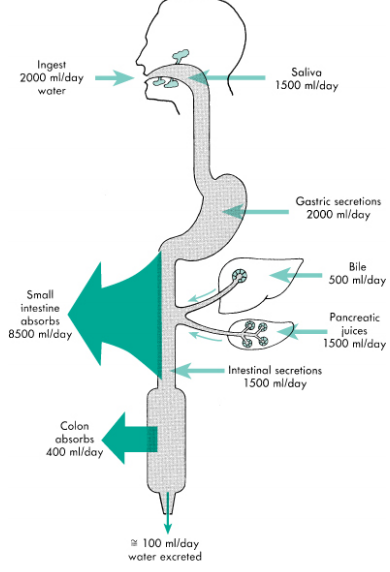
What is the average daily loss of water in the GI tract? What is the average daily amount of GI secretion? How much water does the GI tract absorb daily?
Average daily intake: approximately 2 liters
Average daily loss through GI tract: 100 ml (only 5% of intake) through feces
Average daily GI secretion: 7 liters
Average daily water absorption by GI tract: ~9 liters (8.5 in small intestine alone)
Absorption of water is (passive/active) and is determined by differences in _____.
What is the standing osmotic gradient hypothesis?
Absorption of water is passive and is determined by differences in osmolarity.
Net transport of water between GI lumen and vascular system can occur in both directions. Water can be absorbed in the absence or even against (colon) an osmotic pressure gradient between GI lumen and blood by the mechanism of standing gradient osmosis.
Standing gradient osmosis:
- Active Na+ pumping (Na/K ATPase) into lateral intercellular space
- passive entry of Cl- into lateral intercellular space
- establish osmotic gradient in lateral space
- entry of water by osmosis into lateral space
- hydrostatic flow of water
Note that this costs energy! (ATP used by the Na+/K+ pump)
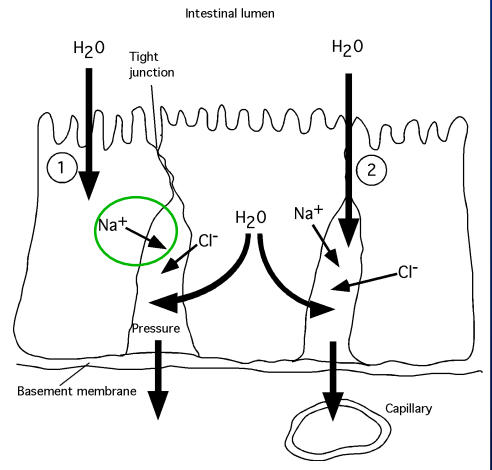
Tight junctions connect epithelial cells of the GI tract. Where in the GI tract are tight junctions the leakiest? For what 2 substances are they leaky?
What are the 2 types of transmucosal transport for these substances?
Tight junctions connect epithelial cells of the GI tract. Tight junctions are leaky (the most in the duodenum) for water and ions.
Transmucosal transport of water and ions can occur through tight junctions and lateral intercellular space (paracellular transport) or through epithelial cells (transcellular transport).
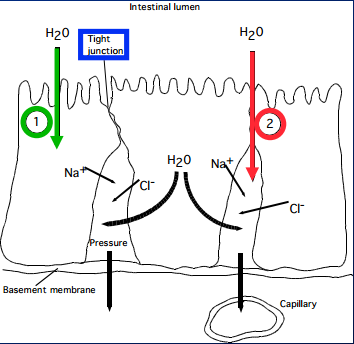
What is solvent drag?
Explain the absorption and secretion of water, Na+, K+, Cl-, and HCO3- in the small and large intestines.
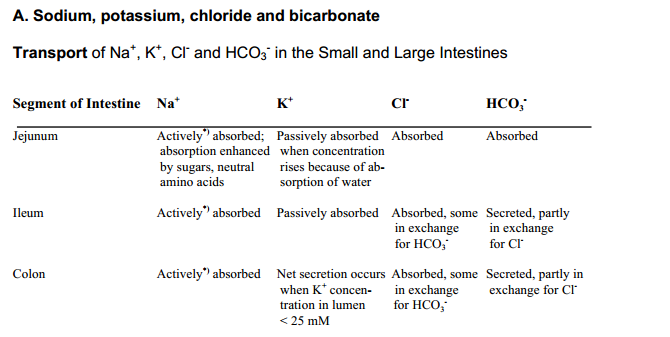
Na absorption: electrogenic Na/K pump is responsible to maintain a large electrochemical gradient for Na to enter the cell. Therefore, the absorption of Na+ is often referred to as ‘active‘ because it is tightly linked to the activity of the ATP consuming Na/K pump.
Solvent drag: When large volumes of water are absorbed the solutes dissolved in the water are also carried along with the water (via paracellular route). For example: hypotonic meal –> large volumes of water are absorbed from lumen to blood together with small solutes (Na+, Cl-).
Summary of attached table:
- The small intestine is a net absorber of water, Na+, Cl-, and K+, but is a net secretor of HCO3-
- The large intetine is a net absorber of water, Na+, and Cl-, but is a net secretor of K+ and HCO3-.
Is the absorption of Ca2+ active or passive? Where does the most absorption of Ca2+ occur?
Calcium is absorbed actively in the duodenum and passively by all segments of smallintestine (highest absorption activity in duodenum and jejunum).
Explain the mechanism of active transport of Ca2+.
What hormone is the active transport of Ca2+ under the control of?
Explain the passive absorption of Ca2+.
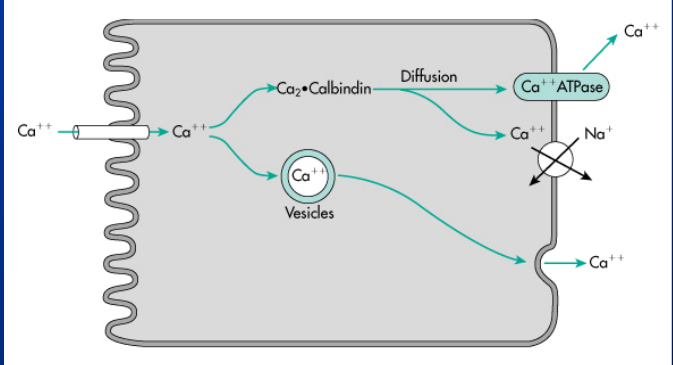
Active Ca2+ absorption is transcellular and under the control of vitamin D.
Ca2+ passively enters enterocytes where it is bound by the calcium binding protein Calbindin or is sequestered in vesicles. This maintains a gradient for the diffusion of Ca2+ into enterocytes. The Ca2+/Caldindin complex diffuses through the enterocyte. Ca2+ is released into the blood in 3 ways:
- Ca2+ ATPase
- Na+/Ca2+ exchanger
- fusion of Ca2+ vesicles with the basolateral membrane (exocytosis)
Passive Ca2+ absorption occurs via paracellular pathway and is not controlled by vitamin D.
Where does active absorption of Mg2+ occur? Passive absorption?
Many enzymes and ATP-dependent processes require Mg2+ as cofactor. Active absorption occurs in the ileum. Mechanism is poorly described. Minor passive absorption occurs.
What are 3 disturbances of iron metabolism?
Disturbances of iron metabolism
- Iron depletion can lead to anemia.
- Iron overload (ingestion of large amounts of iron).
- Idiopathic hemochromatosis (excessive absorption of iron due to genetic defects of iron transporting proteins).
What are the 2 forms of dietary iron?
heme iron
non-heme iron
What are sources ofheme irion? What type of transport occurs for the absorption of heme iron? How do enterocytes process heme after absorption?
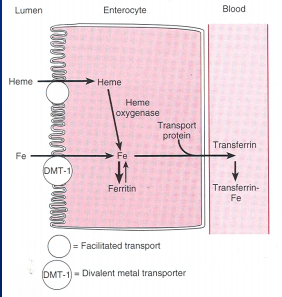
Heme iron (e.g. from hemoglobin, myoglobin and cytochromes) is absorbed by enterocytes. Absorption occurs by facilitated transport (heme transporter) or by endocytosis. Iron is split from heme intracellularly (heme oxygenase or heme oxidase reaction), releasing free Fe.
What are the 2 forms of non-heme iron?
Which form is not soluble at pH7 and is not transported? What vitamin contributes to iron absorption and how?
- Ferric (Fe3+) iron salts are not soluble at pH 7 and are not transported
- Ferrous (Fe2+) iron salts are soluble (vitamin C helps reducing Fe3+ to Fe2+ and thereby contributes to iron absorption)
What are the 2 ways the brush border participates in iron absorption?
- Duodenal brush border plasma membrane: iron transport protein (e.g. divalent metal transporter DMT1)
- iron reductase on the brush border surface can reduce Fe3+ to Fe2+ prior to transport
In the cytosol of enterocytes, absorbed Fe is stored or transported across the basolateral membrane. How is iron stored? How is it transported in the cytosol? How is it transported in blood?
Where is non-heme iron deposited? (after release into the blood)
How is iron taken up by cells?
In the cytosol absorbed Fe is stored or transported across the baso-lateral membrane:
- Stored iron: bound to apoferritin to form ferritin (storage form of iron; apoferritin is the protein part of ferritin).
- Transported iron: iron is bound to transport proteins (mobilferrins) to prevent iron from forming insoluble complexes and to facilitate the diffusion of iron through the cytosol.
- In the blood, Fe is bound to the iron carrier protein transferrin. Cells elsewhere that take up iron from the blood have membrane receptors for the iron-transferrin complex, which is taken up by receptor-mediated endocytosis.
Non-heme iron is deposited in all tissues (but specially in liver and reticuloendothelial system).
What 2 parameters are used to regulate iron absorption?
How is iron excreted?
Iron absorption is closely regulated by iron storage in enterocyte and by plasma iron concentration.
An important mechanism for preventing excess absorption of iron is the almost irreversible binding of iron to ferritin in the intestinal epithelial cell. Iron bound to ferritin is not available for transport into the plasma and is instead lost into the intestinal lumen and excreted in the feces when the intestinal epithelial cell exfoliates.
Is the absorption of fat soluble vitamins active or passive?
Where in the GI tract does absorption of fat soluble vitamins occur?
How are fat soluble vitamins absorbed?
Vitamins A, D, E and K: Because of the fat-soluble character of these vitamins the absorption is passive and occurs in the small intestine. Fat-soluble vitamins are packed into mixed micelles of lipid digestion and absorption.
What are the 2 mechanisms by which water soluble vitamins are absorbed?
Where in the GI tract are water soluble vitamins absorbed?
Water soluble vitamins are absorbed in the small intestine by Na-dependent and facilitated transport mechanisms.
What are the gastric and intestinal phases of vitamin B12 absorption/
Where in the GI tract is vit B12 absorbed?
How is vitamin B12 transported in blood?
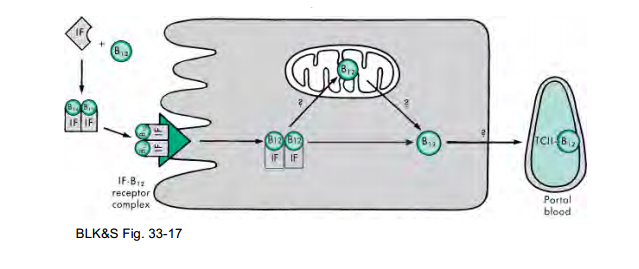
- Gastric phase: Vitamin B12 (cobalamin) is bound to R proteins (Vit. B12-binding glycoproteins in saliva and gastric juice), to lesser extent to intrinsic factor (IF, a Vit. B12-binding protein secreted by the parietal cells of the stomach).
- Intestinal phase: pancreatic enzymes degrade Vit. B12/R protein-complex. Vit. B12 is transferred to IF. IF resists digestion by pancreatic proteases. The Vitamin B12-intrinsic factor complex is absorbed in the terminal ileum via IF-B12 receptor (endocytosis). Transport in the blood of Vitamin B12 by binding to the protein transcobalamin. Vitamin B12 is stored in the liver.
What role may pancreatic insuffiency play in vit B12 deficiency?
IF-B12 receptor does not recognize Vit. B12/R protein complex. In pancreatic insufficiency, R proteins are not degraded, Vit. B12 remains bound to R proteins and is not available for absorption. Vit. B12 deficiency develops.

-
GI system and metabolism week 136
-
Intro to intermediary metabolism week 120
-
Motility I week 125
-
Development of the digestive system week 126
-
Motility II week 148
-
Anatomy of the abdominal wall and inguinal region week 137
-
GI tube histology week 142
-
GI secretions week 145
-
Vitamin self study week 125
-
Abdominal organs and celiac trunk week 137
-
Self study: autoimmunity of the GI tract week 116
-
Intro to carb metabolism glycolysis week 231
-
Carbohydrate metabolism: regulation of glycolysis week 220
-
Abdominal neurovasculature week 223
-
GI absorption week 223
-
Gluconeogenesis week 219
-
Glycogen metabolism week 226
-
Carb metabolism: special pathways week 220
-
Lipids, lipoproteins, and lipid trafficking week 225
-
FA and TG synthesis week 225
-
FA degradation and ketone body metabolism week 224
-
Mesenteric arteries, portal system, and biliary tree week 318
-
Hereditary hemochromatosis (HH) workshop week 315
-
Liver and biliary system week 317
-
Structure of glands in the digestive system week 326
-
Complex lipids week 338
-
Cholesterol metabolism week 321
-
Nucleotide metabolism week 427
-
Amino acid metabolism I and II week 467
-
Urea cycle week 414
-
Biotransformations week 420
-
The hormones that control metabolism week 438
-
Integration of metabolism week 424
-
Regulation of blood glucose by the endocrine system week 433
-
Anorexia and bulimia week 47
-
Exercise physiology week 47
-
Obesity week 46
-
Childhood obesity week 44
-
Diabetes Mellitus self study15
-
Metabolic syndrome week 522
-
Endocrine responses to normal disturbances week 528



