Define glaucoma.
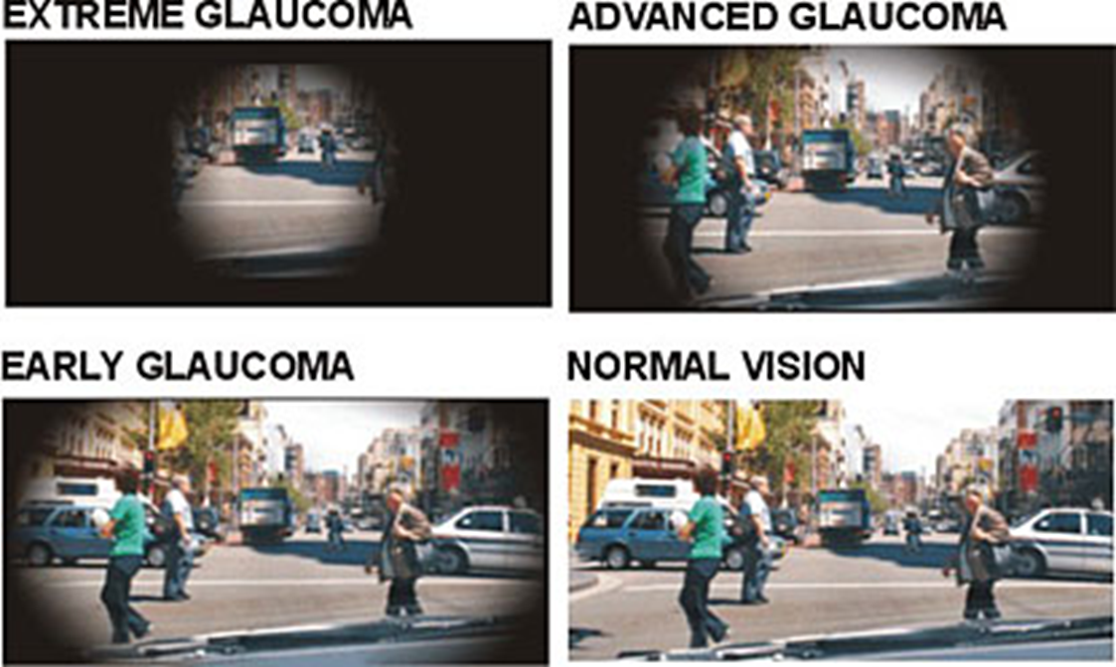
Glaucoma is due to increased pressure inside the eye, which is sufficiently elevated to cause optic nerve damage and result in visual field defects, with loss of sight .
What is normal intra-ocular pressure?
Normal intraocular pressure (IOP) is 10–21 mmHg. Some types of glaucoma can result in an IOP exceeding 70 mmHg
What is the epidemiology of glaucoma?
Second most common cause of blindness worldwide
Third most common cause of blind registration in the UK
What is primary open-angle glaucoma?
Most common form of glaucoma
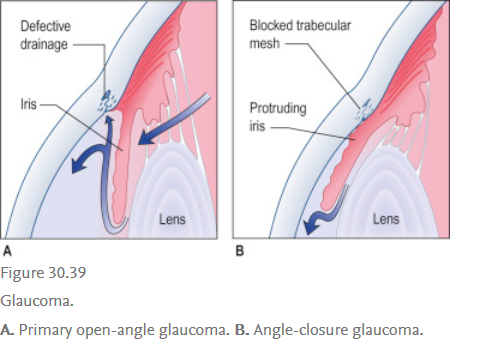
IOP result from reduced outflow of aqueous humoue through the trabecular meshwork.
What are the risk factors for primary open-angle glaucoma?
- Age (20% of 80yr olds affected)
- Race (black africans x5 more at risk than caucasians)
- FH
- Myopia
What are the clinical features of POAG?
Gradual, insidious, painless loss of peripheral visual field causing loss of vision
Initially asymptomatic - identified in routine ophthalmic examination
Central vision remains good until end-stage disease
What are the clinical parameters which characterise POAG?
- increased intraocular pressure,
- increased cup to disc ratio (over 0.6 is probably glaucoma)
- visual field defects, detected by formal visual field testing (perimetry)
Treatment: prostaglandin analogue eye drops
How is POAG diagnosed?
By measuring IOP
Optic disc exam - enlarged cup with a thin neuroretinal rim
Visual field exam - normal blind spot with scotomas
What is acute angle-closure glaucoma?
Ophthalmic emergency - sudden rise in IOP to leves over 50mmHg. This occurs due to reduced aqueous drainage when teh ageing lens pushes the iris forwards against the trabecular meshwork.
What are the risk factors for acute angle closure glaucoma?
Shallow anterior chamber e.g. hypermetropes and women
Reduced light conditions (when pupil is dilated) - attack is more likely to occur.
What are the clinical features of AACG?
- Sudden onset red, painful eye with blurred vision.
- Patients become unwell - N&V
- Headache
- Severe ocular pain
- Eye is injected and tender and feels hard
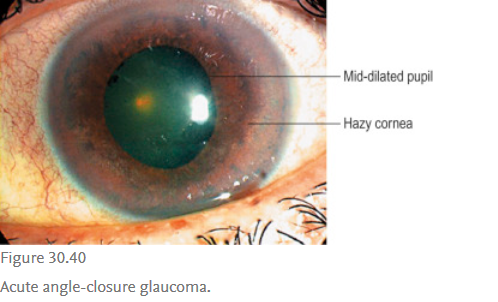
- Hazy cornea
- Pupil is semi-dilated
What are the differential diagnoses of acute red eye and how do you distinguish between them?
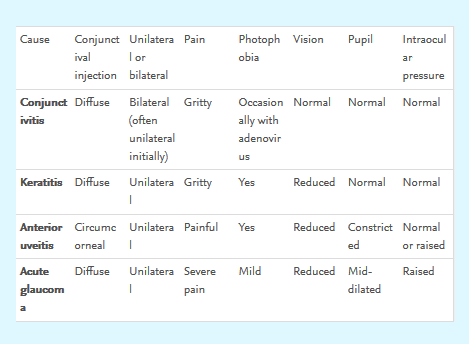
What are the red flags for red eye which require urgent referral?
- Severe pain
- Photophobia
- Reduced vision, particularly if sudden
- Coloured halos around point of light in a patient’s vision
- Proptosis
- Smaller pupil in affected eye
- Plus on medical assessment:
- High intraocular pressure
- Corneal epithelial disruption
- Shallow anterior chamber depth
- Ciliary flush
What are these investigations called?
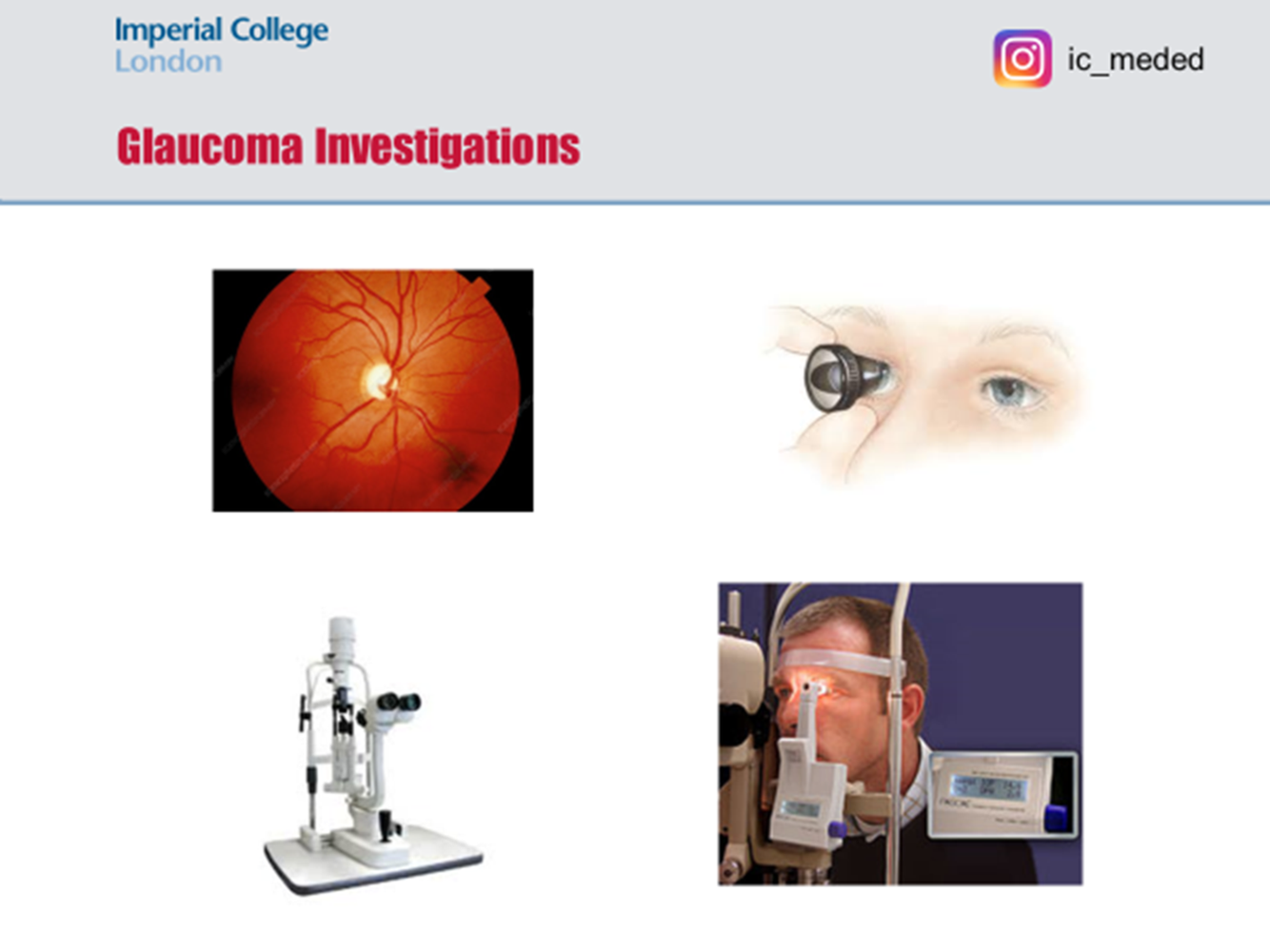
Fundoscopy may show disc cupping
Gonioscope in the top right – this device allows you to look at the angle of the iris to help determine if it is closed or open angle glaucoma
Slit lamp allows to examine the eye as a whole more closely
Tonometry in the bottom right measures intraocular pressure
What investigations would you do for AACG? What would the results show?
Gonioscopy (exam of anterior chamber) - definitive diagnostic test. Trabercular meshwork is not visible in angle closure because peripheral iris is in contact with it.
Slit-lamp examination - shallow anterior chamber; signs of glaucoma: large optic cup, narrowing of neuroretinal rim, splinter haemorrhage, nerve fibre loss.
Automatic static perimerty - visual field defects- identifies presence and amount of visual field loss.
Other tests:
- US biomicroscopy
- anterior segment optical coherence tomography (of angle)
- evaluation of optic nerve head by fundocsopy - may show large optic cup and nerve fibre loss
- retinal optical coherence tomography
- Heidelberg’s retinal tomography
- GDx nerve fibre analyser
What investigations would you do for open-angle glaucome? What would the results show?
Tonometry (Goldmann tonometry is most accurate and expensive; small sterile cone makes contact with the cornea)- IOP elevated if above normal range: 10 mmHg and 21 mmHg
Direct/indirect ophthalmoscopy - cup-to-disc ratio over 0.6 may be suspicious of glaucoma as is asymmetry of greater than 0.2 between the two eyes; visualisation of optic disc and retina quality; flame haemorrhages in late disease
Slit-lamp biomicroscopy - cornea should be clear, anterior chamber should be deep, and drainage angle should be open
Visual field testing - scotomas indicating loss of the nerve fibre layer. By the time of disease detection, 50% of the nerve fibre layer may be damaged
Other tests:
- Gonioscopy
- Photographs of the optic nerve head
- Pachymetry - measures corneal thickness which may be thin and predicts progression from high IOP to glaucoma
- Nerve fibre layer analysis
- Optical coherence tomography scanning
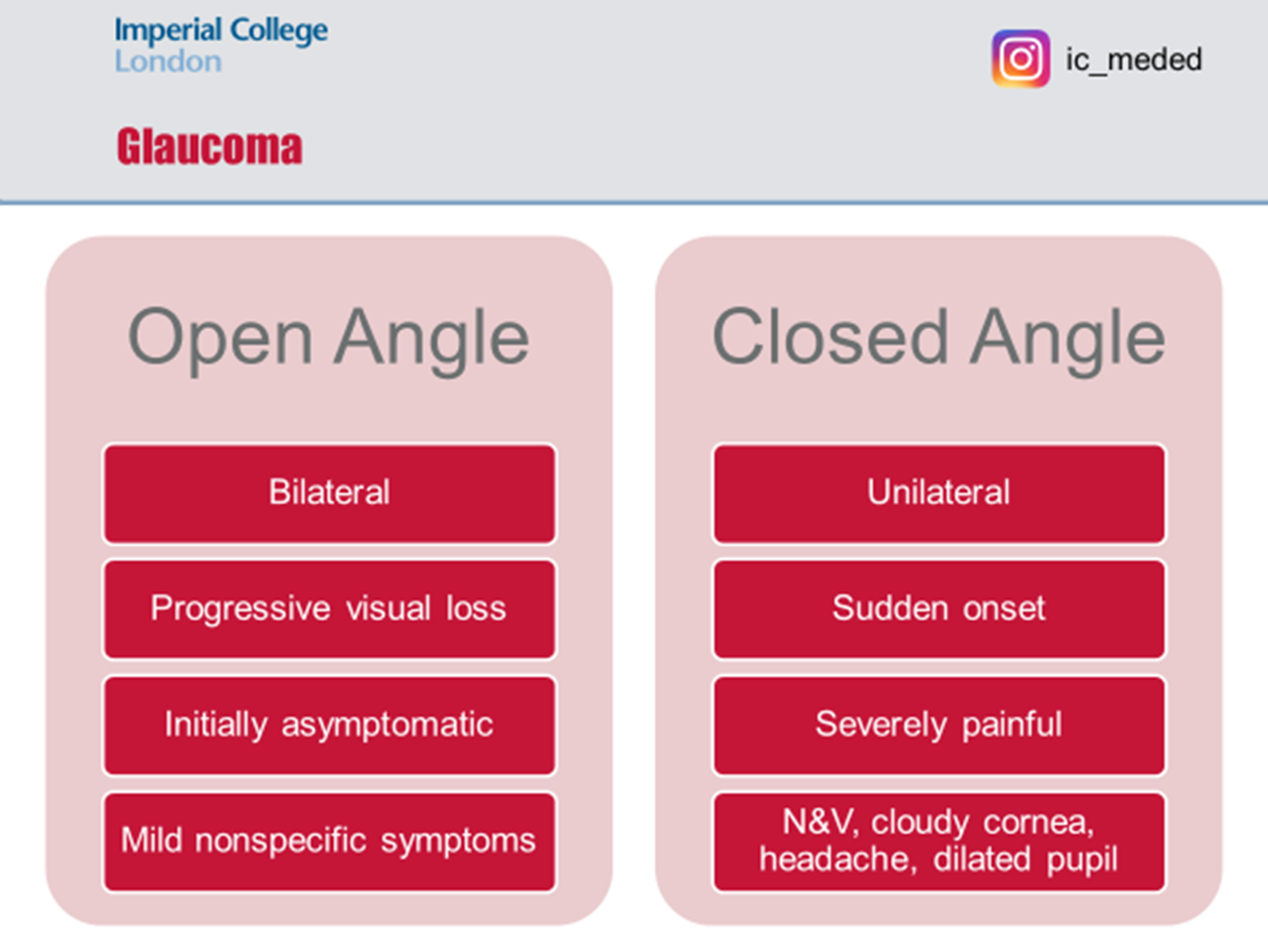
List 4 differences between open and closed angle glaucoma.
Open angle makes up 90%, and progresses more slowly
Acute, although less common, is important to be aware of because it can present as an acute, red and painful eye and if you don’t recognise and treat it the patient may lose their vision
What is the management of acute angle closure glaucoma?*
Reducing IOP in acute angle closure glaucoma:
- IV acetazolamide is the first line treatment
- Topical prostaglandin analogues also lower IOP
- Beta blocker eye drops
- IV mannitol occasionally
- AND topical steroids to reduce inflammation
- AND pilocarpine drops to cause miosis (constriction) of pupil to unblock closed drainage angle
- AND laser peripheral iridotomy (same day or several days later) to both eyes as the other eye is also likely get an attack
What is mydriasis?
Dilated pupil - you get a fixed mid dilated pupil in AACG (NOT MIOSIS)
What does hypermetropia mean?
Long sightedness ( a risk factor for AACG)




